Monday, 31 December 2018

What Is Biblical Preaching?: Multiethnic Culture and Preaching

Apostle Paul was able to gather multiethnic audiences because he knew how the various people who gathered would hear what was being said.

Although it has been a number of months, we continue in our series on biblical preaching (in partnership with The Gospel Project). We have asked some teachers, preachers, and scholars to consider preaching, interact with it, and contrast some different approaches.

Today, we welcome Pastor Bryan Loritts. Bryan serves Lead Pastor at the Abundant Life Christian Fellowship of Silicon Valley, California. He is an award-winning author of six books, including his newest release Insider Outsider. Heco-founded Fellowship Memphis in 2003, and later founded The Kainos Movement, an organization committed to seeing the multi-ethnic church become the new normal in our world.

Read previous posts by Kyle Idleman, Eric Geiger, H.B. Charles, Jr., J.D. Greear, Chip Henderson, Jason Allen, and Rochelle Scheuermann.

Ray Charles was music’s triathlete. If Ray played baseball, he’d be your consummate utility player. From gospel to R&B and even country, Ray Charles defied labels. In fact, it was his unique ability to sing so many different genres that made his concerts so multiethnic. Whatever you needed Ray to be he was, without losing his unique self in the process.

The Apostle Paul was to preaching what Ray Charles was to music. Paul could walk into any synagogue, unfold the scroll, and preach the glorious gospel of Jesus Christ to Jews with such effectiveness that they were moved to either salvation or riots.

Moments later, Paul could be found in a Gentile environment like Mars Hill, quoting from their own poets, and using their own altars to make what Charles Spurgeon called his “bee-line to the cross.” I’ve often coveted this aspect of Paul’s ministry, pleading with God to allow me to preach a gospel big ...

Continue reading...


from Christianity Today Magazine http://bit.ly/2EZiVY0

Friday, 28 December 2018

Heartbeat Bills Used to Divide Pro-Lifers. Here’s Why That’s Changing.

Even the “most restrictive” abortion laws—like one vetoed this week in Ohio—may now have a place in incrementalist strategy.

Two years ago, Ohio Governor John Kasich had the support of the state’s biggest pro-life group when he vetoed a bill to ban abortion after about six weeks, once an unborn baby’s heartbeat is detectable.

Last week, the pro-life politician again vetoed a state “heartbeat bill”—only this time Ohio Right to Life (ORTL) took a different stance.

The organization wanted to see the state legislature override his decision. Though lawmakers failed to do so yesterday, ORTL plans to lobby his successor to sign the ban, considered the most restrictive abortion policy in the country, into law.

What changed over the past few years to prompt their new stance? In short, the Supreme Court.

For years, the pro-life movement has taken on different tactics toward a shared goal of eliminating abortion. ORTL adopted a “strategic incremental approach,” at times supporting more feasible abortion regulations—such as the ban on abortions after 20 weeks Kasich signed in 2016, or the ban on “dismemberment abortions” he signed this year—over more restrictive legislation that risked being turned down in the courts.

Kasich defended his veto with nearly identical wording last week as he did two years prior. “As governor I have worked hard to strengthen Ohio’s protections for the sanctity of human life, and I have a deep respect for my fellow members of the pro-life community and their ongoing efforts in defense of unborn life,” the outgoing Republican stated.

But the ban runs “contrary to the Supreme Court of the United States’ current rulings on abortion,” he said, referring to Roe v. Wade, which allows for the abortion of any child not viable outside the womb. ...

Continue reading...


from Christianity Today Magazine http://bit.ly/2AgOuJy

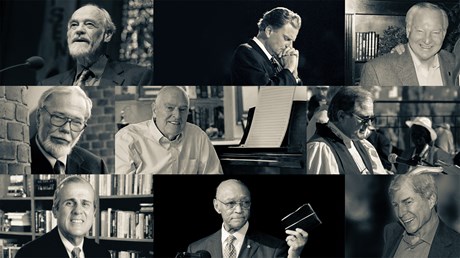
Billy Graham, Eugene Peterson, and Other Evangelicals Lost This Year

Remembering Aretha Franklin, the founder of Awana, and the scholar who made missions cross-cultural.

A collection of CT obituaries and tributes in 2018, listed in chronological order.

Continue reading...


from Christianity Today Magazine http://bit.ly/2rYyoQd

Billy Graham, Eugene Peterson, and Others Evangelicals Lost This Year

Remembering Aretha Franklin, the founder of Awana, and the scholar who made missions cross-cultural.

A collection of CT obituaries and tributes in 2018, listed in chronological order.

Continue reading...


from Christianity Today Magazine http://bit.ly/2GU9Xxw

CT's 2018 Cover Stories, Ranked

Here are the Top 10 features that readers read most.

Yes, we only publish 10 cover stories per year. But we’re proud of all of them!

Here are CT’s 2018 print features, ranked in order of which ones our online readers read most.

Continue reading...


from Christianity Today Magazine http://bit.ly/2Ro95p2

Heartbeat Bills Used to Divide Pro-Lifers. Here’s Why That’s Changing.

Even the “most restrictive” abortion laws—like one vetoed this week in Ohio—may now have a place in incrementalist strategy.

Two years ago, Ohio Governor John Kasich had the support of the state’s biggest pro-life group when he vetoed a bill to ban abortion after about six weeks, once an unborn baby’s heartbeat is detectable.

Last week, the pro-life politician again vetoed a state “heartbeat bill”—only this time Ohio Right to Life (ORTL) took a different stance.

The organization wanted to see the state legislature override his decision. Though lawmakers failed to do so yesterday, ORTL plans to lobby his successor to sign the ban, considered the most restrictive abortion policy in the country, into law.

What changed over the past few years to prompt their new stance? In short, the Supreme Court.

For years, the pro-life movement has taken on different tactics toward a shared goal of eliminating abortion. ORTL adopted a “strategic incremental approach,” at times supporting more feasible abortion regulations—such as the ban on abortions after 20 weeks Kasich signed in 2016, or the ban on “dismemberment abortions” he signed this year—over more restrictive legislation that risked being turned down in the courts.

Kasich defended his veto with nearly identical wording last week as he did two years prior. “As governor I have worked hard to strengthen Ohio’s protections for the sanctity of human life, and I have a deep respect for my fellow members of the pro-life community and their ongoing efforts in defense of unborn life,” the outgoing Republican stated.

But the ban runs “contrary to the Supreme Court of the United States’ current rulings on abortion,” he said, referring to Roe v. Wade, which allows for the abortion of any child not viable outside the womb. ...

Continue reading...


from Christianity Today Magazine http://bit.ly/2rZOFV8

The Top 20 Christianity Today Articles of 2018

What evangelicals are afraid of losing, if we really believe in “Reckless Love,” and why a survivor of Larry Nassar's abuse says there's more to the gospel than forgiveness.

Did you catch all of the most-read CT articles from 2018?

Here's a look back at what readers kept clicking this past year.

Continue reading...


from Christianity Today Magazine http://bit.ly/2EVSJ1f