Tuesday, 30 July 2019

Has Kanye Lost His Jesus Complex and Found Christ?

The rapper attributes his turnaround and creative inspiration to godly obedience.
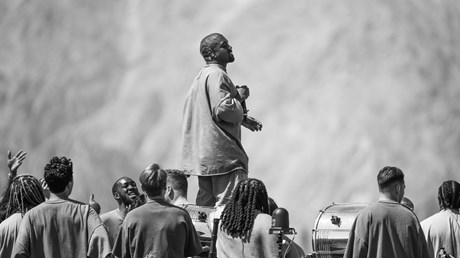
It’s been 15 years since Christianity Today reviewed Kanye West’s debut album, The College Dropout—quoting verses from “Jesus Walks” and other God-tinged tracks, while warning that the release overall is “far from pious, with an array of expletives and lyrical undesirables.”

“One wonders why West so adamantly makes a case for Christ in ‘Jesus Walks,’ yet quickly dismisses him via duplicitous party rhymes,” wrote Andree Farias. “The answer is probably in the album’s liner notes, where West openly declares that he’s not where he needs to be, despite still being on God’s side.”

Christian fans have asked questions about Kanye’s relationship with God over and over since then (as they do with many other celebrities who reference faith in their work and interviews). What does it mean for him to make a “gospel album with a lot of cursing”? What’s up with the Yeezus nickname and Christ imagery? Is Kanye’s discussion of his spiritual life sincere or just part of an act?

For followers of Kanye—who’s now also a designer, shoe mogul, husband to Kim Kardashian, and friend of President Donald Trump—the questions around his Christianity have compounded lately.

While Kanye has referenced God and Jesus throughout his career, back to the “Jesus Walks” days, the 42-year-old has begun to make more overt remarks about God’s work in his life and ventures, including his much-talked-about “Sunday Services,” weekly gatherings for family and celeb friends to fellowship and sing together.

Plus, he’s publicly discussing topics like the role of the church, passages of the Bible, ...

Continue reading...


from Christianity Today Magazine https://ift.tt/2GCipzf

Are We Morally Distressed by What is Taking Place on Our Border?

The UN Declaration of Human Rights guarantees everyone asylum protection, but Jesus’ commands us to go the extra mile.

Jesus was a baby born in the Middle East who became a refugee in Africa because of the rage of a mad king. As a migrant who took shelter in a foreign country, he understood the ambivalence of living in the shadows. I can’t think of a better way of lifting Jesus high than saving refugees who are in peril.

As an urban pastor and Harvard-trained ethicist, I am morally distressed about the way we are treating the most vulnerable in our country. How we treat the powerless compared with the way we treat the most powerful reflects both our present collective moral consciousness, and our future moral trajectory.

What happened to the light Lady Liberty shone so brightly from the shores of New York Harbor? It is a light that once lit up the whole world, as those fleeing violence, tyranny and religious persecution were embraced in her arms. Today, this light is under threat of being extinguished by a new vision that prefers walls to bridges.

As ambassadors of God’s kingdom, we are called to do justice, to love kindness, and to walk humbly with our God, as Micah compels us (6:8). What then can we do?

First, let’s resist relying on anecdotes, and work instead to get an accurate picture of the issues surrounding immigration.

G.K. Chesterton once remarked, “It isn't that they can't see the solution. It is that they can't see the problem.” Hasty conclusions are often the product of superficial analyses. As Chesterton notes, the problem can stem from a shallow understanding of a particular situation.

The president has declared a national emergency on the southern border, despite the fact that in 2017 his own State Department said no terrorists were found entering the U.S from the southern border. Similarly, ...

Continue reading...


from Christianity Today Magazine https://ift.tt/2KdaPMj

The Apostles Never ‘Shared’ the Gospel, and Neither Should We

Why it’s time to retire our favorite evangelistic phrase.

For some time now, American Christians have conceived of their witness in terms of “sharing the gospel.” Read any book or listen to any talk on personal evangelism, and you’ll inevitably encounter the phrase. On one level, the terminology is positive, conveying the gracious act of giving others a treasure we possess. However, if by “sharing” we imply a kind of charity where we only give the gospel to willing recipients, then our Christian vernacular has become a problem.

I first awakened to this reality while doing language study in Central Asia. As I took a course in spiritual terminology, a missionary teacher bemoaned the fact that many Westerners had imported the idea of sharing the gospel into the vocabulary of the local church. He asserted that such a concept was completely foreign—to their context and the Bible. Scripture, instead, spoke primarily of preaching the gospel, declaring and proclaiming a message.

But what, you might ask, could be wrong with sharing the gospel? Isn’t the greater problem that people aren’t sharing it at all? However, I’ve come to wonder if these dual realities aren’t somehow related, with the way we speak about evangelism imperceptibly affecting the way we do evangelism.

More Than Semantics

Throughout the Book of Acts, we find repeated examples of authoritative witness—even in the face of suffering—from the apostles and early church. We find them proclaiming the gospel and speaking boldly. We read of them persuading others. We see them reasoning from Scripture, both expounding and applying it. We observe them testifying before rulers and governors, bearing witness before civil crowds and angry mobs. What we don’t find ...

Continue reading...


from Christianity Today Magazine https://ift.tt/2LDofDH

Monday, 29 July 2019

Both Purity Culture and Hook-Up Culture Failed Me

Then I found church fellowship.

For evangelicals, the conversation about sexual purity in a libertine age is a perennial one. The purity culture of the ’90s, in particular, casts a long shadow and cycles through the public square on a regular basis. One of the architects of the movement, Joshua Harris, recently announced his departure from faith. As part of an ongoing “deconstruction process,” as he calls it, his rejection of Christian purity culture (a few years ago) was one of many steps that led—not causally but sequentially—to his rejection of faith itself.

The news left me feeling hollow. As I’ve watched Harris’ story unfold through the years, I’ve seen aspects of my own life mirrored in his. Yet while my story starts in a similar place, it travels in the opposite direction toward a reconstruction of faith. I, too, rejected purity culture but in its stead, I discovered a deeper commitment to the beautiful orthodoxy of Christian faith, a deeper appreciation of the doctrine of the Incarnation, and a deeper love of the church.

The story starts in my teen years. Along with a lot of other young men and women in evangelicalism, I was carried along by the tide of the purity movement and saw it as an expression of personal piety and devotion to faith. My actions, however, were almost entirely driven by future outcomes. In other words, I expected a marital relationship down the road, and I was afraid of ruining my chance at a perfect one. I took a vow to abstain from sex until marriage and wore a ring on the fourth finger of my left hand. When I started hanging out with a guy in high school, I refrained from holding hands with him, because I believed it was a short road from intertwining fingers to winding up in ...

Continue reading...


from Christianity Today Magazine https://ift.tt/2MpMYvu

Church Planting Research and Development: Part 1

Is There Ecclesiological Room for R&D in Church Planting?

The notion of Research and Development in the church strikes fear in the hearts of some. Why would we need it? Hasn’t God given us everything that we need regarding the nature and practice of the church in his Word?

If we introduce the concept of R&D, aren’t we on a pragmatic slippery slope that will inherently devolve into manmade distortions of God’s church? Isn’t the goal simply to uncover this singular ecclesiological model and design our planting models accordingly?

Well, yes and no.

The Bible is the essential and sufficient guide for our understanding of the nature and practice of his church. The church is, after all, solely his. He has revealed how he has created the church to function and thrive.

God has graciously given us insight into the development of the first church through the record of his Word. He has spoken clearly about the mission, practice, and leadership of the church and provided standards that cannot be improved upon through human ingenuity.

But such a high view of Scripture’s ecclesiological authority does not necessarily render any missiological R&D as out of bounds.

In fact, a high view of the nature of Jesus’ church actually demands it. Each church is embedded in a certain cultural context that necessitates wise decisions regarding how best to flesh out the mission of Christ among particular peoples in specific places around the world.

Such work necessitates contextual R&D. In fact, it is vital and unavoidable if we have any hope of transformative impact on culture.

Let’s dispel with a myth.

There’s simply no such thing as a culture-free local church. Each church, by virtue of its existence within time and space, is found within a cultural continuum ...

Continue reading...


from Christianity Today Magazine https://ift.tt/2yoiEco

Boomers, Take It from Woody or Iron Man: It’s Time to Pass the Torch

This summer’s blockbusters showcase the importance of transferring wisdom between generations.

Dear Baby Boomers: If there were ever a time to pay attention to what’s coming out of Hollywood, it would be now.

I’m not saying that just because the Beatles-themed movie Yesterday is holding steady at the box office. From superhero flicks to kid’s movie reboots, many of the summer blockbusters of 2019 are voicing a deep longing to learn from the wisdom of previous generations. But this common impulse isn’t just about our favorite characters—it’s a wakeup call for everybody.

The immediate backdrop for these cinematic stories is the public maligning Boomers in particular have recently faced. Some have gone so far as to suggest that Boomers have “ruined everything” for younger Americans. To their credit, certain Boomers have responded by apologizing for the world they’ve handed to younger generations.

As a newly 40, card-carrying member of Generation X, I’ve always found myself somewhere in the middle—a generational interloper between the graying Boomers and hipster millennials and members of Gen Z. Gen Xers can be self-deprecating, apathetic, and downright cynical, but as we’ve aged, we’ve also come to embrace our unique role as interpreters and bridge-builders, mentoring our millennial friends and colleagues while “leading from below” in support of our Boomer bosses.

From that perspective, I see the big screen reflecting a cultural shift when it comes to inter-generational relations. (Spoilers to follow.)

Take Avengers: Endgame, the Marvel movie that kicked off the summer season and is now the highest grossing film of all time. The movie concludes with the sacrificial death of Tony Stark (Iron Man). Released a mere two months later, Spiderman: ...

Continue reading...


from Christianity Today Magazine https://ift.tt/2GAbrKW

True Doctrine Doesn't Wait

Without good theology, you can't have Christlike love and compassion.

In a recent email to me, a writer encouraged CT to pursue a new trajectory. He argued we should move away from orthodoxy, even if “beautiful,” and instead in a direction where orthopathy (meaning right feelings or emotions) and orthopraxis (right practice) are seen as “first-order issues responsive to the two great commandments and the mission of Jesus, and witnessed through love and unity.” This is a near-perfect summary of the increasing confusion found in much of Christianity, but especially in the progressive variety.

The reasons for such confusion are many, and some are understandable. Many progressive Christian writers today came from 1990s evangelicalism. If, in fact, that evangelicalism was legalistic, evasive, and self-righteous, it should be rejected.

But reaction to error makes for distorted theology. Robert Barron, in The Priority of Christ: Toward a Post-Liberal Catholicism (Baker Academic, 2016) [p. 13], notes the following about liberalism and late medieval Christianity: “Early modernity saw itself as a salutary response to oppressive and obscurantist strains in Christian culture, but since it was reacting to a corruption of true Christianity, it itself became similarly distorted and exaggerated.” The same can be said about some reactions to unhealthy evangelical faith.

The term orthopathy has various definitions, but in evangelical contexts it generally refers to having the proper emotional and attitudinal posture. And orthopraxis refers to the correct practice of action. That we should be compassionate and ethical nearly goes without saying—our take on “beautiful orthodoxy” certainly includes them. But there’s a reason Paul, in epistle after epistle, ...

Continue reading...


from Christianity Today Magazine https://ift.tt/2ZlJqOK