Wednesday, 27 November 2019

Should Lebanon’s Christians Join Protests? Viral Sermons Argue Yes and No.

Confrontation at protest site forces evangelical faith from the pulpit to the public square.
Does a revolution need a leader?

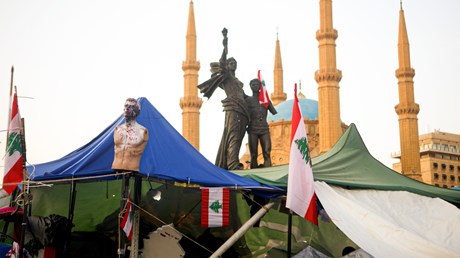
As the rocks rained down near the tent of Ras Beirut Baptist Church’s effort to discuss the question, suddenly the faith of the Christians gathered there was put to the test.

For the past month, Lebanese evangelicals have debated Scripture, sharing sermons online. One viral effort urges believers to stay away from widespread demonstrations in submission to authority. Another licenses participation in the popular push for justice.

Trying to find a third way, RBBC has visited the protest site weekly at Beirut’s Martyrs Square to discuss issues related to the revolutionary movement.

“We are not supporting a political agenda, but listening to people about why they are coming down to the streets,” Joe Costa, RBBC youth leader, told CT. “You cannot evangelize people if they are hungry or hurt. You have to be with them where they are.”

And this time, the church’s tent was at the front line as dozens of Hezbollah flag-waiving partisans approached on their motorcycles.

Since October 17, citizens of Lebanon and its multi-confessional democracy have shed their religious identities in largely peaceful demonstrations against their political leaders. Some politicians have responded by justifying the violence of their followers, without authorizing it. Other politicians have expressed sympathy, asking for trust to make things better.

But long seen as the untouchable defenders of their communities’ interests, over the decades many political leaders have become wealthy.

“Corruption is like decay in our bones,” Hikmat Kashouh, pastor of Resurrection Church of Beirut (RCB), told CT. “No single person doubts it, including those in authority today.” ...

Continue reading...


from Christianity Today Magazine https://ift.tt/37HaL2j

When the Shepherds Spy on the Sheep

In communist East Germany, the church was supposed to be a refuge from the government’s godlike gaze. But the secret police managed to bribe and flatter their way in.

Among the many plans for the 30th anniversary of the fall of the Berlin Wall, the augmented reality MauAR app offers users a glimpse into both the sudden and gradual accretions of that sprawling built environment of political control over the 28 contentious years it stood (1961-1989). Through the application’s lens, the Wall rises again, along with guard towers, barbed wire, and the raked sand of the death strip. For a forgetful world, it provides a sobering virtual glimpse into what life was like.

Far harder to see are the moral forms of control built up by the German Democratic Republic (GDR) in the four decades during which the communist regime held power. In a timely way, Elisabeth Braw’s God’s Spies: The Stasi’s Cold War Espionage Campaign Inside the Church, searches this more hidden dimension. A former journalist and now director of the Modern Deterrence project at RUSI, a London-based defense and security think tank, Braw analyzes why so many East German pastors, bishops, and theologians worked as Stasi unofficial collaborators (Inoffizieller Mitarbeiter, or IMs).

From ground-breaking interviews and careful record-combing, Braw offers up new material for students of the GDR era. But she also treads soberly upon the old, familiar, yet easily forgotten paths of the mealy moral middle of human beings in systems that reward duplicity and corruption.

The Price of Betrayal

The Stasi, East Germany’s Ministry for State Security (or MfS), existed to protect the regime, securing and consolidating power through godlike knowledge, and ever-alert for signs of subversion. Of course, the only way to achieve that kind of atmospheric knowing—that pervasive and intimate level of surveillance—was ...

Continue reading...


from Christianity Today Magazine https://ift.tt/33owV69

Palestinian Evangelicals Gain Official Recognition

As Trump administration changes US policy on Jewish settlements, Palestinian council head urges prayer for all.

After 12 years of waiting, evangelicals in Palestine now claim they have greater civil rights than their fellow believers in the Holy Land.

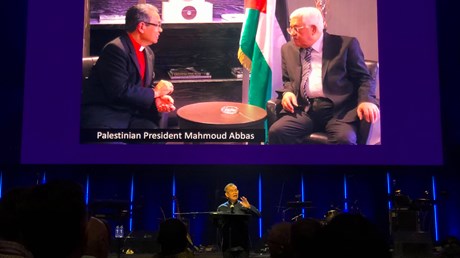
Earlier this month, the president of the Council of Local Evangelical Churches in the Holy Land—which represents congregations and ministries located in the West Bank, East Jerusalem, and the Gaza Strip—triumphantly held aloft his evidence at the once-a-decade general assembly of the World Evangelical Alliance (WEA).

“Here is the presidential decree signed by … President Mahmoud Abbas,” Munir Kakish told the approximately 800 WEA delegates from 92 nations gathered in Bogor, Indonesia. “Our hearts are full of thankfulness to God for this new declaration.”

When the Palestinian Authority (PA) was created in 1994 following the Oslo Accords, pastors of local evangelical churches met to create a council in order to have a voice with the new government, Kakish told CT.

Ministering in the Holy Land since 1978, Kakish pastors two churches: an independent congregation in Ramallah, Palestine, and a Baptist congregation in Ramla, Israel. They are only 30 miles apart, but divided by the Israeli separation wall.

“I knocked on [the PA’s] doors many times,” he said. “But now the timing was right, and the personnel … were understanding.

“Most of all, it was our persistence to obtain our civil rights as Palestinian citizens.”

Over time, the council—which Kakish has led since 2007—gained credibility as he introduced evangelical leaders from around the world to local stakeholders. At this month’s assembly in Indonesia, he thanked WEA president Efraim Tendero and executive adviser Deborah Fikes.

Founded in 1846, ...

Continue reading...


from Christianity Today Magazine https://ift.tt/2OpBXuH

How PEPFAR Galvanized Christians in the Fight to Eradicate AIDS

And why advocates say US commitment to the cause cannot let up now.

On the 32nd commemoration of World AIDS Day, Christian groups remember their role in leveraging political will to create a transformative global public-private partnership that has shaped the trajectory of AIDS pandemic.

Last month, global political leaders finalized commitments to the Global Fund to Fight AIDS, Tuberculosis, and Malaria, extending funding through 2023. The Global Fund, founded in 2002, received a boost the following year when President George W. Bush established the President’s Executive Plan for AIDS Relief (PEPFAR), a US initiative that evangelicals championed and played a critical role in drafting.

The 2019 documentary 27 Million Lives showcases how evangelical organizations and musicians like Michael W. Smith helped promote awareness for the cause, resulting in PEPFAR’s broad support from across the faith community and both parties. The film’s title references the estimated number of lives saved since 2004 because of the work of organizations receiving PEPFAR funds, beginning with a $15 billion commitment over five years.

PEPFAR and the Global Fund “are not any one president’s program, not any one party’s program,” said Michael Gerson, who served in the Bush White House, in the recent documentary. “They really are the American people coming together to do something amazing in the world.”

Several humanitarian groups who have been involved with the campaign—like World Vision, World Relief, and Food for the Hungry—have spoken up in recent years against proposed cuts to foreign aid under an “American First” budget and have defended the country’s continued role in the eradication of AIDS around the globe.

When President Donald ...

Continue reading...


from Christianity Today Magazine https://ift.tt/33rCGzO

Give Us This Day Our Daily Catch

With the oceans no longer teeming with life, scientists and missionaries alike challenge Christians to faithfulness in the face of daunting odds.

Last month, the United Nations released a sobering report about the state of the earth’s oceans. The 1,200-page document, issued by the Intergovernmental Panel on Climate Change (IPCC), reported warming water temperatures and sharp declines in fish populations and warned that ocean levels could rise up to three feet by the end of the century.

That’s in stark contrast to early history as accounted in the Bible, pointed out Bob Sluka, the lead scientist of A Rocha’s Marine and Coastal Conservation Program. “Genesis 1 talks about the oceans teeming with life in abundance,” he said. “The only place these days to really see that is in marine protected areas.”

The report is a first for oceans and a wake-up call, said Kyle Van Houtan, chief scientist at the internationally-acclaimed Monterey Bay Aquarium in California. “What this report says, at the highest level, is that the ocean has been buffering the impacts of climate change for decades, and that buffering has a limit,” Van Houtan said. “Even though it has an immense ability to absorb and buffer heat and carbon from us, our industries, and our activities, it cannot do that indefinitely.”

Van Houtan, who studied theology at Duke Divinity School while getting his doctorate in ecology, first felt called to help steward creation because of his grandfather, a farmer whose faith exemplified a love for Christ and for creation. “There was a deep reverence for his role as a steward of the land and the animals.”

In contrast, since the Industrial Revolution, human activity has directly contributed to the devastation of ocean health. Van Houtan said the long-term effects of the ocean’s lessened capacity could ...

Continue reading...


from Christianity Today Magazine https://ift.tt/35J7CNL

Thankful for the Bad: Upside Down Gratitude This Thanksgiving

Upside down gratitude is the ability to give thanks even for the parts of our lives which lead us to sadness and struggle and suffer.

Arguably the oldest book in the Bible, the Book of Job has become, for many of us, a guidebook on how to suffer well (if there is such a thing). It is worth wondering why Moses (or another) chose to document the life of Job as one of the first entries of God’s faithfulness to humanity.

The book begins with a descriptive of Job’s character: “In the land of Uz there lived a man whose name was Job. This man was blameless and upright; he feared God and shunned evil.”

In a seemingly senseless act, God allows Satan to, one by one, take away the blessings God has bestowed upon him—his livestock, his servants, his children. At this last measure, Job gets up, tears his robe, shaves his head, and falls to the ground in worship saying, “Naked I came from my mother’s womb, and naked I will depart. The Lord gave and the Lord has taken away; may the name of the Lord be praised” (Job 1:20-21).

Job’s first recorded act in such loss is worship.

This would not be mine, I will be honest.

Nor has it been mine when pain and hurt and sickness have come upon me.

And yet my mind immediately goes to the suffering church around the world, who often, in one accord, cry, “The Lord gives and the Lord takes away; blessed be the name of the Lord!”

Now we must not idolize Job. His responses (and his friends’ responses) over the course of the loss ebb and flow like the ocean’s tides. This is because Job, like us, was human. He could neither ignore the fears and anger and loss that gripped his heart any more than we can ignore ours today. But read where he lands the proverbial plane:

I know that my redeemer lives, and that in the end he will stand on the earth. And after my skin has been ...

Continue reading...


from Christianity Today Magazine https://ift.tt/2DiM0LY

Jesus Came to Proclaim Good News to the Poor. But Now They’re Leaving Church.

The income gap in the US corresponds with a church attendance gap.

It’s well-established that the gap between the middle class and those who earn the highest incomes in the United States has grown wider over time, spurring partisan responses over how or whether to address income inequality.

But there’s a facet of this issue that should be particularly worrisome to Christians: Many of the poorest Americans are abandoning church en masse. By stepping away from church communities, the people who are most financially strapped also end up losing out on social networks and social capital—which can make their economic situation and outlook even worse.

To test the relationship between religion and socioeconomic status, I took four income brackets (adjusted for inflation over the time) from the General Social Survey (GSS) and calculated the share that said they never attended religious services. The change over the last 46 years was stunning.

In the 1970s, the difference in church attendance among the four income groups was relatively small (about 5%). That gap has widened significantly over the last four decades, with a noticeable spike in recent years. In 2018, a quarter of the wealthiest Americans reported never attending services, while the share of those in the bottom bracket who never darkened a church door was over 35 percent. In essence, the inequality gap in attendance has now doubled.

The growing social gap between the rich and poor extends beyond church attendance, as Americans in the lowest income bracket report being increasing isolated from their own communities overall.

Based on four GSS questions about socializing with friends, family, and neighbors over the last year—grouped together as measure of social activity—there were no significant differences among ...

Continue reading...


from Christianity Today Magazine https://ift.tt/2XOxcy6