Friday, 28 February 2020

Southern Baptists Have Only 13 African American Career Missionaries. What Will It Take to Mobilize More?

The International Mission Board launches new efforts to address historic shortage.
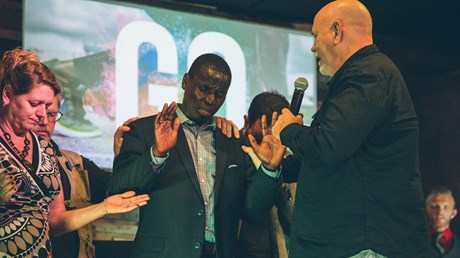
Most Ugandans assume Southern Baptist missionary George Smith is one of them. They talk to him and his wife Geraldine, who are African American, like they’re talking to one another, they said.

Anglo missionaries, on the other hand, tend to be “a spectacle,” said Smith. “They draw a crowd.”

Through 20 years of ministry in Africa with the Southern Baptist Convention’s International Mission Board (IMB), blending in with locals has afforded the Smiths distinct ministry advantages—from freedom to call local believers “on the carpet” in sermons, as Smith puts it, to an opportunity to live with Africans as peers.

Back in the United States, IMB leaders also have recognized the strategic advantage of sending black missionaries around the world. They’re making a concerted push to send more African Americans—not only for the sake of missions strategy, but also to align the percentage of black IMB missionaries with the percentage of black church members in the Southern Baptist Convention (SBC), which includes nearly 4,000 predominantly African American churches.

At this point, it’s going to be a stark challenge. Of approximately 3,700 career missionaries serving with IMB at the end of last year, just 13 (0.3%) were African American, according to the IMB’s 2020 ministry report. For the percentage of black missionaries to approach the percentage of black church members in the SBC overall—6 percent, according to Pew Research—nearly half of the 500 new missionary slots the IMB aims to create over the next five years would have to be filled by African Americans.

Observers within and outside the SBC are hopeful, though they wonder if the IMB’s black ...

Continue reading...


from Christianity Today Magazine https://ift.tt/3cjBmEM

Pro-Life Democrats Remind Candidates They Exist

Ahead of the South Carolina primary, religious voters’ push for a “diversity of opinions” on abortion gets little reception from presidential hopefuls.

Though South Carolina’s Democrats are more religious and more pro-life than voters in other early primary states, presidential candidates are sticking to the increasingly strident pro-choice positions held by their party.

Democrats for Life of America used the campaign push in the South as a chance to call on candidates to consider the place of pro-life voters in their coalition. The South Carolina Legislature has voted forward a “heartbeat bill,” one of the most restrictive anti-abortion laws in the country, and its Republican Senator Lindsey Graham sponsored the 20-week abortion ban voted on in the US Senate this week.

Evangelical Protestants and black Protestants make up half the population in South Carolina (compared to 30 percent of the overall US population). As Democrats engage in unprecedented levels of outreach to religious voters, many candidates make their way through black churches in the Southern state as they rally support. Kristen Day, executive director of the pro-life Democrats group, spoke at a press conference before Tuesday’s debate, reminding the presidential hopefuls from her party that many of the African American voters they are courting are less supportive of abortion than white Democrats or the party overall.

Exit polls from the 2016 primary show 61 percent of Democratic voters in South Carolina were African American, and Christian faith plays a key role among black voters, Day said.

Speaking in Charleston, South Carolina, Harriet Bradley, an African American minister and state chapter coordinator for Democrats for Life of America, quoted Proverbs 6:16–17, naming “hands that shed innocent blood” among the “things the Lord hates.” She described her ...

Continue reading...


from Christianity Today Magazine https://ift.tt/32xHUvh

Pro-Life Democrats Remind Candidates They Exist

Ahead of the South Carolina primary, religious voters’ push for a “diversity of opinions” on abortion gets little reception from presidential hopefuls.

Though South Carolina’s Democrats are more religious and more pro-life than voters in other early primary states, presidential candidates are sticking to the increasingly strident pro-choice positions held by their party.

Democrats for Life of America used the campaign push in the South as a chance to call on candidates to consider the place of pro-life voters in their coalition. The South Carolina Legislature has voted forward a “heartbeat bill,” one of the most restrictive anti-abortion laws in the country, and its Republican Senator Lindsey Graham sponsored the 20-week abortion ban voted on in the US Senate this week.

Evangelical Protestants and black Protestants make up half the population in South Carolina (compared to 30 percent of the overall US population). As Democrats engage in unprecedented levels of outreach to religious voters, many candidates make their way through black churches in the Southern state as they rally support. Kristen Day, executive director of the pro-life Democrats group, spoke at a press conference before Tuesday’s debate, reminding the presidential hopefuls from her party that many of the African American voters they are courting are less supportive of abortion than white Democrats or the party overall.

Exit polls from the 2016 primary show 61 percent of Democratic voters in South Carolina were African American, and Christian faith plays a key role among black voters, Day said.

Speaking in Charleston, South Carolina, Harriet Bradley, an African American minister and state chapter coordinator for Democrats for Life of America, quoted Proverbs 6:16–17, naming “hands that shed innocent blood” among the “things the Lord hates.” She described her ...

Continue reading...


from Christianity Today Magazine https://ift.tt/2TmOsbU

Thursday, 27 February 2020

Five Family-Friendly Resources for Lent

What does it mean to teach our children about lament, fasting, and mortality? These books, apps, and flashcards can help.

It’s one thing to observe Lent solo. It’s another thing to try to practice Lent with a family, especially if your family includes fussy babies, grumpy middle schoolers, or fantastically busy teenagers. For some parents, every day feels like Lent. You’re often laying down your life or giving up things that you love. When Ash Wednesday comes around, what can you give up when you already feel utterly spent?

My wife and I have felt all these things in some fashion with our two children and have been deeply grateful to discover resources that others have created in order to practically help families who wish to follow Jesus on this 40-day pilgrimage. The following five resources, which include books, downloadable apps, and creative devotionals, will offer families a starting point to practice Lent together.

Lenten Survival Guide for Kids: I’m Supposed to Do What?! by Peter Celano (Paraclete Press, 2014).

Written for elementary and middle school-aged children, this playful guide aims to help kids understand why they should care about a terribly big word that adults frequently take awfully seriously: Lent. Without talking down to them, Celano, an editor at Paraclete Press, offers children a chance to learn about such things as “What Lent Is,” “What Lent Definitely Is Not,” “40 Days of Survival Tactics,” and “A Few Prayers and Practices—Only for Kids.”

As Celano explains in this book, Lent is not about “giving up” silly things or about making sad faces to show how difficult life has suddenly become. It’s about learning to love God and to know who Jesus is and what it means to follow him—even as a kid! With Scriptures to memorize and ...

Continue reading...


from Christianity Today Magazine https://ift.tt/2we5Yr2

One-on-One with Doug Gehman on ‘Before You Quit’

The main reason people persevere is that they “see” something that is bigger than themselves or their current reality.

Ed:Why do you think emerging leaders need the message of this book right now?

Doug: One of the weaknesses of contemporary Western culture is our lost appreciation of the power of perseverance. We stand on the shoulders of previous generations who understood this vital quality. The sad reality of our time is their hard-won advancements are now slowly being swept away in a flood of pleasure and entitlement.

Emerging Christian leaders must learn the value of the long pull, and that every advance in Kingdom work is the fruit of gritty courage, patient determination, and strong but gracious resistance to the deceitfulness of sin.

Christ’s redemption was not cheaply won. It will not be easily realized. We must view leadership – with eyes wide open – as a rewarding but challenging task. What distinguishes successful leaders from all others is their long-term dependence on the enabling grace of God. Such leaders are not heroes. They are common men and women who have discovered they can do all things through Christ who gives them strength.

Christ’s redemption, now fully purchased and freely given, is completed in each of us only after patient endurance through joys and sorrows, and wonderful moments of overcoming glory and sometimes desperate pain.

Leaders who thrive have prepared themselves for this reality. They walk with holy reverence for what Christ has done for the world, and have fixed their eyes “not on what is seen, but what is not seen,” namely the eternal purposes of God.

Ed: Why do people persevere? What makes people put up with difficulties, delays, and struggles?

Doug: The main reason people persevere is that they “see” something that is bigger than themselves or their current ...

Continue reading...


from Christianity Today Magazine https://ift.tt/2TjTSED

Wednesday, 26 February 2020

Learning About Other Faiths Doesn’t Lead Evangelical Students to Lose Theirs

Compared to other colleges, students at evangelical institutions end up gaining the most knowledge of world religions.

One of the negative stereotypes of evangelical colleges is that they keep students in a religious “bubble.” But new survey data shows that these schools are particularly effective at teaching students about other faiths, and that this exposure to outside traditions is actually correlated with a deeper commitment to their own beliefs.

The Interfaith Diversity Experiences and Attitudes Longitudinal Survey (IDEALS)—a panel study that surveys the same students before, during, and at the end of their college career—measures basic knowledge about world religions. The sample included over 1,300 students from 15 evangelical universities, the majority of which were members of the Council for Christian Colleges and Universities.

Compared to students who planned to attend Catholic or private secular universities, evangelical students had a lower baseline level of knowledge. The average student attending an evangelical university could answer just 4.9 questions correctly. However, this score was higher than those attending public universities (4.8) and those who attended Protestant schools that were not classified as evangelical (4.6 questions correct).

All institutions of higher education impart some knowledge of world religions, but there are clear differences between the types of schools. For instance, the average student attending a Catholic college answered 0.64 more questions correctly after four years at college, which is close to the average for the entire sample (0.67).

Those attending evangelical schools—many of which require some sort of religious formation or classees in their curricula—saw a larger improvement, answering 0.83 more questions correctly on average by the end of their college ...

Continue reading...


from Christianity Today Magazine https://ift.tt/2VsD8gX

One-on-One with Daniel Im on ‘You Are What You Do’

Doing does not result in done. It only leads to more doing.

Ed: Why did you write You Are What You Do?

Daniel: Because our definition of “normal” has changed—seemingly overnight. For example, working a steady nine-to-five job isn’t normal anymore. And waiting until you’re retired to explore the world, try new experiences, eat delicious food, and enjoy life isn’t normal either—if retirement is even a thing anymore.

What’s now “normal” is this desire that we all have for freedom and flexibility, which conveniently is exactly what the gig economy promises.

And contrary to common belief, this is not just something that affects those in their 20s and 30s. According to the research, there are people in every generation who have side hustles because this desire for freedom and flexibility has become our new oxygen.

I wrote You Are What You Do because I wanted to examine the ways that this new “normal” is affecting everyday work, life, and love. As I was digging into the research and examining the ways that this new “normal” was affecting the people with whom I interact on a regular basis, I discovered seven lies that were subtly and subversively affecting us right to our core: You are what you do, you are what you experience, you are who you know, you are what you know, you are what you own, you are who you raise and you are your past.

In You Are What You Do, not only do I show readers how to recognize these everyday lies in their lives—and why it’s sketchy to build their lives upon them—but I also unpack the truth on the other side—the truth that leads to freedom and will move us from surviving to thriving.

Ed: For whom did you write it?

Daniel: For the mom who’s rediscovering herself ...

Continue reading...


from Christianity Today Magazine https://ift.tt/3caxrdG