Thursday, 30 July 2020

Local Churches Seize the Initiative of Bible Translation

Advances in technology mean Christians without Scripture don't have to wait.

For years, Bible translation stories went something like this: A Western couple would approach a translation organization about their calling to translate the Bible. The couple would embark on a multiyear process of raising support and an even longer process of language learning. They would study linguistics for at least two years. Then, after arriving in the country, they would study a regional trade language. Then they would begin to learn the local language. When they became fluent, the translation process could start.

“From vision to verse, it was a six-to eight-year process,” said David Thomas, the American Bible Society’s managing director of translation.

Some are trying new approaches to speed this long process up. In 2015, Wycliffe Associates announced that a team had been able to translate almost half of the New Testament in two weeks by working on the text simultaneously instead of sequentially and forgoing training on translation principles. The new process seemed promising, but a peer review challenged the accuracy of the translation.

The bigger factor has been new technology and increased collaboration. For example, Every Tribe Every Nation, a coalition of the biggest Bible translation organizations, has developed a digital library with more than 2,000 texts in 1,400 languages to aid translation.

Perhaps most significantly, the digital developments in Bible translation have empowered local churches around the world to seize the initiative. Instead of waiting for Westerners, these Christians have started pushing forward with what Thomas calls a “holy impatience.” They’ve taken more control, fueling the growth of a church-centered translation movement.

“Churches are saying, ...

Continue reading...


from Christianity Today Magazine https://ift.tt/2Bxp25U

3 Keys to Raising Women Leaders

We need to proactively plan to raise up women leaders, to call out their gifts, and to give them an opportunity.

Raising up women leaders should matter to all of us, but it requires an oft-lacking intentionality.

Women make up more than half the church, and God has gifted both men and women for his glory and for his purposes. People from different theological traditions will have different pathways for ministry, but none exclude the opportunity for some level or place of leadership.

Believing something is different than doing it, however. We need to proactively plan to raise up women leaders, to call out their gifts, and to give them an opportunity.


One Size Does Not Fit All

Years ago, I worked at a place where my wife Donna would later express felt like the movie “Stepford Wives,” where all the women had to fit the same mold. There was only one way to be a godly woman, and not much space for leadership development.

Donna said, "That's not who I am."

I said, "That's not who I want you to be either."

A gifted woman leader with whom I later served experienced similar challenges. "It seems the only way I'm allowed to use my gifts is in a narrowly confined set of expectations,” she observed. “They don't seem to be driven by Scripture, but seem to be more driven by a kind of subculture." Looking at many of the settings she had been in, she was right.

How, then, do we raise up women leaders and allow them to lead? I once had a peer who was great at developing leaders, both men and women. But one relational aspect of this was that he loved sports and would play with a group of other leaders in the morning before work.

Those leaders were all men. It was a good thing, not a bad thing, but it raised a question from my team.

One day, two of the women leaders on my team came to me and ...

Continue reading...


from Christianity Today Magazine https://ift.tt/2BMsqKW

Wednesday, 29 July 2020

John Ortberg Resigns from Menlo Church

Elders cite "pain and broken trust" as the church launches a new investigation of son's volunteer work with children.

John Ortberg, popular Christian author and speaker, has resigned as pastor of Menlo Church, a megachurch congregation outside of San Francisco. His resignation is effective Sunday, August 2.

“I have considered my 17 years as pastor here to be the greatest joy I’ve had in ministry,” Ortberg said in a statement. “But this has been a difficult time for parents, volunteers, staff, and others, and I believe that the unity needed for Menlo to flourish will be best served by my leaving.”

In November, Ortberg was placed on leave after Menlo Church elders learned he allowed a volunteer who had admitted being attracted to children to work with kids at the church and in the community.

Ortberg had first learned of the volunteer’s admission in July 2018. He did not inform other church leaders or the youth sports team that the volunteer coached. Church leaders did not learn of his actions until Daniel Lavery, Ortberg’s son, sent an email blowing the whistle.

The elder Ortberg returned to the pulpit this spring after the elders hired a lawyer to conduct an inquiry into the matter.

But controversy at the church flared up again after Lavery revealed the volunteer in question was his younger brother and the pastor’s youngest son, a fact that had been withheld from the congregation. Lavery, former friends of the Ortberg family, and other critics of the decision have called for the pastor to step down.

Questions were also raised about the inquiry into possible misconduct, as the lawyer the church hired did not speak to parents or to any children or youth who the volunteer had worked with.

No allegations of misconduct on the part of Ortberg's youngest son have been made.

Continue reading...


from Christianity Today Magazine https://ift.tt/2EwOzhi

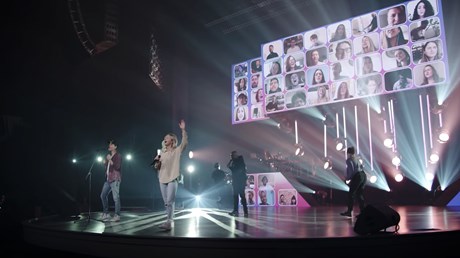
‘The Blessing’ Sung Around the World: 100 Virtual Choirs Spread Worship Anthem

How the familiar benediction became a viral hit during the pandemic.

Just a couple weeks before the coronavirus pandemic shut down the US, Kari Jobe held a songwriting session with her husband Cody Carnes and Elevation Worship’s Steven Furtick and Chris Brown. Together, they set to music one of the Bible’s best-known benedictions, Numbers 6:24-26:

The Lord bless you
and keep you;
the Lord make his face shine on you
and be gracious to you;
the Lord turn his face toward you
and give you peace.

When they introduced “The Blessing” at an Elevation Church campus near Charlotte, North Carolina, on March 1, Jobe told worshipers that the lyrics represent “the heart of the Father over us as his kids” and invited them to receive the song as “a blessing over you and your family and your children.”

They had no idea how many Christians would want to hear and sing out those words as the pandemic spread in the months to come. In just five months, “The Blessing” has become a chart-topping hit and viral sensation covered by more than 100 virtual choirs around the globe.

“Because this song is based on Scripture, the message is timeless, and we wanted to release it as quick as we could knowing the effect it could have on people ’s hearts and spirits immediately, as it did ours,” Jobe told The Christian Beat. “God knew it would be something we could hold onto during a season of our lives that ’s full of uncertainties and unknowns.”

The 12-minute video of the live performance at Elevation premiered on March 6 and has over 21 million views. One of those early viewers was Alan Hannah, assistant lead pastor at Allegheny Center Alliance Church in Pittsburgh, who helped organize the first virtual choir to cover the song. ...

Continue reading...


from Christianity Today Magazine https://ift.tt/2EpySby

For Third-Party Christians, Some Things Are More Important Than Winning

Meet the presidential candidates who say they are called to the bottom of the ballot.

Brian Carroll doesn’t seem like someone who’s running for president. He has no staff, hasn’t raised any money, and doesn’t expect to make it to the White House. He doesn’t even believe he’s his party’s best shot.

But that’s all part of the plan. As the American Solidarity candidate for president, Carroll wants to grow the party, which was founded in 2011 on Catholic social teaching and neo-Calvinist political theology. Eventually, he hopes, the party can attract candidates who are better than him. Then those candidates can attract more votes, and then Democratic and Republican candidates might try to steal those votes by speaking to the issues that evangelicals like Carroll care about.

“We want somebody addressing our issues,” said Carroll, whose pro-life convictions lead him to support universal health care and an immigration policy that wouldn’t separate children from their parents. “At some point, someone in the two major parties is going to say, ‘These are issues taking votes away from us. Why don’t we try to appeal to these people?’ ”

Short of that, Carroll, a retired teacher and an elder in an Evangelical Covenant Church, hopes to give Christians another choice on the ballot and “a chance to vote without feeling polluted.”

He is one of a handful of third-party and independent candidates appealing to evangelicals in 2020. These candidates reject Democrats and Republicans both and, more importantly, reject the idea of voting for the “lesser of two evils.” With low budget, no budget, and ad hoc campaigns, they say they are challenging evangelicals to rethink their votes, recalculate the costs of compromise, ...

Continue reading...


from Christianity Today Magazine https://ift.tt/315CRn1

Churches Gather, That's Part of What They Do: Thoughts on Ecclesiology in a Pandemic

It's essential to understand the biblical call to gather if we are to rightly think through the challenges of church in the COVID-19 crisis.

Around the world, churches have begun to “reopen” for in-person gatherings (though some have already shut down again due to an uptick in COVID-19 cases). Likely, over the past months you have seen or read countless tweets and posts around the following ideas: “The church has never been closed” or “The church isn’t a building; it is a people.”

Fair enough.

Yes, the church is a people—the “called out” ones, which was more a political descriptive in antiquity. But I only half-agree with the premise “the church has never been closed” with regards to the shutting down of in-person gatherings during the COVID-19 crisis.

The church’s gathering has been closed in many cases, and seeing that as a bad thing and a necessary thing are not contradictory.

We need to think through more about how gathering really matters.

The church

The church, like God’s mission, has a centripetal force and a centrifugal force—it has both a gathered and a scattered function. And when people espouse that the church has never been closed, in my mind they are saying this “new normal” of not being able to gather is acceptable.

That’s not the best way to think of it, I believe.

Theologically, if the church cannot gather corporately (in-person), an element or part of the essence of the church has been closed. And, in line with being closed, we need to prioritize it being open—and see it being closed as a deficient practice to be remedied at some point.

To be clear, I am not arguing that churches should have never postponed in-person gatherings due to COVID-19. And I’m not arguing that churches should reopen as soon as possible.

Here I want to simply ...

Continue reading...


from Christianity Today Magazine https://ift.tt/2WLP9hh

Tuesday, 28 July 2020

New Research: Most Churches Cautiously Holding Services Again

Churches are gathering again, but services and programs remain drastically different from the beginning of the year.

NASHVILLE, Tenn. -- Churches are gathering again, but services and programs remain drastically different from the beginning of the year.

At the start of the COVID-19 outbreak, according to previous surveys from Nashville-based LifeWay Research, Protestant churches across the U.S. stopped gathering in-person in a matter of weeks.

The latest LifeWay Research survey of Protestant pastors found congregations have slowly and cautiously started to meet again.

“While more and more churches have resumed in-person worship services, it has not always been a straight path back,” said Scott McConnell, executive director LifeWay Research. “Some have had difficulty resuming or had to stop meeting again as things got worse in their area.”

Cautious regathering

Each Sunday in April, fewer than 1 in 10 Protestant churches held in-person services. Starting in May, those numbers began to climb. By the first weekend in June, a majority (55%) were gathering. In July, more than 7 in 10 have met physically.

Still, 21% of Protestant pastors say they have not met in person the past three months.

Around 1 in 5 churches (21%) offered drive-in services where attendees participated from their vehicles at some point during the pandemic.

For those churches choosing to meet physically indoors, 99% point to some type of health and safety precaution they are taking.

More than 3 in 4 pastors say they provided hand sanitizer, masks or gloves to those needing it (94%), conducted additional cleaning of surfaces (86%), or closed seats to increase distance between people (76%).

Most have recommended masks (59%), but only around a third (35%) have required attendees to wear them.

Around 1 in 5 have added services (21%) or additional viewing rooms (18%) ...

Continue reading...


from Christianity Today Magazine https://ift.tt/2PascQB