Tuesday, 29 September 2020

Ravi Zacharias’s Ministry Investigates Claims of Sexual Misconduct at Spas

Three women have come forward with additional allegations against the late Christian apologist.
Editor’s note: See today’s related article about why we report bad news about leaders—even after they have passed away.

Ravi Zacharias International Ministries (RZIM) has opened an investigation into allegations that its late founder and namesake sexually harassed multiple massage therapists who worked at two day spas he co-owned.

Three women who worked at the businesses, located in a strip mall in the Atlanta suburbs, told Christianity Today that Ravi Zacharias touched them inappropriately, exposed himself, and masturbated during regular treatments over a period of about five years. His business partner said he regrets not stopping Zacharias and sent an apology text to one of the victims this month.

RZIM denies the claims, saying in a statement to CT that the charges of sexual misconduct “do not in any way comport with the man we knew for decades.” The organization has hired a law firm “with experience investigating such matters” to look into the allegations, which date back at least 10 years. RZIM declined to answer any further questions about the inquiry.

During his ministry career, the renowned apologist—who died in May at age 74 from cancer in his sacrum—spoke of chronic back pain resulting from a spine injury in 1985. He said he managed the pain with massage and physiotherapy.

The women who worked at the spas said when Zacharias wasn’t traveling with RZIM, he came in for treatment two or three times a week. The businesses were a 15-minute drive from the ministry’s headquarters in Alpharetta.

The three women knew Zacharias as the owner and a client as well as a Christian leader and famous author. Some of his books were sold in the store, and the employees read ...

Continue reading...


from Christianity Today Magazine https://ift.tt/3ibMIMX

A Note from the Editors on the Ravi Zacharias Investigation

Why we report bad news about leaders—even after they have passed away.

Christianity Today is motivated by a deep love for the church. That love is sometimes painful, especially when it means reporting evidence of harmful behavior by ministry leaders. These allegations are hard for us to publish, and they can be hard to read. Over the years, some readers have wondered why we publish evidence of wrongdoing by ministry leaders otherwise doing good in the world. Other readers, who support investigative reporting in general, think it should be aimed outside our particular Christian community. But our commitment to seeking truth transcends our commitment to tribe. And by reporting the truth, we care for our community.

Love compels us to love those hurt by ministry leaders—not just the immediate victims, but countless others who see the fallout from leaders’ sin and abuse and wonder if Christians really care. Deep love for the church also compels us to love erring ministry leaders. They often need disclosure to lead them to repentance.

Our love drives us to investigate allegations—or to continue our investigations—even when an accused leader is deceased. Sin’s devastation persists long after a ministry leader dies. Should we ask victims to carry the burden, trauma, and shame of their experiences alone in the dark? No. Neither a ministry leader’s good deeds nor his death should silence his victims. And people who sin need the grace that comes with the light. Death precludes the opportunity for a sinner’s repentance, but not the opportunity for a victim’s restoration and freedom.

The whole church needs that light, as painful as it can be. Christianity Today doesn’t undertake the long and expensive work of investigating accusations ...

Continue reading...


from Christianity Today Magazine https://ift.tt/3ieMGDS

Is God Talk Gone from the Presidential Debates?

After few faith references by Trump and Biden at party conventions, the candidates are expected to stick to policy discussions when they take the national stage.

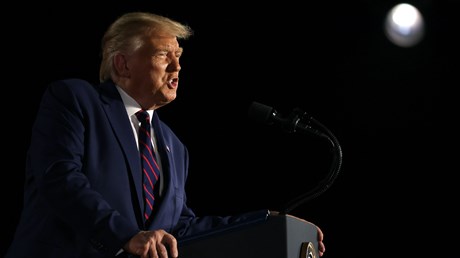
In tonight’s debate, the first between President Donald Trump and Joe Biden, the two candidates will have a lot of ground to cover. They’ll be addressing top issues for voters like the response to COVID-19, the economy, health care, and the makeup of the Supreme Court.

The debate is also a chance for voters to hear how Trump and Biden speak about their political priorities and motivations. Both have been campaigning to draw in voters of faith, including evangelicals.

The party conventions held last month offer a glimpse at how they have employed religious language in the race. Faith references came up throughout the Republican National Convention in August far more often than at the Democratic National Convention, which had been held the week before.

But when it came to the remarks from the candidates themselves, the trend reversed. Biden, a lifelong Catholic, made faith a bigger part of his speech than Trump did.

Ahead of the debate, I took a closer look at the kinds of religious terms we’ve seen from both platforms so far, based on an analysis of 2020 convention transcripts.

References to God were most common at both party conventions, followed by mentions of faith, blessing, prayer, and Jesus—who occasionally came up by name at the RNC but almost not at all at the DNC.

There are limits to text analysis to keep in mind—this method won’t identify religious language that is not explicit, and it also counts all words equally. Thus, Mike Pence quoting a long passage from the Bible that uses God’s name once counts the same as Joe Biden ending his speech by saying, “God bless America.” But, despite these constraints, it offers an unbiased glimpse of the most direct religious ...

Continue reading...


from Christianity Today Magazine https://ift.tt/3cGgWq6

Monday, 28 September 2020

Atlases No More: Parenting During the COVID-19 Crucible

How to lead your family well through times of transition.

Transitions in family life are inherently difficult. They require us as parents to be open to change while also maintaining a sense of family cohesion. When we are able to anticipate, communicate about, and plan for major family transitions, we adapt better. When we avoid acknowledging or are taken unawares by a necessary transition, we can struggle to preserve a sense of balance as a family and stressors can begin to pile up quickly. And, when under the burden of such a pile up of stressors, we can so easily buckle under the weight, failing to live up to our usual standards for loving our spouses and our children well.

We haven’t been able to plan for all of the changes COVID-19 has produced in our lives. It has stripped away many of the supports we have relied upon to uphold our family structures (e.g., school, sports, friends, extended family, church). It has upended our routines. Such changes have left many of us as parents feeling the need to, like the Greek mythological figure Atlas, support the weight of the world all by ourselves to keep it from crushing us and our families.

Unfortunately, no one knows for certain if and when we will be able to resume our “normal” lives and make use of our old family supports and routines once more. Thus, we must ask how we can transition our families to adapt to life in a world of social distancing, quarantine, and self-isolation. I believe that one of the founders of the field of family therapy, Dr. Salvador (“Sal”) Minuchin, can assist us in this endeavor.

During his lifetime, Sal helped families to make sense of the way they organized themselves as a unit. He paid particular attention to the structure of the family (e.g., the roles played by each member ...

Continue reading...


from Christianity Today Magazine https://ift.tt/3cEvW7U

Evangelical Biden Voters Straddle Partisan Divides

Unlike most Americans, they say many of their close friends will vote differently from them in 2020.

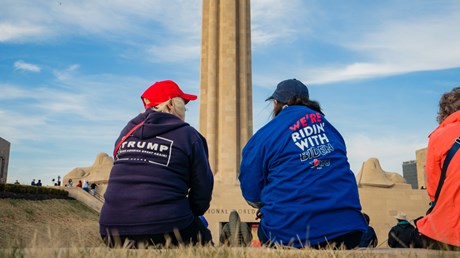
In another divisive election year, here’s one demographic that personally feels the strain of the nation’s partisan tensions: white evangelicals who plan to vote for Joe Biden.

The Pew Research Center recently found few Americans, Republicans or Democrats, have many close friends who support a different presidential candidate in the 2020 race. In religious breakouts provided to Christianity Today, evangelical Biden supporters emerged as the exception. Just under half say their close friends disagree with them over the 2020 race.

These longtime Democrats, former Republicans, and previous third-party voters represent an increasingly rare group straddling partisan lines, a position they’re in largely due to their faith.

White evangelicals who back Biden are about twice as likely (46%) as Biden supporters overall (22%) to say that many of their close friends plan to vote for Trump. And they are three times as likely to have close friends who support a different candidate as their fellow white evangelicals who plan to vote for Donald Trump (16%).

“Most of my family, friends from home, and a decent number of friends from college are Trump supporters,” said Clayton Job Myers, who graduated from Oklahoma Baptist University in May. He plans to vote for Biden this year because of his opposition to Trump’s rhetoric and what he sees as religious posturing. “I do my very best not to let that change how I view them and how I treat them.”

As the country becomes more polarized, Americans may be drawn to the idea of friendships that overcome political divides. Many read and shared accounts of the unlikely relationship between Supreme Court justices Antonin Scalia and Ruth Bader Ginsburg after her ...

Continue reading...


from Christianity Today Magazine https://ift.tt/3kY3zo6

Amy Coney Barrett, a Catholic and Scalia Protégé, Nominated by Trump

With an abortion record opposite Ruth Bader Ginsburg’s, Barrett has said her faith does not shape her decisions behind the bench.

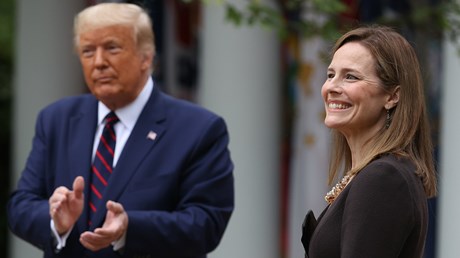
Amy Coney Barrett paid homage to Justice Ruth Bader Ginsburg in her White House speech Saturday as a shatterer of glass ceilings. She said she would be mindful of the woman whose place she would take on the Supreme Court.

The conservative Catholic even commented that her seven children think their father is the better cook, much as Ginsburg used to talk about her husband’s prowess in the kitchen.

But the replacement of the liberal icon Ginsburg, the second woman to serve on the high court, by Barrett, who would be the fifth, would represent the most dramatic ideological change on the Supreme Court in nearly 30 years and cement conservative dominance of the court for years to come.

Barrett, a judge on the federal appeals court based in Chicago, made clear in her Rose Garden address that she looks to conservative Justice Antonin Scalia, for whom she once worked, and not Ginsburg, on matters of law.

“His judicial philosophy is mine, too. Judges must apply the law as written. Judges are not policy makers,” Barrett said. She was referring to their common method of interpreting laws and the Constitution based on what they were understood to mean when they were written.

Ginsburg, who died this month at age 87, and Scalia were dear friends, but they were on opposite sides of the most divisive issues of the day.

Barrett’s conservative judicial record, her writings, and speeches suggest that she too would be Ginsburg’s polar opposite on a range of issues that include abortion and guns.

Conservative evangelicals have applauded Trump’s decision to nominate Barrett, who would be the third Supreme Court justice added during his term.

“There is no question that Judge Barrett is qualified by intellectual ...

Continue reading...


from Christianity Today Magazine https://ift.tt/3jbYTuA

Eritrea Frees Evangelical Prisoners Due to COVID-19

Dozens of persecuted believers released on bail. But hundreds reportedly remain imprisoned in the "North Korea of Africa."

The Eritrean government has released on bail more than 20 prisoners detained for years because of their faith, the BBC reports.

Sources told the British broadcaster that the prisoners are from evangelical and Pentecostal denominations, some held at Mai Serwa prison outside the capital Asmara.

Christian Solidarity Worldwide (CSW) confirmed the news, putting the number released at 27.

In 2002, Eritrea introduced a new law that forbids all churches except for Orthodox, Catholic, and Evangelical Lutheran ones. Sunni Islam is also officially recognised.

The Horn of Africa nation is No. 6 on the Open Doors 2020 World Watch List of the 50 countries in which it is most difficult to live as a Christian.

According to a religious freedom campaigner from Asmara but now based in North America, Hannibal Daniel, believers who’d been in prison for up to 16 years have been freed on bail.

A regional spokesperson for Open Doors International said that, for some time, the group had heard discussion that prisoners might be freed on bail due to the coronavirus pandemic—as has happened in other countries—but could not independently confirm the reports: “If true, this could be quite significant.”

According to CSW sources, the group released consisted of 19 men and 8 women detained without charge or trial for 2 to 16 years. About 54 total releases were anticipated.

However, CSW stated no detained church leaders were released, while a handful more were arrested in Asmara weeks before.

“It is a government strategy,” stated CSW, quoting one of its sources. “They cannot detain everybody, so they keep you for some time, hoping that you will become weak or frightened. Then they put in other people. They release and ...

Continue reading...


from Christianity Today Magazine https://ift.tt/30euMLw