Thursday, 29 October 2020

French Churches Heighten Security After Deadly Attack

Evangelicals pray for peace after three were killed at a Catholic church in Nice, the third incident in recent months attributed to Muslim extremists.
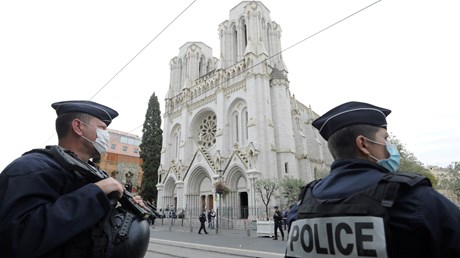
French evangelicals are mourning along with the Catholic church and the rest of the nation after an attacker armed with a knife killed three people Thursday at a basilica in the Mediterranean city of Nice.

“Let us be peacemakers in a French society that lacks it. Pray for our fellow citizens, whatever their religion. Let us love our neighbors, as Jesus ordered us to do,” stated the National Council of Evangelicals of France (CNEF), citing Matthew 5:9.

Police in Nice have closed all places of worship in the city, and the evangelical group advised pastors across the country to heed government recommendations to heighten security due to the threat of further violence.

The incident at Notre Dame Basilica in Nice was the third attack in two months in France that authorities have attributed to Muslim extremists, including the beheading of a teacher.

It comes amid a growing furor over caricatures of the Prophet Muhammad that were republished by the satirical newspaper Charlie Hebdo—renewing vociferous debate in France and the Muslim world over the depictions that Muslims consider offensive but are protected by French free speech laws.

Other confrontations and attacks were reported Thursday in the southern French city of Avignon and in the Saudi city of Jiddah, but it was not immediately clear if they were linked to the attack in Nice.

“He cried ‘Allah Akbar!’ over and over, even after he was injured,” said Nice Mayor Christian Estrosi, who told BFM television that two women and a man had died, two inside the church and a third who fled to a nearby bar but was mortally wounded. “The meaning of his gesture left no doubt.”

Christian leaders across France responded by crying out to God ...

Continue reading...


from Christianity Today Magazine https://ift.tt/3eezkav

Gabriel Salguero: Threading the Election 2020 Needle

The importance of Christian discipleship in election season.

Over the last month, I have done over a dozen press interviews on the Hispanic evangelical vote and election 2020. I imagine that much of the interest is because Latino evangelicals are at the nexus of two major voting constituencies in America. There are close to 60 million Latinos living in the United States and they overwhelmingly vote Democrat. Evangelicals, who are about 25% of the US population, vote overwhelmingly Republican. Latino Evangelicals, members of both communities, are the quintessential swing voters. As the pastor of The Gathering Place, a Latino-led multi-ethnic congregation, I am, like many others, experiencing first-hand the delicate and monumental task of shepherding a political diverse congregation in polarized times. Florida is a historically significant swing state and Hispanic evangelical swing voters may be determinative, so the political commercials and campaign outreaches to our community are considerable. Indubitably, I get the question, “Pastor, how should I vote as an evangelical?” I never tell people who to vote for or how to vote but I do lay out Gospel principals for public engagement. Pastors are shepherds not autocrats.

My initial response is to remind our entire church family that evangelical is NOT a political category. Evangelicalism ought not be defined by partisan ideology but by theological concomitants. David Bebbington’s quadrilateral of conversionism, biblicism, activism and crucicentrism has always been a helpful framework for me. In addition, I point many of our congregants to the useful standard of evangelical identification that NAE/LifeWay Research has developed. That many parishioners, pundits, and politicians have defined evangelicalism in political terms ...

Continue reading...


from Christianity Today Magazine https://ift.tt/3mLAAVR

The Civil War in Our Hearts

Political division finds fuel in sin that separates us from each other. Only peacemakers win the title “children of God.”

A reader recently replied to an article I’d written about the presidential election to say his reason for voting for his preferred candidate has nothing to do with the policy considerations my piece addressed. “Nah,” he wrote, he’ll stick with his pick to “cause irritation and anger” for voters on the other side. The antagonism is the point.

I don’t think this reader was unique in that regard. Tribal political antagonism is on a long upward trend, giving this election season’s cyclical worries about a new civil war a less fantastical feel than in elections past. Is that possible? Are we really heading toward large-scale political violence over our election results? I’m skeptical—but even if no one ever takes up arms, we already have a civil war in our hearts.

“You have heard that it was said to the people long ago, ‘You shall not murder, and anyone who murders will be subject to judgment,’” Jesus taught in the Sermon on the Mount. “But I tell you that anyone who is angry with a brother or sister will be subject to judgment. Again, anyone who says to a brother or sister, ‘Raca,’ is answerable to the court. And anyone who says, ‘You fool!’ will be in danger of the fire of hell” (Matt. 5:21–22). The consequences of murder and malice are different, of course: Only one leaves a corpse. But both warp our souls and our relationships. The rejection of love that motivates us to murder someone, Jesus said, is just as real and grave a sin when it leads us to despise her.

By that standard, America has been at civil war for some time. Negative partisanship is on a decades-long rise, which means that many of us vote ...

Continue reading...


from Christianity Today Magazine https://ift.tt/2HBi17P

Recognizing the 'Sins of Our Fathers' Means Admitting We're Their Children

The Bible tells us we only escape original sin through our perfect savior.

My dad has been bald since I can remember. As a high-school kid, I convinced myself that I didn’t have his hairline. Here I am, 34 years old and slowly succumbing to the inevitable arithmetic of heredity plus time.

Some inheritances can’t be escaped. We’ve seen this truth on full display during the widespread protests this summer. A generation of Americans is coming to terms with the nation that’s been passed down to them. Each Confederate monument crashes with symbolism: I’m not like my father—or my forefathers!

In recent years, our culture has been groping in the darkness toward a doctrine of primeval sin based on societal categories of gender, race, class, and sexual orientation. Meanwhile, evangelical Christians seem to be struggling with the plain ramifications of what we claim as basic truth. Belief in original sin means taking seriously in the present the sins of the past.

Historic Christianity has produced various conceptions of original sin , but analytical theologian Oliver Crisp has pinpointed where all orthodox traditions intersect: “Original sin is an inherited corruption of nature, a condition which every fallen human being possesses from the first moment of generation.” Sin is not merely a matter of imitating bad behavior. It’s an inheritance: “In a way akin to congenital genetic conditions that are passed from both parents to their child, original sin is passed down the generations as a kind of moral disorder or defect.”

Anecdotal and statistical data bear this out. Regarding patterns of intergenerational child abuse, the Children’s Bureau reported, “Many (but not all) studies on the topic have found that parents who experienced childhood ...

Continue reading...


from Christianity Today Magazine https://ift.tt/2Jly765

Wednesday, 28 October 2020

Meet the Evangelicals Who Won’t Vote for Trump, Biden, or Anybody at All

They’re not apathetic. Convicted nonvoters think Christian citizenship calls for a different kind of engagement.

Despite their opposing views of who should win the upcoming election, Republicans and Democrats share a sense of urgency over the 2020 presidential race. Both parties would have voters believe that this is “the most important election of their lifetimes” and they have a responsibility to vote in the right candidate.

It’s always awkward to be a nonvoting Christian during campaign season, and this year, nonvoters really feel the pressure. The enthusiasm over the 2020 presidential election, combined with increased voting options due to the pandemic, has already led to record-setting early voting numbers. Nonvoting is assumed to be a decision made out of resignation, apathy, or lack of concern for the country.

While some religious traditions abstain from voting because they do not take part in politics at all (think Jehovah’s Witnesses) or because they separate themselves from broader society (the Amish), evangelical nonvoters say they can be politically engaged beyond the ballot box.

“I’m still involved with changing things, but I didn’t want to do that in the name of a political party,” said Natasha Kennedy, an evangelical in Washington State who has never voted in a US election and doesn’t plan to this year.

Instead, she pushes back against both parties and advocates for Christ’s kingdom without any allegiance to a political platform.

Her position dates back to when she turned 18. As she considered entering the mission field, Kennedy decided she would demonstrate her devotion to Christ and his kingdom by not voting in US elections.

Like many Christian nonvoters before her, she saw the act of casting a ballot as a sign of approval for a political power structure that in ...

Continue reading...


from Christianity Today Magazine https://ift.tt/3mw37yu

Karen Swallow Prior: Voting for Neither

Author and Professor Karen Swallow Prior on voting third-party in the upcoming election.

Candidates for office should be evaluated based on what they want to accomplish and how they will do it. On this basis, I cannot vote for either Biden or Trump.

While I am not a single-issue voter, the protection of human life and dignity tops my hierarchy of political concerns. Neither Trump nor Biden addresses these matters consistently, holistically, or satisfactorily.

For me, as well as for many other Americans, abortion is a social justice issue. In aiming to increase abortion access and funding locally, nationally, and globally, Biden and the Democratic Party’s position is so extreme that it is out of step with the majority of Americans, even most who are pro-choice. Some will assert that the decline of abortion rates which followed a peak in the 1980s is the direct result of Democratic policies and that, therefore, laws regulating abortion are not the most significant factor in its reduction. Perhaps this is so. However, the most important function of the law is to protect human life, dignity, and rights. Tragically, U.S. law has failed to do this too often throughout history (and even today). But such failures are all the more reason to ensure that this primary purpose is fulfilled. Just as racism, for example, must be fought in hearts and laws, so, too, human lives must be guarded by both. Conversely, while refusing to elect a racist won’t in itself end racism, it sure does help. Likewise, abortion will not be reduced by electing one who champions it. I will eliminate for consideration a candidate who does not support this basic function of the law.

President Trump, on the other hand, switched from being pro-choice to pro-life while running for president in 2016. Even so, his record on abortion since then ...

Continue reading...


from Christianity Today Magazine https://ift.tt/2TKCpWB

Tuesday, 27 October 2020

Josh Dickson: The Christian Case for Joe Biden

The National Faith Engagement Director for Biden for President on why Christians should support Biden for president.

As a follower of Jesus, my faith informs my values, and my values inform my politics— which is why I work for Joe Biden. As the National Faith Engagement Director for the Biden Campaign, I spend my days talking to people of faith about why I believe Joe is the clear moral choice in this election. But I haven’t always been a Democrat.

Like many Christians, I grew up Republican. I remember celebrating George H.W. Bush’s presidential victory when I was four and, in college, casting my first presidential vote for his son. If you are a Christian, I was told that you simply vote Republican.

As the son, grandson, and great-grandson of Moody Bible graduates, I was also raised in the church. Through Awana, youth group, and Cru in college, I was taught to share my faith in an active way and that we follow Jesus through our words and our deeds. As a kid, ministry was volunteering at soup kitchens, service projects at senior centers, hunger walks, and mission trips. We literally put hands and feet to our faith.

From a young age, I was also taught to use the opportunities given to me to create opportunities for others, especially the marginalized. Jesus speaks to this in Matthew 25, calling us to care for the hungry, the stranger, the sick, the prisoner, and anyone in need. This is why, after college, my faith led me to teach in a low-income school on the South Side of Chicago.

And that’s where my world changed.

The students I taught were bright and capable with boundless potential. But, based on their zip code, their odds of getting a college degree were less than 10%. As I got to know their families, I saw devoted, hard-working people doing the most with what little opportunity they had. I saw real lives that matter ...

Continue reading...


from Christianity Today Magazine https://ift.tt/35FEmJd