Tuesday, 29 June 2021

Pew: What India’s Christians, Hindus, and More Think About Religion

Pew surveys 30,000 Indians across 17 languages and finds support for tolerance yet also religious segregation.
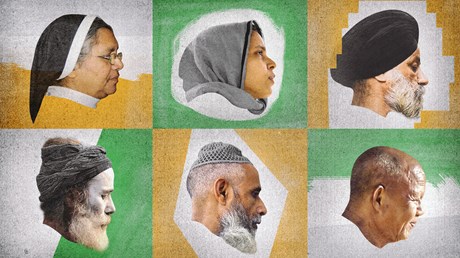
A third of Hindus in India would not be willing to accept a Christian as a neighbor. Neither would a quarter of Muslims or Sikhs.

Only a third of Indian Christians are very concerned about stopping inter-religious marriage, vs. two thirds or more of Indian Hindus, Muslims, and the general population.

A quarter of Christians say religious diversity harms India, while about half say it benefits the country. (Both are similar to the general population.)

A third of Indian Christians identify as Catholics and half identify with Protestant denominations. A third of Christians identify as members of Scheduled Castes, often called Dalits (and formerly the pejorative untouchables).

Almost all Indian Christians are very proud to be Indian, and three-quarters agree that Indian culture is superior to others.

These are among the findings of “Religion in India: Tolerance and Segregation,” a significant new report released today by the Pew Research Center. Its conclusion, in a sentence: “Indians say it is important to respect all religions, but major religious groups see little in common and want to live separately.”

For its “most comprehensive, in-depth exploration” ever of India, Pew surveyed almost 30,000 Indian adults nationwide, face to face across 17 languages, between November 2019 and March 2020 just before the COVID-19 pandemic. The resulting survey, weighted to India’s 2011 census, is “calculated to have covered 98 percent of Indians ages 18 and older and had an 86 percent national response rate.”

Pew surveyed 22,975 Indians who identify as Hindu, 3,336 who identify as Muslim, 1,782 who identify as Sikh, 1,011 who identify as Christian, 719 who identify as Buddhist, 109 who identify ...

Continue reading...


from Christianity Today Magazine https://ift.tt/2UQG2xV

Accelerating the Great Commission: Where Do We Need More Research?

Article 5 in a series of articles based upon the Lausanne North America Listening Call

Question 4: Where is further research needed to accelerate the Great Commission?

We live in a world that’s always conducting research. Because we are bombarded by various kinds of research every day, we tend to forget the purpose of research. The purpose of research can range from information gathering to problem-solving or to increase our understanding in an area, field of study, or discipline.

For the church, the question of “where further research is needed?” can be met with a warm reception or a cold rejection. There may be some who believe the church doesn’t need to do any further research and all churches need to do is to be faithful to the Bible and let God worry about the results—especially when it comes to the Great Commission. On the other hand, there may be those hungry to receive the latest research so they can pivot their strategy with the hope of being more effective missionally.

We at the Wheaton College Billy Graham Center and Lausanne North America believe in research. Therefore, we welcome more information, data, and research in areas with the hope of becoming more effective at the mission.

On our Lausanne Listening Call last March, over two hundred Christian leaders shared what areas they believed more research was needed in to accelerate the Great Commission today. After spending some time with the data, we broke down the majority of what was shared into the following three topics/areas where more research is needed in order for the church in North America to become more effective at participating in the Great Commission.

1.) Learning how to be human in a technopoly.

Neil Postman in his book, Technopoly, notes three classifications of culture: tool-using cultures, technocracies, ...

Continue reading...


from Christianity Today Magazine https://ift.tt/3hhGqgj

Monday, 28 June 2021

While Southern Baptists Debate Critical Race Theory, Black Pastors Keep Hoping for Change

Frank I. Williams of the Bronx is optimistic the convention can continue to address racism and promote diversity—if leaders like him commit to being part of the solution.

When pastor Frank I. Williams thinks about diversity in the majority-white Southern Baptist Convention (SBC), he sees signs of encouragement and hope.

Over his ministry career, the New York preacher has watched voices of Black leaders and other leaders of color become more prominent in the denomination. As the new president of the National African American Fellowship of the SBC, Williams is excited about the momentum around young, diverse pastors in the SBC, particularly as a new generation of church planters.

His optimism around these pastors is justified. At this month’s SBC annual meeting in Nashville, SBC Executive Committee president Ronnie Floyd celebrated how majority-Black congregations in the denomination have nearly quadrupled since 1990. In all, by 2018, 22.3 percent of its churches were majority-non-Anglo, he reported.

For more than decade, the nation’s largest Protestant denomination has grappled with declines in membership. Yet during that time, Asian, Hispanic, and African American tallies continued to grow—adding more Black members and majority-Black churches than any other group.

But the 2021 annual meeting, the largest Southern Baptist gathering in 25 years, seemed to reflect a different story about its diversity.

For one thing, though the SBC does not track the race of attendees, the room of nearly 16,000 messengers was overwhelmingly white. And when race did come up for discussion, it was brought up mostly by white leaders, not in the context of diversity fueling growth within the denomination but in the ongoing debate around critical race theory (CRT).

Over the two days of business in Nashville, concerns over critical race theory were mentioned repeatedly in motions from the floor, discussions ...

Continue reading...


from Christianity Today Magazine https://ift.tt/2Tj4uHA

The Jesus People Movement: Insights and Takeaway for the Future

Celebrating 50 years one of the most important revivals of modern American Christianity.

Six decades ago, America experienced a period of moral, political, and even spiritual turmoil very similar what many are experiencing today. Years of political polarization were capped by an outpouring of protest and violence at the DNC Convention in 1968. The Vietnam War was increasingly seen as an intractable quagmire even as the casualty count grew. Political and cultural leaders were being assassinated at an unprecedented rate. As the decade neared its end, the counterculture solutions of free love and drugs were revealed as counterfeit solutions even as ruined countless lives.

At this most unlikely point, the Holy Spirit provoked one of the most unlikely revivals amongst some of the most unlikely people in American history. Originating in various points across the country but most strongly in Southern California, networks of hippies, musicians, pastors, and evangelists. It was amazing how hippies, houseless people and the marginalized of society were being transformed by the Word of God into preachers, worship leaders, and agents of redemption.

Remembering the Jesus People

For those hoping and praying for revival, it is important to reflect on the history of God’s faithfulness to his people. Just as God called Israel to rememberhis past works so that they would not depart from the truth (Deut. 8:2), the Church must listen to and learn from the past so we might engage our world today. With this in mind, let me offer two initial takeaways in surveying the Jesus People Movement that current students, pastors, church leaders, and everyday Christians praying for revival may learn.

First, amidst U.S. and global turmoil, the revival was led largely by and focused toward young people. Over the course of a decade, thousands ...

Continue reading...


from Christianity Today Magazine https://ift.tt/3joF5H5

No Longer Evangelical

Is the label 'evangelical' sustainable for Christians in our post-everything world?

I became a Christian at the age of 20, while doing my honors work in philosophy at the University of Michigan. Up until that point, I was an atheist, being raised by atheists. My childhood home had a sign declaring, “The Moore’s, The Atheists,” and a barrel for Bible burning—seriously. That’s why when I converted to Christianity, I had nearly zero history with organized religion and was utterly unfamiliar with a great many terms and labels that came with my conversion.

One of the most important labels I inherited at the time was “evangelical.” I was told that was what I had become, an evangelical Christian. It seemed right to me, because, after all, I had not become a Catholic, Pentecostal, fundamentalist, or Orthodox Christian, I had become an “evangelical Christian,” and that meant something to me at the time.

At the time, as I learned about the ecosystem of the variety of Christian expressions, evangelicals cared deeply about intellectual engagement, spreading the message of Jesus to the world, working together to accomplish that mission, and had a commitment to personal spiritual transformation. That isn’t to say these hallmarks didn’t also present themselves in other forms of Christianity, but after my conversion in the early 1990s, I found them all to be replete within evangelicalism.

How has evangelicalism changed

At its core, evangelicalism is a global expression of Protestantism, which is patently “trans-denominational,” and fundamentally concerned with the spread of the Christian message through mission and evangelism. At its best, evangelicalism was a highly ecumenical movement that enjoyed a long era of engaging issues of social good and ...

Continue reading...


from Christianity Today Magazine https://ift.tt/3jmqtIr

First Denomination to Condemn Uyghur Muslim Genocide? Southern Baptists

Such statements that bridge faiths are rare, based on my two decades working on religious freedom. Christians need to make more.

While headlines focused on intra-Baptist fights during the recent Southern Baptist Convention (SBC) in Nashville, many commentators overlooked a remarkable resolution advocating for Uyghur Muslims in China.

With Resolution 8, Southern Baptists joined Pope Francis in highlighting the abuses suffered by Uyghurs but went a step further by labeling their persecution as genocide.

Uyghurs are an ethnolinguistic group, predominately Muslim, found in the western Chinese province of Xinjiang. Chinese atrocities specifically targeting Uyghurs and other traditionally Muslim ethnic groups are well documented. These abuses by China were a rare area of agreement between the Trump and Biden administrations, with both labeling the Chinese persecution as a genocide.

In Nashville, among resolutions dealing with sexual abuse and electing a new SBC president, the 15,000 delegates or messengers considered Resolution 8: “On the Uyghur Genocide.” It cited “credible reporting from human rights journalists and researchers” which “concludes that more than a million Uyghurs, a majority Muslim ethnic group living in Central and East Asia, have been detained in a network of concentration camps in the Xinjiang Province.”  

Griffin Gulledge, a Ph.D. student in systematic theology at Southeastern Baptist Theological Seminary, drafted the resolution. He became outspoken after watching videos of Uyghurs chained and shackled. “China is committing one of the grossest acts of human rights violations in modern history,” he wrote on Twitter, “and we aren’t saying a word because it financially benefits most of the rest of the world.”

Gulledge’s resolution built the biblical case for Christian human ...

Continue reading...


from Christianity Today Magazine https://ift.tt/3qyhaGJ

First Denomination to Condemn Uyghur Muslim Genocide? Southern Baptists

Such statements that bridge faiths are rare, based on my two decades working on religious freedom. Christians need to make more.

While headlines focused on intra-Baptist fights during the recent Southern Baptist Convention (SBC) in Nashville, many commentators overlooked a remarkable resolution advocating for Uyghur Muslims in China.

With Resolution 8, Southern Baptists joined Pope Francis in highlighting the abuses suffered by Uyghurs but went a step further by labeling their persecution as genocide.

Uyghurs are an ethnolinguistic group, predominately Muslim, found in the western Chinese province of Xinjiang. Chinese atrocities specifically targeting Uyghurs and other traditionally Muslim ethnic groups are well documented. These abuses by China were a rare area of agreement between the Trump and Biden administrations, with both labeling the Chinese persecution as a genocide.

In Nashville, among resolutions dealing with sexual abuse and electing a new SBC president, the 15,000 delegates or messengers considered Resolution 8: “On the Uyghur Genocide.” It cited “credible reporting from human rights journalists and researchers” which “concludes that more than a million Uyghurs, a majority Muslim ethnic group living in Central and East Asia, have been detained in a network of concentration camps in the Xinjiang Province.”  

Griffin Gulledge, a Ph.D. student in systematic theology at Southeastern Baptist Theological Seminary, drafted the resolution. He became outspoken after watching videos of Uyghurs chained and shackled. “China is committing one of the grossest acts of human rights violations in modern history,” he wrote on Twitter, “and we aren’t saying a word because it financially benefits most of the rest of the world.”

Gulledge’s resolution built the biblical case for Christian human ...

Continue reading...


from Christianity Today Magazine https://ift.tt/3diNRT9