Thursday, 26 August 2021

Fate of Lalibela Rock Churches Raises Concerns Among US Ethiopians

TPLF forces have taken control of one of Christianity’s oldest heritage sites.

The fate of the ancient rock-hewn churches of northern Ethiopia has become a grave concern for Ethiopian Americans, as a civil war between the government of Prime Minister Abiy Ahmed and Tigray rebels imperil the fate of many religious sites across the country.

For months, Ethiopian troops have fought a rebellion by the Tigray People’s Liberation Front (TPLF), which began after TPLF forces attacked an Ethiopian military installation in early November 2020. Tensions had risen after Ahmed’s government withheld funds for elections held in Tigray province in defiance of federal COVID-19 restrictions on gatherings.

In recent weeks, the TPLF forces have captured the town of Lalibela, in the northern Amhara region, the site of a cluster of some of Christianity’s oldest houses of worship. The Lalibela churches were carved by medieval Ethiopian Christians as an alternative pilgrimage site to Jerusalem, whose geography the complex loosely follows.

“The recent military intrusion of the TPLF into Lalibela threatens the home of the ‘New Bethlehem,’ where 11 rock-hewn churches built in the 12th century are still places of worship today,” said a longtime analyst of the region.

The churches are also a favorite with foreign tourists to Ethiopia. “We call on the TPLF to protect this cultural heritage. We also call on all parties to the conflict to end the violence,” the State Department said in a statement following the seizure of Lalibela on August 5.

The churches were declared a UNESCO World Heritage Site in 1978. Ironically, that designation came during the height of the Ethiopian Civil War, which pitted a number of rebel groups against the Communist dictator Mengistu Haile Mariam.

“My ...

Continue reading...


from Christianity Today Magazine https://ift.tt/3mzGCM9

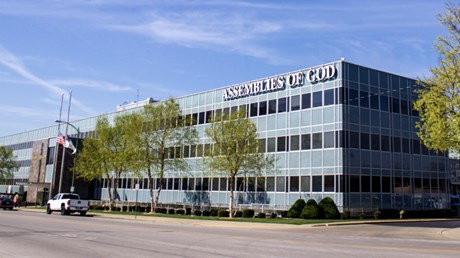
Assemblies of God Avoids Jury Trial in Sexual Abuse Case

Oregon lawsuit sought to hold national organization liable for crimes committed in a Royal Rangers program in the 1980s.

The Assemblies of God has settled a sexual abuse lawsuit in Oregon. If it had gone to trial, the suit would have been the first to put the Pentecostal denomination before a jury as a defendant in a sexual abuse case, allowing citizens of Portland to decide whether the Assemblies is legally liable for abuse that happened in the church scouting organization in the 1980s.

The denomination filed more than a dozen motions to get the case dismissed, according to Gilion Dumas, the attorney representing three men suing the denomination. The Assemblies also filed three appeals with the state supreme court.

The motions were rejected and appeals dismissed. When a trial date was set for September 7, the denomination agreed to a settlement.

“The trial court concluded that our legal theories of liability were viable, but they were not tested, ultimately, by a jury,” Dumas told CT. “It was the first time that the national organization was named and successfully kept in a sex abuse case. They tried to get out of it, but the court denied those motions and denied them consistently.”

A previous lawsuit was settled in 1990. Another was settled in 2017. The lawsuits sought damages between $5 million and $42 million, but the settlement amounts are secret. The dollar figures are protected by nondisclosure agreements, Dumas said.

Assemblies of God legal counsel Richard R. Hammar was unavailable to comment, according to church spokesman Mark Forrester. (Hammar is the cofounder and senior editor of CT’s sister publication, Church Law and Tax.) He authored Reducing the Risk in the early 1990s, one of the first abuse prevention programs for churches. Assemblies leadership recommends the 14-point plan to all its congregations. ...

Continue reading...


from Christianity Today Magazine https://ift.tt/2Y1qXuY

She Didn’t Believe, But God Heard Her Cry

I was privileged to be part of his answer.

I’ve heard Christians I love and respect say that prayer doesn’t change anything. “We pray in order for God to change us,” they say. I get the sentiment. I, too, believe that as I pray and ask God’s will to override my own, my heart changes. Slowly, softly, sometimes painfully, I feel my desires transform. But I don’t think that’s all prayer does. I know prayer can also change our circumstances. I’ve experienced it.

Several years ago, I was teaching a communication course at a college campus in Michigan. One particular student, Shatina, would always make her way to the back of the classroom. Most days, she’d put her head down on the desk and practice not making eye contact with me for the full 90-minute class. I generally have positive relationships with my students, but Shatina never seemed interested in that. She didn’t laugh at my jokes. She didn’t raise her hand. She sat in the back of class and, when class was done, she left.

One day, as Shatina walked into class, a thought popped into my head: Give Shatina the money that is in your wallet.

I wondered if this thought was from the Holy Spirit. But I didn’t grow up in a church culture with a strong focus on the Holy Spirit, so over time, I think I’d taught myself to ignore such promptings.

I can’t just hand students cash from my wallet, I thought to myself. In fact, it would be inappropriate. So I dismissed the thought as my own and taught my class as usual. When class ended, the students left, including Shatina. The second she was gone, a thought emerged in my mind again: You keep asking me to give you big opportunities, and you haven’t been faithful in this small one.

I still wasn’t ...

Continue reading...


from Christianity Today Magazine https://ift.tt/3jh9FSL

Wednesday, 25 August 2021

Getting High Is (Increasingly) Lawful. Is It Ever Beneficial?

A pastor’s perspective on recreational and medicinal marijuana.

Movements to legalize marijuana are spreading across the country, changing laws and causing millions of Americans to reassess their convictions. With pot’s popularity on the rise, what should Christians say in response? Todd Miles, professor of theology at Western Seminary in Portland, Oregon, tackles this complicated question in Cannabis and the Christian: What the Bible Says about Marijuana. Pastor and writer Nathaniel Williams spoke with Miles about the relevant moral principles and medical facts.

Why did you write a book about marijuana?

This is a pastoral issue that my church has faced. I am on the elder board, and shortly after marijuana was legalized in Washington State, one of our congregants asked, “Is marijuana okay?” We realized at that point that the typical answer—“No, it’s against the law”—would no longer suffice. We knew we had to start thinking about the topic like Christians for a change.

I put together some thoughts and presented them at a pastor’s conference, and the room was packed. This experience showed me that the church was really looking for wisdom and guidance.

Since then, I’ve given this presentation all over the Pacific Northwest and Northern California, and I’ve also developed a talk on medical marijuana. In some people’s minds, the issues surrounding recreational and medical marijuana are basically the same. But others distinguish between them, and that’s the approach I take.

The marijuana legalization movement is spreading rapidly across the country. Why do you think this is happening?

America is losing some of its traditional values and concerns over drugs like marijuana. We’ve entered a confusing moment where some ...

Continue reading...


from Christianity Today Magazine https://ift.tt/3zj0IOt

Tuesday, 24 August 2021

Some Christian Leaders Advise Parents on COVID-19 Exemptions

Legal experts suggest churches should be cautious about providing documentation to help people get around mask and vaccine rules.

Some Christian leaders have spoken out alongside the public officials, doctors, and other community figures who are helping people circumvent COVID-19 precautions.

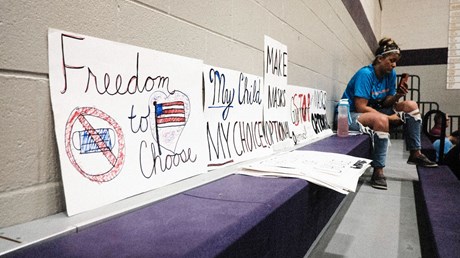
An Oregon school superintendent is telling parents they can get their children out of wearing masks by citing federal disability law. A pastor at a California megachurch is offering religious exemptions for anyone morally conflicted over vaccine requirements. And Louisiana’s attorney general has posted sample letters on his office’s Facebook page for those seeking to get around the governor’s mask rules.

While proponents of these workarounds say they are looking out for children’s health and parents’ rights, others say such stratagems are dishonest and irresponsible and could undermine efforts to beat back the highly contagious delta variant.

Mask and vaccine requirements vary from state to state but often allow exemptions for certain medical conditions or religious or philosophical objections.

Just as health experts question the guidelines for determining whether a child’s condition would merit an exception to mask requirements, some Christian legal experts say it is “troublesome” to require churches provide documentation for a person’s religious exemption.

“A church would want to be cautious regarding who would be providing such support. Would it be coming from the elders as a whole? The pastor? One leader?,” said Erika Cole, a Christian and attorney based in Maryland. “The question of who would have the authority to provide such support is another issue that would have to be considered.”

In Oregon, Superintendent Marc Thielman of the rural Alsea School District told parents they can sidestep ...

Continue reading...


from Christianity Today Magazine https://ift.tt/3kpMwNl

Christian Virtue Strengthens the Social Justice Cause

Liberation from injustice starts with obedience to God and his moral order.

In the early 1980s, Indian guru Bhagwan Shree Rajneesh established a commune called Rajneeshpuram and embarked on a search for utopia in the wilderness of Wasco County, Oregon. (The Netflix documentary Wild Wild Country recounts the story.) The cult sought to create the perfect city by deconstructing the social norms and religious strictures that in their view suppress one’s true self.

Rajneesh taught that free love and dynamic meditation were the key to liberating the individual and reaching “superconsciousness.” The group bought 80,000 acres and indulged all their wildest inclinations in orgy-style meditation sessions. They wanted a perfectly compassionate and just community, where no one’s self-expression would be restricted.

But before long, the brokenness of human nature brought them back to reality. When the commune received political pushback from other residents in the area, they became anything but compassionate. In the name of free love and self-expression, they attempted murder and committed fraud and bioterrorism to get their way. They also abused each other and exploited the homeless. Their attempt to completely rid themselves of all constraints left them defenseless against their own internal evils.

I see this dynamic in the public square today. Contemporary concepts of compassion and justice that ignore human brokenness and individual sin can only lead to the same desolate destination. When those ideas involve pretending men can be pregnant or arguing that the traditional family is a tool of the oppressor, we’re not progressing. We’re descending away from truth. If we want to achieve justice, we first have to understand human nature. And to understand human nature, we have ...

Continue reading...


from Christianity Today Magazine https://ift.tt/2XTwK5L

COVID-19 Killed Our Sense of Personal Progress

Scripture says that might be a good thing.

“The average human lifespan is absurdly, terrifyingly, insultingly short.” That’s how Oliver Burkeman begins his new book, Four Thousand Weeks: Time Management for Mortals. In it, he confronts readers with the disquieting truth that we have a paltry 4,000 weeks on this earth, and a lot of what we do with them is meaningless, at least by some human standards.

As bleak as it sounds, that is exactly the message we need to hear right now.

Life expectancy in the United States has dropped for the first time since World War II. Thanks in large part to the COVID-19 pandemic, Americans can now expect their 4,000 weeks to be reduced by roughly 78 weeks (or 18 months). The fact that life is hard and death is coming would be unremarkable news in any other time or place. But for those of us in the modern West (and perhaps America, in particular), mortality is a question we’ve found ingenious ways to avoid.

Consider how often we opt for efficiency. For many of us, “making the best use of our time” doesn’t mean living a purposeful life. It means getting as much done as possible. We multitask and hustle and pursue what Burkeman dubs “the fully optimized life.” And truthfully, it works. We accomplish a lot. We get stuff done.

It works, that is, until a global pandemic hits and our ability to plan comes to a screeching halt. It works until we find ourselves in much the same place we were six months ago, feeling mocked by progress. It works until death and grief flood our newsfeeds daily. Suddenly, absent our ability to plan and predict, we discover that we lack the skills needed to navigate troubling, seemingly meaningless times. We find ourselves emotionally and mentally numbed. As hospitals ...

Continue reading...


from Christianity Today Magazine https://ift.tt/3Dcynf1