Thursday, 26 May 2022

Buffalo’s Black Christians Grieve the ‘Evil Among Us’

Angry but not shocked at racist violence, the victims' families at funerals this week have a prayer: Let these deaths not be in vain.
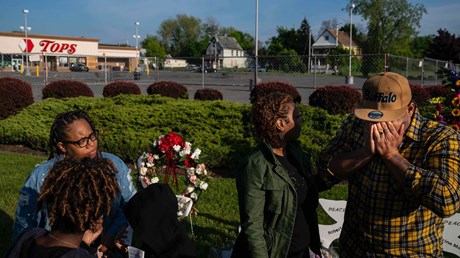
Buffalo this week is bearing the heaviness of 10 funerals all at once.

Even though organizers tried to stagger funeral times, hundreds of cars converged on one cemetery on Wednesday for back-to-back burials. One local congregation, Elim Christian Fellowship, held memorials two days in a row this week, gathering hundreds to cry, sing, and proclaim that death did not have the last word over the loved ones they lost.

The church called for 30 days of mourning in honor of longtime member Celestine Chaney, 65. Chaney was among the 10 people killed in a racist attack at their local Tops grocery store back on May 14. Most of the victims were devout Christians, active in Black churches in Buffalo.

The city’s Christians aren’t rushing the grieving process, even as national news reporters have left town and attention has shifted to another horrifying shooting at a Texas elementary school.

“I’m sure God is angry with what he sees,” said Bishop Glenwood Young Sr., who leads the Church of God in Christ in Western New York. Young’s sister-in-law, 77-year-old Pearl Young, was one of the Tops victims.

The grief and anger in Buffalo is different than after other recent mass shootings. The shooter, based on officials’ accounts, targeted Black people because of his white supremacist beliefs. He killed the elderly, people called mother and auntie by their friends and neighbors. The incident added to the poor neighborhood’s troubles by creating a food desert, with the grocery store indefinitely closed after the shooting.

At the funerals and around the community, conversations swelled with righteous anger. CT heard from people who held to a firm belief that God would do something to address the evil that ...

Continue reading...


from Christianity Today Magazine https://ift.tt/pf3OmzJ

When Churches Become Mafias

The recent SBC abuse report shows that churches often prioritize tribal unity and safety over “divisive” truth.

This piece was adapted from Russell Moore’s newsletter. Subscribe here.

If you ever want to do something kind for me, please don’t send flowers.

If I were to see a bouquet of them at the door, I would probably have a reflexive adrenal response. That’s because, for years in my Southern Baptist context, the lore was always about a leader in the denomination—who fancied himself a sort of party boss or even bishop—who would send to those who crossed him a bouquet of flowers, with nothing but a card with his name. The flowers were interpreted to signify something along the lines of “You’re dead to me” or “I know what you did” or some such thing.

The first time I heard this, I stopped and thought, “Wait, how is this not the mafia?”

Now I don’t know how many people ever received such flowers. When younger people asked about it, the leader would grin and look away. Maybe the legend was always bigger than the reality. But when it comes to fear and intimidation, legend is really all it takes.

And behind the legend is an even larger truth—one that the rest of the world can now peek into ever so slightly, after the release of an independent investigation that describes a culture of cover-up, retaliation, and stonewalling by the Southern Baptist Convention’s Executive Committee on matters of church sexual abuse, church sexual abuse survivors, and the advocates and whistleblowers who stood with them.

Since then, many people from outside the denomination called or texted as they watched some of the official proceedings, and all expressed some variation of how creepy they found the southern politeness—with everyone calling ...

Continue reading...


from Christianity Today Magazine https://ift.tt/PhF4uAX

After Raising a Hallelujah, Bethel Music CEO Leaves Redding

Joel Taylor, who directed the popular label since the beginning, has resigned.

Millions of Christians would not be gathering to “Raise a Hallelujah” had it not been for Joel Taylor, the producer and executive who helped to lead Bethel Music from a worship ministry to a major label.

Taylor announced last week that he was resigning “after 13 wonderful and challenging years” as CEO of Bethel Music. During that time, the organization captivated Christian listeners with long, spontaneous worship sets and harnessed its digital brand with high-quality music videos.

“When we founded the label, we knew God was going to use us to build something special,” Taylor wrote on Instagram. “But God’s plan was even bigger than our dreams … and we had big dreams.”

The launch of Bethel Music under Taylor in 2010—when the label was cofounded by worship pastors Brian and Jenn Johnson—coincided with a notable rise in the popularity of worship music for consumption via radio, streaming, and live performance.

“They didn’t play worship on the radio back then, and they told us we wouldn’t ever be on the radio. When we wanted to bring worship to the world on tour, we were told people wouldn’t host us,” Taylor wrote. “We had to listen to God and believe in our hearts the ‘impossible’ could happen.”

Bethel Music began as an extension of the music ministry at the Redding, California, charismatic megachurch. Within the first couple years, the budding label had released worship hits like “Love Came Down” and “One Thing Remains.” From 2014 to today, its singles have consistently landed on the Christian charts, with six songs reaching ...

Continue reading...


from Christianity Today Magazine https://ift.tt/7rkWaz0

Wednesday, 25 May 2022

Southern Baptists Move to Release Pastor List, Repudiate Old Approach to Survivors

More change needed, survivors say, but new lawyers bring signs of hope.

Days after a bombshell investigative report, the Southern Baptist Convention’s Executive Committee (EC) decided to do what previous leaders refused to for 15 years: release a list of pastors who had been credibly accused of abuse.

Sitting on either side of interim EC president Willie McLaurin during a meeting over Zoom on Tuesday, a new pair of lawyers discussed the EC’s initial response. They proposed immediately issuing a statement repudiating the dismissive stance EC leaders had taken toward victims in the past and making public a list of 700 alleged abusers that former leaders kept in secret.

The quick moves contrast with the historic approach captured in the investigative report and in last year’s meetings, where ascending liability was a common talking point and lawyers defaulted to closed-door session to advise the trustees.

“We have become too familiar with using techniques to slow processes down,” said SBC president Ed Litton. “We need to be very mindful that a world is watching, and they don’t need to see business as usual… we have to do this right.”

The two lawyers from Bradley Arant Boult Cummings LLP—Gene Besen and Scarlett Singleton Nokes—began as outside legal counsel at the start of the year. They spoke openly in the meeting, with Nokes reflecting on her faith and the need for the fruit of “gentleness” to drive the EC’s work on this issue going forward.

On Twitter, survivor Jennifer Lyell called them “the most positive consequential thing to happen in the @sbcexeccomm in the past 20 years.”

It’s the first time in a generation the EC has been represented by attorneys other than Jim Guenther and Jaime Jordan. They ...

Continue reading...


from Christianity Today Magazine https://ift.tt/rQJeYqK

Ecclesiastes Is the Story of Abel Writ Large

Biblical Hebrew uses similar names for “vanity” and the slain brother. That’s no accident.

“Meaningless! Meaningless!” So says Qohelet, the author of Ecclesiastes, as he begins his reflections. “Utterly meaningless! Everything is meaningless.”

For many, these words resound with a skeptical and, some may say, nihilistic tone. But must they? Russell L. Meek, a gifted Old Testament scholar at Moody Theological Seminary, has endeavored to answer this question in his new book, Ecclesiastes and the Search for Meaning in an Upside-Down World.

Meek seamlessly weaves together scholarly insight, theological profundity, pastoral tact, and moving anecdotes drawn from his own experiences with pain, abuse, sin, and ultimately redemption in Christ. His work is quaint and accessible. I believe it will bless discouraged ministers and laypeople alike, and perhaps would make an excellent guide for a small group study or Sunday School class working through the book of Ecclesiastes.

Well-acquainted with ‘Abel-ness’

Meek begins by observing how Qohelet portrays our upside-down world—one tainted by human sinfulness and still reeling (to borrow from John Milton) from paradise lost. Meek suggests that Qohelet uses the creation narrative of Genesis “to remind us that sin is the ultimate cause for death and injustice in life.”

And yet, as Meek puts it, Qohelet teaches that when we enjoy “fleeting gifts from God,” we “return to the good that once was,” with “God’s gifts represent[ing] a portion of life before sin.” He further notes that, for Qohelet, even in a fallen world, God’s justice may be delayed (Ecc. 8:11), but it is never denied (3:17, 8:12, 12:14).

As for the time between the lost paradise of Eden and the arrival of God’s final ...

Continue reading...


from Christianity Today Magazine https://ift.tt/wv4lbLE

Why Christ’s Ascension is Essential

Jesus’ return to heaven was not an awkward stage exit but the climax of our redemption story.

For a long time, I never really understood the Ascension.

To me, the disciples’ question in Acts 1:6 seemed eminently reasonable. Why did Jesus have to go? Why not just usher in the fullness of the kingdom then and there, and start wrapping the whole thing up? Wouldn’t it be a great asset to our labors in missions and apologetics to have Jesus still around?

As it stands, the Ascension plays right into the skeptic’s darkest doubts about the gospel narrative. How convenient that the supposedly risen Messiah should vanish without showing himself to anyone other than his friends and family!

The Bible, however, stubbornly refuses to agree with my sensibilities. Far from treating the Ascension as a weird stage exit whose main function is to explain why Jesus isn’t around anymore, Scripture speaks of it as a necessary part of God’s plan. Not only is it necessary, but the disciples even refer to it as a primary proof of Jesus’ messianic identity.

Rather than trying to explain away his absence, they tout it with vigor. The Ascension stands on equal footing with the Crucifixion and Resurrection in the earliest declarations of the gospel (Acts 2:33–36; 3:18–21; 5:30–31).

Even Jesus connects the Ascension with his work of dying and rising again. When Mary Magdalene sees him in the garden after his resurrection, he’s not simply strolling about, enjoying the fact that everything has been accomplished. No, he’s a man on a mission, and there is still another: “Do not hold on to me, for I have not yet ascended to the Father” (Jn. 20:17).

Yet in my experience within evangelical churches, I have seldom heard the Ascension preached with emphasis ...

Continue reading...


from Christianity Today Magazine https://ift.tt/laVtqzg

Tuesday, 24 May 2022

After 2,000 UK Church Buildings Close, New Church Plants Get Creative

In England, some rally to restore aging and emptying Anglican sites, while diverse congregations look beyond traditional sanctuaries.

A survey released by evangelical organizations in the United Kingdom last month found that, while around half of the country’s population identify as Christian, only 6 percent are “practicing” and active enough in their faith to attend church at least once a month.

The attendance decline is one reason over 2,000 churches have closed during the last decade. Communities are grappling with whether or how to save the historic buildings as new expressions emerge through church planting.

“If you were running a commercial organization, and you had a branch on every single High Street in the country but dwindling numbers of people visiting them, you would go bust if you didn’t close some branches,” said Theos senior fellow Nick Spencer. “That is the reality facing the church.”

The number of churches in the UK fell from 42,000 to 39,800 in a ten-year span, according to a 2021 report from the Brierley Research Consultancy.

“If you have churches in rural areas, and there are fewer people going into them, and indeed fewer people living in rural areas, and you don’t have the money to keep churches going, then they’re likely to close,” Spencer said.

A recent report from the Church of England found that up to 368 churches could be at risk for closure in the next two to five years, though the church said the rate of closure is slowing. These numbers of course don’t take other denominations into account, but many of the buildings belong to the Anglican Church.

Declines in attendance—and, in turn, involvement and giving—have left churches with fewer resources to maintain their aging buildings. Even churches with a fairly large worshiping ...

Continue reading...


from Christianity Today Magazine https://ift.tt/fWuKgeb