Tuesday, 28 June 2022

At Canadian Megachurch, One Abuse Investigation Spurs Another and Another

As former pastor Bruxy Cavey appears in an Ontario court, the reckoning continues at The Meeting House.
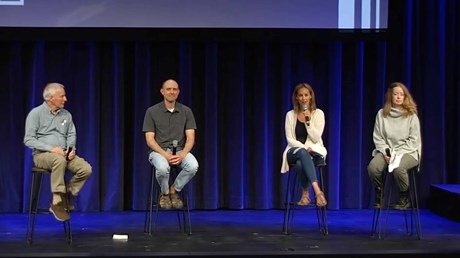
Reeling from the arrest of their former teaching pastor, Bruxy Cavey, for sexual assault, and a growing number of sexual misconduct allegations against other previous pastors, leaders at The Meeting House are looking for ways to move forward.

“We are deeply sorry for the abuse and harm that has occurred, be it sexual, emotional, or spiritual in our church family,” Jennifer Hryniw, cochair of the board of overseers, recently told the congregation, which operates in 20 locations across Ontario. “We are deeply sorry for how many of these stories have been handled in the past. We continue to be humbled to now be the stewards of these stories.”

The Meeting House was supposed to be a humble kind of church. The Canadian Anabaptist congregation was built around movie theater venues and home gatherings and led by a modest pastor with long hair and baggy clothes.

But during the past few months, The Meeting House has been put to shame by the allegations of clergy sexual abuse.

Despite The Meeting House’s slogan of being “a church for people who aren’t into church,” it was often recognized for its high production value, its facilities, or having “all of the answers,” noted Quincy Bergman, a pastor at its Oakville, Ontario, headquarters.

“That creates almost—and I feel it in myself sometimes and in others—a smugness of who we are,” he told the congregation earlier this month. “God has a way of humbling you when you think you are too big for your britches.”

Cavey, a 57-year-old “hippie pastor,” was the face of the church and its pastor since 1996, before going on leave last December when an allegation against him was brought to the church ...

Continue reading...


from Christianity Today Magazine https://ift.tt/Q4OdqLN

Monday, 27 June 2022

Meet the Pioneering Radio Preachers Who Revolutionized Religious Broadcasting

How Fulton J. Sheen and Walter A. Maier unlocked the evangelistic power of the airwaves.

In the 1930s and 1940s, two of the most widely heard preachers in America were also two of the most unlikely candidates for such fame. Fulton Sheen and Walter Maier were both sons of immigrants, both seminary professors specializing in ancient languages, and both from historically oppressed religious traditions. But through the power of radio—which was then a novel mass medium—they reached millions of listeners and ultimately reshaped the trajectory of conservative religion in America.

Their story is told in Kirk Farney’s compulsively readable dual biography, Ministers of a New Medium: Broadcasting Theology in the Radio Ministries of Fulton J. Sheen and Walter A. Maier. Maier, born to German immigrants, showed early academic promise and attended Concordia Seminary (the flagship seminary of the Lutheran Church—Missouri Synod) before completing a PhD at Harvard Divinity School. Being part of a still largely German-speaking Lutheran church was an obstacle given public suspicion towards German-American immigrants during and after World War I. Maier, seeking to establish his patriotic bona fides and to “register his disapproval of the Prussian military clique,” joined the US Army as a chaplain. Yet he promptly pushed the limits of official toleration by ministering to German prisoners of war.

After the war, Maier joined the faculty at Concordia Seminary, where in 1924 he convinced the school to apply for a radio license, financing station KFUO with money fundraised from faculty, students, and alumni. Maier’s early adoption of radio as a means of outreach quickly paid off. Within a few years, his show, The Lutheran Hour, aired on stations nationwide, first on the CBS network and then on ...

Continue reading...


from Christianity Today Magazine https://ift.tt/zqWY0aN

Court Dismisses Suit Against Platt’s McLean Bible Church

While the DC-area congregation celebrates getting to move forward, critics continue to accuse leadership of a liberal takeover.

The year-long legal fight between McLean Bible Church and a faction who accused leaders including David Platt of a “theological takeover” has come to an end.

On Friday, a Fairfax, Virginia, court dismissed a lawsuit from a group of current and former members of the Washington DC-area megachurch, who contested a June 2021 elder election for allegedly violating church bylaws. Pastors announced the outcome across its locations on Sunday.

“I’m incredibly grateful for the courage of our church in staying together and persevering, in pursuing peace in ways that required numerous steps of faith, and for trusting God all the way through to the actual dismissal of the lawsuit,” said Wade Burnett, a lead pastor at MBC.

Earlier this month, the church requested the case be thrown out after redoing the election at the center of the legal challenge. Burnett said the group that filed the suit would not agree to meet for reconciliation or to discuss a dismissal.

A lawyer for the plaintiffs had said MBC’s response “fails to be even a pretense of a good-faith offer to resolve the case” and called it “a continuation of the Board of Elders’ determination to avoid transparency and accountability at all costs.”

Members of Save McLean Bible Church, a Facebook page for critics of current MBC leadership, have alleged a Southern Baptist takeover of the 60-year-old nondenominational congregation and liberal drift in its teachings, pinned to Platt coming on staff in 2017.

They suggested the process for last summer’s elder election—as well as the recent redo—were designed to uphold selections aligned with current leadership. “To no surprise to anyone, the elders put ...

Continue reading...


from Christianity Today Magazine https://ift.tt/UoHDeVN

Praying Football Coach Wins at Supreme Court

Conservative majority says Washington school was wrong to worry about “excessive entanglement” between church and state.

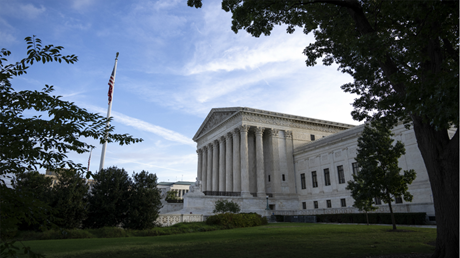
Update (June 27): The US Supreme Court ruled 6 to 3 on Monday that a high school coach’s post-game prayers on a football field were in-bounds.

Joseph Kennedy’s prayers are protected by the First Amendment’s right to free speech and free exercise of religion, the court decided. The coach didn’t coerce any Bremerton, Washington, high school players into praying, so the school district was wrong to try to stop him from practicing his Christian faith.

“The Constitution neither mandates nor tolerates that kind of discrimination,” Justice Neil Gorsuch wrote for the conservative majority, citing a 1992 precedent. “Learning how to tolerate speech or prayer of all kinds is part of learning how to live in a pluralistic society,’ a trait of character essential to ‘a tolerant citizenry.’”

According to Gorsuch, the ruling would have been different if Kennedy had forced students to join him or said his prayers as part of his official coaching responsibilities. But state employees don’t lose the right to say private prayers of thanksgiving just because they work for a public school.

“Mr. Kennedy prayed during a period when school employees were free to speak with a friend, call for a reservation at a restaurant, check email, or attend to other personal matters,” Gorsuch wrote. “He offered his prayers quietly while his students were otherwise occupied.”

Justice Sonia Sotomayor wrote a sharp dissent, joined by justices Elena Kagan and Stephen Breyer. Despite the characterization in the majority opinion, Kennedy’s prayers weren’t actually brief, quiet, or private, she said.

The dissent included three photos of Kennedy surrounded by praying ...

Continue reading...


from Christianity Today Magazine https://ift.tt/khs3V9t

Sunday, 26 June 2022

Bonus Episode: A Conversation with Stephen Prothero on Culture Wars Now That ‘Roe’ Is Gone

What the overturn may mean for American society.

On this special episode of The Russell Moore Show, author and professor Stephen Prothero discusses the overturn of Roe v. Wade and what it may mean for the United States.

Moore and Prothero talk about potential implications for other legislation like Obergefell. They consider the potential effects of the Roe v. Wade overturn on America’s culture wars. Listeners may appreciate their conversation on talking about abortion with someone who holds a different opinion, and what it may look like to have a reasoned, productive dialogue on the subject.

“The Russell Moore Show” is a production of Christianity Today
Chief Creative Officer: Erik Petrik
Executive Producer and Host: Russell Moore
Director of Podcasts: Mike Cosper
Production Assistance: CoreMedia
Coordinator: Beth Grabenkort
Producer and Audio Mixing: Kevin Duthu
Associate Producer: Abby Perry
Theme Song: “Dusty Delta Day” by Lennon Hutton

Continue reading...


from Christianity Today Magazine https://ift.tt/Osb6LlW

Saturday, 25 June 2022

What Does a Pro-Life Economy Look Like?

Abortion has been a national institution for nearly 50 years. Where should Christians spend their pro-life dollars now?

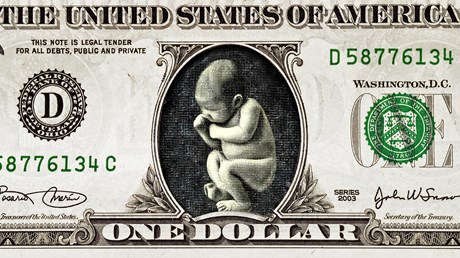
During the past 49 years of abortion debates under Roe v. Wade, some have lost track of how profits and poverty drive the issue—and why pro-life Christians must continue to innovate as we put our money where our mouths are.

A common argument for a pro-choice ethic is that abortion access is good for the economy. Many like US Treasury Secretary Janet Yellen argue that limiting abortion access will only make things worse financially for vulnerable women. And if resources for pregnant mothers do not continue to improve, this is an understandable argument.

Seventy-five percent of abortions occur in households living on less than twice the federal poverty level, and nearly half are below the poverty line, according to Centers for Disease Control and Prevention data. Sixty percent of women who choose abortion already have children, and 55 percent are single. Presently, there is little economic incentive for single women already struggling to feed their children to have another child.

Yellen and others also suggest the economy at large will suffer if abortion access is restricted. Already harrowing workforce dropout rates will only increase and having more mouths to feed in already disadvantaged homes will result in more poverty.

If you follow this line of fiscal logic, one could argue abortion access can lead our 401(k)s to expect pregnant workers will forgo maternity leave and maintain uninterrupted productivity. It can lead our tax bills to expect fewer households will enroll in government assistance after an unplanned pregnancy. If this is the case, then perhaps we have all blindly yet complicitly profited from the economy of abortion.

However, this by no means suggests abortion access is good for ...

Continue reading...


from Christianity Today Magazine https://ift.tt/YjROAhE

Friday, 24 June 2022

Counting the Cost of Paying Ransoms for Missionaries

A Haiti kidnapping raises questions about no-payment practices.

International Christian organizations and missions experts agree it’s not best practice to pay kidnapping ransoms.

But ransoms do get paid. And the impacts are hard to quantify. The cost is a burden borne by local churches, fellow missionaries, ministers, aid workers, and the many people they hope to serve.

A thousand dollars or a hundred thousand might tip the scales for kidnappers in the future, as they weigh whether to abduct more people. But one payment—or two, or three—might not tip the scales at all.

Three members of a group of captive Christian Aid Ministries workers were released last December by a Haitian gang known as the 400 Mawozo, after someone outside the Anabaptist organization paid the kidnappers. It’s unknown how much money the gang received, though the final amount was likely only a fraction of the original $1 million per person they demanded.

The remaining missionaries escaped. But money did exchange hands for three of them. As experts have assessed its impact over the past year, they haven’t reached a consensus on what it means for the future of missions in Haiti.

For some, it seems that the security situation in Haiti has deteriorated so significantly that paying one gang to release three missionaries had no effect at all.

“How can you raise the threat of kidnapping any higher? It’s already off the charts,” said Scott Brawner, president of Concilium, an organization that helps international Christian ministries assess risk. “Whether a ransom has been paid or not has not raised the threat of kidnapping. There are multiple kidnappings of Haitian nationals on a daily basis.”

More than 100 people in Haiti were kidnapped the same month as the Christian ...

Continue reading...


from Christianity Today Magazine https://ift.tt/4TvZBun