Friday, 15 July 2022

Blessed Are the Political Peacemakers

Experts warn political violence is coming. Christians can look to Scripture, not the American Revolution, for guidance.

The seventh hearing of the congressional committee investigating the sedition at the Capitol on Jan. 6, 2021, was much about violence: who did it, who encouraged it, who knew it was coming yet did not intervene.

“The crucial thing is the next step: What this committee, what all of us, will do to fortify our democracy against coups, political violence,” said Rep. Jamie Raskin (D-Md.) toward the end of the hearing. Political violence, he said, is “the problem of the whole country now.”

Raskin is far from alone in raising alarm about the possibility of political violence—seeking political ends through violent means instead of normal, peaceful processes like voting, running for office, lobbying, or protest.

“We know from other countries that have descended into really serious political violence that this is a trajectory, and we’re on it,” researcher Rachel Kleinfeld warned in a Washington Post article Monday. “We’re actually pretty far advanced on it.”

Kleinfeld said we could see rising right-wing militia violence as well as violence from a “disaffected left.” She ominously projected that the “percentages of Americans endorsing violence are approaching Northern Ireland’s Troubles at their height in 1973.”

(The scale of this kind of political violence can vary widely, from an individual’s attack to a revolution, but the Troubles are a good example of what many anticipate happening in the US—“episodes of violence were largely localized, and in the background” yet normal life continued though “everyone was more fearful and depressed.”)

There’s reason to be skeptical of the survey results she’s ...

Continue reading...


from Christianity Today Magazine https://ift.tt/2PmOnk0

More Cremations Mean Fewer Chances to Grieve Together

With church funerals and burials no longer the norm, pastors hope to restore occasions to gather and remember.

Surging cremation rates are upending traditional practices around death, as more people opt out of traditional church funerals and some skip communal experiences of grief altogether.

Randy Anderson, who has worked in funeral homes in Alabama for over 30 years, tells the story of a widow who chose to forgo a funeral for her husband, instead cremating his remains and keeping the ashes at home. Then every few months, she’d bump into acquaintances who would ask how he was doing.

Frustrated by awkward conversations reopening her grief, the wife called a local funeral home to plan a funeral service three years later. More than 300 people attended the ceremony.

If trends hold, more than half of Americans who die this year will be cremated, compared to just 4 percent in 1960. The proportion is expected to reach nearly 80 percent by 2040, according to the National Funeral Directors Association (NFDA).

Families who chose cremation are less likely to gather together with others: 38 percent do not host a service, compared to 35 percent who offer a memorial service and 27 percent who provide a casket and viewing prior to cremation.

“There is a myth that if you have no service and move along, the grief will go away,” said Anderson, who serves as president of the NFDA.

But like the widow with the delayed funeral, people need to grapple with death alongside fellow mourners. “Grief shared is grief diminished,” he said.

Many choose cremation for economic reasons: An average funeral with burial and viewing is $7,848 compared to a direct cremation at $2,300. It’s also more convenient, as geographically dispersed families need flexibility to delay the service or to gather in a different location. The COVID-19 pandemic ...

Continue reading...


from Christianity Today Magazine https://ift.tt/NwqpiLg

South Carolina Protects Doctors Who Decline Procedures on Religious Grounds

It's the third state to give medical professionals legal backing for refusing to perform treatments such as gender transition.

Christian doctors in three states now have legal protections if they choose not to participate in certain medical procedures based on their religious conscience.

Most recently, South Carolina Gov. Henry McMaster signed into law last month a bill protecting medical practitioners from lawsuits or job loss for declining to perform various medical procedures that go against their religious or moral views. The law does not protect against emergency procedures.

Religious conscience protection laws for health care providers passed in Arkansas and Ohio in 2021. Another went before the legislature in Florida earlier this year.

“We had a number of instances of individuals and doctors being pressured and coerced to participate in medical procedures that violated their conscience,” said Aaron Baer, president of the Center for Christian Virtue, which lobbied for the Ohio law.

Some common practices that these laws have affected include various procedures undergone for the sake of gender transition, end-of-life care, contraception, and abortion.

The Ohio version of the law[TM1] went into effect last September. Under the provision, “a medical practitioner, health care institution, or health care payer has the freedom to decline to perform, participate in, or pay for any health care service which violates the practitioner’s, institution’s, or payer’s conscience as informed by the moral, ethical, or religious beliefs or principles held by the practitioner, institution, or payer.”

The Center for Christian Virtue helped draft the clause and built off a preexisting policy from the Ohio State University providing similar protections that the statewide policy brings to their employees. South Carolina’s ...

Continue reading...


from Christianity Today Magazine https://ift.tt/c1xSHQq

Thursday, 14 July 2022

Post-Roe America Needs a Forward-Looking Church

The way pro-life Christians care for vulnerable women and children testifies about the coming kingdom.

This piece was adapted from Russell Moore’s newsletter. Subscribe here.

In the aftermath of the Supreme Court’s Dobbs v. Jackson Women’s Health Organization overturning Roe v. Wade, some people are wondering who’s up and who’s down in terms of getting or claiming power.

And while those kinds of people are usually the loudest, they don’t represent most people who are asking the question “What do we do to carry a pro-life vision into caring for women and children in crisis in our communities?”

For others, the question itself is the problem.

Critics will point out that many of the states most likely to restrict abortion (such as the plaintiff in this case, my home state of Mississippi) also have high rates of infant mortality, higher likelihood of women dying in childbirth, and higher rates of hunger and poverty. They will also emphasize that these states often have the thinnest social safety nets for people in poverty or without health insurance.

Like many others, churches are asking, “How do we care for these women and children?” But those with a cynical view of pro-life Christians see this as a deflection from the issue of government policies that would benefit poor and struggling women and their children—those most vulnerable to the abortion industry.

For some, the cynicism comes from seeing the abortion debate as only a strategy to motivate voters. But the typical pro-life Christian asking about the next steps of ministry is quite likely already working to serve such women and children—whether by giving financial assistance, helping to get children out of the foster care system, or repairing families torn apart by substance abuse.

Typical pro-life Christians ...

Continue reading...


from Christianity Today Magazine https://ift.tt/s76lFPa

Archaeologists Uncover First-Known Depictions of Jael and Deborah

The ancient mosaics, identified by the biblical heroine’s telltale tent stake, were discovered during a synagogue excavation in Galilee.

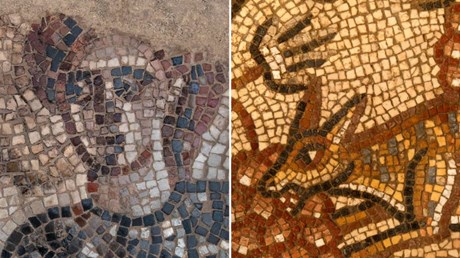
The earliest known depiction of biblical heroines Jael and Deborah was discovered at an ancient synagogue in Israel, the University of North Carolina at Chapel Hill announced last week. A rendering of one figure driving a stake through the head of a military general was the initial clue that led the team to identify the figures, according to project director Jodi Magness.

“This is extremely rare,” Magness, an archaeologist and religion professor at UNC-Chapel Hill, told Religion News Service. “I don’t know of any other ancient depictions of these heroines.”

The nearly 1,600-year-old mosaics were uncovered by a team of students and specialists as part of The Huqoq Excavation Project, which resumed its 10th season of excavations this summer at a synagogue in the ancient Jewish village of Huqoq in Lower Galilee. Mosaics were first discovered at the site in 2012, and Magness said the synagogue, which dates to the late fourth or early fifth century, is “unusually large and richly decorated.” In addition to its extensive, relatively well-preserved mosaics, the site is adorned with wall paintings and carved architecture.

The fourth chapter of the Book of Judges tells the story of Deborah, a judge and prophet who conquered the Canaanite army alongside Israelite general Barak. After the victory, the passage says, the Canaanite commander Sisera fled to the tent of Jael, where she drove a tent peg into his temple and killed him.

The newly discovered mosaic panels depicting the heroines are made of local cut stone from Galilee and were found on the floor on the south end of the synagogue’s west aisle. The mosaic is divided into three sections, one with Deborah seated under a palm tree looking ...

Continue reading...


from Christianity Today Magazine https://ift.tt/Evh0Qbx

My Husband Died Suddenly in the Wilderness

As his widow, I live with grief everyday. But I also live in the Good Shepherd’s grip.

One early morning on our family vacation, my husband, Rob, left our campsite for a long hike in the backcountry of Mount Rainier National Park. He and his hiking partner set out on the trail excited and energized for the path ahead. Both loved hiking and knew how to do it well.

Being in the outdoors was Rob’s favorite way to recreate and connect with God. But his cold and lifeless body returned to the trailhead late that afternoon, airlifted by a helicopter out of the wilderness. That day, marked on the calendar as a highlight of our family trip, became the most sorrowful of our lives.

In a moment, my world changed forever. I am still dumbfounded at the swiftness of death’s destructive work. Rob’s passing ushered me into a harsh and lonely landscape of loss. His sudden, tragic passing erased my plans for the future and set my feet at the trailhead of a new, unwanted path.

For the rest of my days, I will walk with grief. I will travel down a trail nobody wants to take.

I never knew deep grief until I lost Rob. I had suffered other losses but none that broke me so profoundly, none that rearranged the entire order of my life. I will admit, from the very beginning, I have been a reluctant traveler on this new path of sorrow.

Left with four children to raise alone, there is not a moment I do not long for the life I lived before. Rob and I enjoyed 17 imperfectly wonderful years of marriage. Our life together was deeply satisfying. We shared the same passions and dreams. He loved me with all his heart, and I adored him.

As Sorrow and Suffering have beckoned me forward on this grief journey, like Much-Afraid in Hannah Hurnard’s classic book Hinds’ Feet on High Places, I have cried ...

Continue reading...


from Christianity Today Magazine https://ift.tt/pQhsMWR

Wednesday, 13 July 2022

The Pro-Life Conviction of the Hodge Brothers

Experiencing death led Hugh and Charles Hodge to fight for the unborn, using science and systematic theology.

This article is the final of a four-part series based on the upcoming book by Marvin Olasky and Leah Savas, The Story of Abortion in America: A Street-Level History, 1652–2022.

When two young boys in a family learn that their three older brothers and their father have died of yellow fever, how does that affect their thinking about life and death? In the Hodge family two centuries ago, that consciousness led one brother to become the 19th century’s pioneering pro-life doctor and the other to become a pro-creation theologian who wrote three volumes of systematic theology still read in seminaries today.

The older of the two survivors, Hugh Hodge, graduated from Princeton and the University of Pennsylvania School of Medicine to became ship surgeon on a voyage to India. There, during a deadly cholera epidemic, he saw the Hindu “burning of a widow with her dead husband” atop a funeral pyre. She did not resist when the fire was lit, and he hoped she suffocated from smoke before feeling the flames.

Hodge almost died when the ship nearly sank on the way back to America. For most of the 1820s, Hodge served as doctor of the Philadelphia Almshouse Hospital in the poorest part of the city, where sometimes all went well and other times typhus raged: “Few escaped the poison. … The mortality in the house was great.” Hodge again almost died, but then recovered, joined a Presbyterian church, married, and had seven children.

In the 1830s, Hodge became professor of obstetrics and the diseases of women and children at the University of Pennsylvania. Each fall, Hodge presented an introductory lecture on obstetrics, but he did not speak about abortion until three deaths made him face that misery.

The first ...

Continue reading...


from Christianity Today Magazine https://ift.tt/OSobeJj