Monday, 9 January 2023

Church Attendance Dropped Among Young People, Singles, Liberals

Overall, most churchgoers—including most white evangelicals—returned to the pews after the pandemic, survey finds.
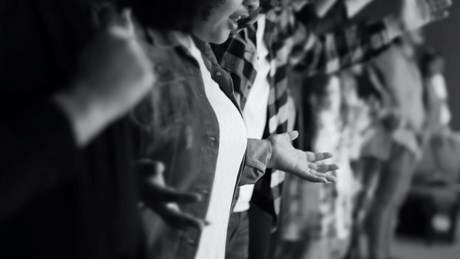
Despite the short-term upheaval COVID-19 caused among American churches, the pandemic’s long-term effect on worship attendance patterns was minimal, according to a study released Thursday by researchers at the American Enterprise Institute (AEI) and the University of Chicago. The biggest exception to that trend occurred among young adults, whose church attendance took a major hit.

“Rather than completely upending established patterns, the pandemic accelerated ongoing trends in religious change,” wrote study authors Lindsay Witt-Swanson, Jennifer Benz, and Daniel Cox.

“Young people, those who are single, and self-identified liberals ceased attending religious services at all at much higher rates than other Americans did. Even before the pandemic, these groups were experiencing the most dramatic declines in religious membership, practice, and identity.”

Two-thirds (68%) of Americans reported the same level of church attendance both before and after the COVID-19 pandemic. Yet pandemic-accelerated declines among some groups left US church attendance down overall.

Before the pandemic, 75 percent of Americans reported attending religious services at least monthly. By spring 2022, that figure dropped to 68 percent attending at least monthly.

Those findings were drawn from the 2022 American Religious Benchmark Survey, which polled 9,425 Americans by phone and online between February and April 2022. To help researchers focus on pandemic-driven changes, the study included only individuals who had registered their religious affiliations and church attendance patterns in a previous survey between 2018 and March 2020.

Young adults (ages 18–29) reported the greatest change in religious attendance following ...

Continue reading...


from Christianity Today Magazine https://ift.tt/YhJzpsc

Saturday, 7 January 2023

Christmas Epiphanies from the Ruins of Ukraine

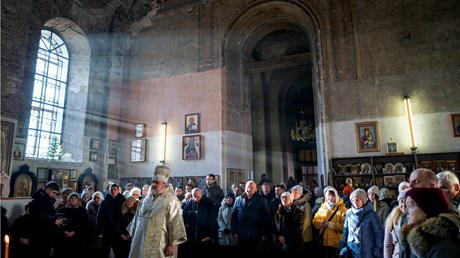
As Putin professes a ceasefire over the Orthodox holiday and a famous Kyiv monastery cathedral changes hands, evangelical seminarians relate the toll of ten months of war.

In advance of Putin’s unilateral declaration of a three-day truce over Orthodox Christmas today, Ukrainian seminary leaders shared their reflections on the impact of ten months of unabated conflict.

“War is exhausting—but this exhaustion does not happen overnight,” wrote Roman Soloviy, director of the Eastern European Institute of Theology. “Nevertheless, our mission continues.”

Reviewing his own emotional response since Russia invaded Ukraine on February 24, Soloviy cited the impossible choices forced upon his nation: Save your family or your neighbors? Flee the country or stay and help?

He could not read, listen to music, or watch movies for many months.

The stress only surged as reports proliferated about atrocities, complicated by the frustration that Ukrainian churches could not help everyone. Decisions needed to be made in darkness, while seeking to balance one’s own psychological health.

A Kherson seminary, Tavriski Christian Institute (TCI), was occupied by Russian forces in March and liberated in November. President Valentyn Siniy recounted the grim chronology:

January: Talks about the war. Doubts about invasion.
February: Team. Responsibility. Daily Zoom calls to pray.
March: Massacre. Inhumanity. Generosity: flour, sugar, potatoes, seeds.
April–May: Russians want to reconcile, without repentance. Families separated.
June–July: Marriages. Fragility of life. Losses. Divorces.
August: TCI shelled. Books trashed. Valuables looted. Vandalism.
September: New location. Big enrollment.
October: Infrastructure destroyed. Nation freezing. Unity. Mutual assistance.
November: Liberation. Joy. First trip home. Ruined city.

For his December entry, Siniy wrote: “Christmas ...

Continue reading...


from Christianity Today Magazine https://ift.tt/iPSKcAB

Friday, 6 January 2023

How to Read Yourself Into Genesis

You’re part of the story of this dysfunctional family. And that’s a good thing!

My wife ’s college roommate would sometimes tell people, “I’m a descendant of George Washington!” It was an interesting way to start a conversation at a party, but more than that, I think, she was claiming a connection to the founding father as a way of writing herself into the history of America. Her story was America’s story, through this somewhat dubious lineage.

We do something similar when we read Genesis. The best way to read the first book of the Bible, with its sprawling story of a dysfunctional family, is to read ourselves into the text. We need to find ways to find ourselves as part of the narrative.

It is natural for most of us to feel a strangeness, reading Genesis, because we come to this story as outsiders who have been invited in. We are, as the apostle Paul said, grafted in through Jesus (Rom. 11:17–24). We have been adopted into this narrative about God’s family, and become children of Abraham, so that “in you all the families of the earth shall be blessed” (Gen. 12:3, ESV).

If you’re reading it for the first time, or the first time in a while, you’ll see pretty quickly that the story of Abraham is a story of profound family dysfunction. We find our place in the narrative easily, because that family is so fractured. But then it is also the story about a promise of restoration—a story where we can be re-storied, re-narrated, restored. That’s the power and promise of Genesis.

But as we read, we really have to prepare for the dysfunction. Consider perhaps the most upsetting bit of parenting in Genesis: when Abraham attempts to sacrifice his son Isaac. If the parent of one of your child ’s friends confided in you, “God is telling ...

Continue reading...


from Christianity Today Magazine https://ift.tt/Lwqd4HY

Why Are There So Many Angry Theologians?

Theology should produce the fruit of the Spirit, not the works of the flesh.

What is the matter with theology today? Far from being described by the string of virtues that make up the fruit of the Spirit, much of what is labeled “theology” is insecurity and fury disguised as dialogue or thoughtfulness. Even the most cursory scrolling of social media could lead you to the conclusion that you must be angry in order to do theology. In our day, it is not uncommon to see theology used as a weapon and not as a well of joy.

Maybe you’ve seen theology weaponized as an instrument of division. In this malpractice of theology, Christian truth is used to pit brothers and sisters against one another. Points of doctrine become the boundary lines in which an “us versus them” war plays out. And while there are indeed good and right times to draw lines in the sand, there are also those whose theological boundaries are so ever-shrinking that only they and a handful of their followers are seen as those who possess the truth.

Discord arises as theology is used to break unity with those fellow image bearers with whom we ought to be marching arm in arm toward the Promised Land.

Maybe you’ve seen theology weaponized as an instrument of pride. In this malpractice of theology, the accumulation of knowledge amounts to ever-inflating egos and the search for truth is but a grasp for self-importance. When the streams of arrogance flow from the source of ill-used theology, the goal becomes the applause of our neighbors instead of the good of our neighbors.

Instead of bending our intellectual life toward the pursuit of others, we bend others toward the observation of our intellectual capabilities in hopes of praise that ought to be rendered unto the Lord. In this way, theology can become a show; ...

Continue reading...


from Christianity Today Magazine https://ift.tt/ADXO8Hh

Thursday, 5 January 2023

For Norwegians So Loved the Bible, a New Translation Made Many Mad

Revision of John 3:16, John 1:14, Romans 1:1 and other texts prompt controversy in the largely secular Scandinavian country.

In a country where only 2 percent of the population regularly attend church, one doesn’t expect to find a national debate about the correct translation of John 3:16. And yet, across Norway, news that a forthcoming Bible translation will replace gå fortapt (get lost) with gå til grunne (perish) has roused strong feelings.

“Why change something that is completely understandable?” said one woman in Alta, a town on a fjord on the northern coast.

“Such judgment day and sulphur speeches do not belong in a modern, inclusive church—at least not during funerals,” said an Oslo woman on Facebook. “It adds stones to the burden for relatives.”

But the editors of the forthcoming Bible—commissioned by the Norwegian Bible Society and scheduled for publication in 2024—say they are not surprised. Receiving criticism is part of the process.

“It’s always a controversial thing to translate the Bible,” said Jorunn Økland, a biblical and gender studies scholar on the editorial team. “Whatever you do, it’s going to be controversial.”

The Bible was first translated into Norwegian in the 13th century, when it was published in parallel editions with the then-more-dominant Danish. The first full translation was not released until 1858. And yet, just as with English and German Bibles, the words of Scripture became part of the poetry of the language, a storehouse of images, widely seen as a cultural inheritance. Even those who identify as secular can feel protective of the words of the Bible.

“It still provides many of the symbols and metaphors that create meaning,” said Jenna Coughlin, a professor of Norwegian at St. Olaf College ...

Continue reading...


from Christianity Today Magazine https://ift.tt/DdYTGXk

Interview: The Relatable Zeal of Puritan Women

They were extremely into religion without being extreme.

Having grown up in a non-Christian home, Jenny-Lyn de Klerk didn’t discover theology until college. At first, she struggled to understand theological concepts, but everything started making sense after she encountered the Puritan writer John Owen. Her subsequent research on Puritan spirituality helped pave the way for a new book—5 Puritan Women: Portraits of Faith and Love. Author Catherine Parks, an editor with Moody Publishers, spoke with de Klerk about what believers today can learn from these women.

When people learned you were writing a book about Puritan women, what were some of their reactions?

Most fell into two categories: Either people had no idea who I was talking about, or they expressed negative stereotypes about the Puritans. At least on a popular level, people still view the Puritans as fun-killers—and Puritan women as extremely patriarchal. I’m hoping my book can move readers past such stereotypes by helping them get to know a range of real individuals.

Some suggest that the poet Anne Bradstreet departed from Puritan ideals because she wrote about things like intimate love with her husband. How would you respond?

There are all sorts of crazy interpretations of Bradstreet out there. To understand her place within the Puritan movement, we need to start with an accurate definition of Puritanism and then see who fits.

Puritans, for starters, wanted to bring further reform to the Church of England. Though some ministers sought change from within while others felt compelled to leave, they all wanted to go further in replacing certain vestiges of Roman Catholicism with biblical worship practices. And secondly, they emphasized a personal communion with God—a genuine, vibrant relationship ...

Continue reading...


from Christianity Today Magazine https://ift.tt/L8y4Two

Wednesday, 4 January 2023

Christian Boomers Like Me Want Change Too

Some of us are working to change the unhealthy evangelical church culture we helped create.

In the last couple of decades, American Christian boomers (myself included) have been given an advance peek at the kind of obituary the church and the world has already begun to write about us.

Countless think pieces, podcasts, and online conversations have issued well-founded concerns and questions about the failures, flaws, and foolishness of evangelical church culture. These critiques are a magnifying mirror for baby boomers, since most of them speak directly to church cultures we helped create and support.

Not all these critiques are made in good faith—whether they’re from political scientists, sociologists, op-ed writers, exvangelicals, or from the generations born before and after us—but a surprising majority of them are.

For example, CT’s Rise and Fall of Mars Hill podcast details the leadership failure and organizational implosion of the church franchise led by Mark Driscoll. And while Driscoll himself was a Gen X pastor, Mars Hill was nourished in the soil cultivated by boomer megachurch leader culture.

Beyond the cavalcade of prodigal leaders exposed with predictable regularity for their abuses of power, boomer Evangelicalism has often been characterized in the broader culture by who and what we oppose, instead of whom we claim to serve.

As a result, our kids and grandkids are vacating the churches we built and inhabited with the goal of passing on our faith to the next generation. But they’re not the only ones leaving.

In my ownwriting over the past decade about spiritual formation in midlife and beyond, I’ve heard from hundreds of people my age who have been wounded by the very faith systems our generation created. Some boomers were chased away, while others quietly drifted out the ...

Continue reading...


from Christianity Today Magazine https://ift.tt/eQnG3vx