Friday, 10 March 2023

How to Preach to Sleeping People

Sometimes there is more to the story than just a bored listener.

I think his record was 15 minutes.

Usually, he was out in under 10 minutes. Brother Leroy (not his real name) just couldn’t seem to stay awake during the sermon. And he wasn’t a quiet sleeper. On occasion, he would snore, but most of the time he would throw his head back, mouth agape, and drift into a sleep so deep I’m not sure he’d have heard Gabriel’s trumpet.

After the service, I would stand in the back. Brother Leroy would nod and tell me, “Good sermon, pastor.”

I’ll be honest and tell you that as a young pastor, I was deeply offended by this guy. If most of the congregation was falling asleep, I might have concluded I was the problem. But there were many others truly engaged. This one was on Leroy.

I concluded that Leroy was an unspiritual man who had zero taste for the preaching of the Word of God. Christians value God’s Word. How could you fall asleep when someone is passionately sharing the gospel?

Are you bored with Jesus, brother Leroy? Why even bother coming to church? What are you getting out of this little charade?

Compassion for sleepy congregants

Then I had a conversation with brother Leroy. He told me, “I really do appreciate your sermons, young man.” Then he kind of chuckled and said, “Well at least the parts I stay awake for. I’m really sorry if you’ve ever noticed me nodding asleep …”

(Oh, I’ve noticed Leroy. How could I not?!?!?)

“I’m on this darn medicine I have to take in the morning, and I just cannot stay awake. I try, but the medicine seems to win every time.”

Being young and foolish at the time, I probably concluded that Leroy was just making an excuse for his sleeping. But over the years ...

Continue reading...


from Christianity Today Magazine https://ift.tt/FXQrWPZ

Thursday, 9 March 2023

Why Broken Friendships Hurt

For believers, both old and new relationships carry an eternal weight and value.

This piece was adapted from Russell Moore’s newsletter. Subscribe here.

As I headed off to California for the installation of my old friend Matthew J. Hall as provost of Biola University, I commented to my wife, Maria, “I wonder what the most-repeated sentence I’ve ever said to or heard from Matt Hall would be.” And what we landed on was “Well, that was crazy.”

Mark and I have had many opportunities to say that to each other since we first met—back when he was a call screener for a talk-radio show I sometimes guest hosted. His job was to filter out the people who wanted to make a relevant comment from those outraged after I said something positive about, say, Willie Nelson or Harry Potter. (Those were simpler times, reader.) And in the years since, we have often looked at each other whenever some explosive debate on the floor of our denomination was gaveled out of order and said, “Well , that was crazy.”

For 20 years, I’ve been able to laugh with Matt about some display of craziness or another—and I can always count on him to know what qualifies as “crazy.” In the two days I visited with him recently, I found myself laughing at stories we would tell and retell, with lots of sentences starting with “Remember when … ?”

In the past, I might have considered memories of such moments as “nostalgia,” but now I see them as a grace. And I no longer take them for granted.

New friendships are often made from stories. Whenever you meet someone new, that person may ask you, “So what’s your story?” Even when it’s not directly said, it’s an unspoken question. We tell pieces of our life stories to each other ...

Continue reading...


from Christianity Today Magazine https://ift.tt/9kh2Em5

‘Women Talking’ Focuses on Survivors, Not Abusers

The Academy–nominated film started a conversation that the church can learn from.

Earlier this year, CT reported on the sexual abuse and spiritual manipulation of Jean Vanier, who violated at least 25 adult women without disabilities over nearly a 70-year period, and did so “during prayer and spiritual devotion.”

A few weeks ago, Hohn Cho came forward about how elders at Grace Community Church mishandled treatment of women who were abused by their husbands. These names and institutions have been circulated among evangelical communities, among a list of other abusers that have been accused over the past several years.

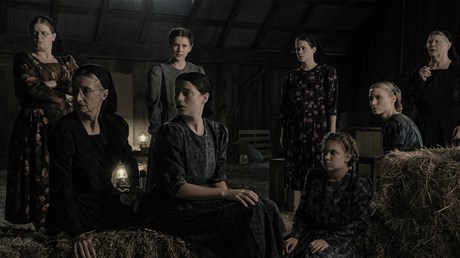
In some accounts of sexual abuse cases, the story presented to the world is about the abuser rather than the act of courage it took for the survivor to step forward—sometimes for the sake of the survivor’s privacy and safety. But that’s not the case when it comes to the recent film Women Talking, written and directed by Sarah Polley (spoilers ahead).

Polley’s film centers on a group of eight women in a religious community left in the wake of sexual violence. The film is adapted from a book with the same title released in 2018 by Miriam Toews. In the book, the author imagines what could have taken place during an egregious yet true event that happened in a Bolivian Mennonite colony back in 2009—in which over a hundred women and girls, including children as young as five years old, were drugged with animal tranquilizers and systematically raped by men in the colony.

Throughout the film, the focus stays on the women who were abused. The stylistic choices of the film are sensitive to the topics at hand and aim to keep the survivors’ stories, dignity, and emotions at the center of the narrative. According to Polley, “We never showed the assaults. ...

Continue reading...


from Christianity Today Magazine https://ift.tt/YFOoVmP

Wednesday, 8 March 2023

4 Incredible Christian Women Who Changed India

How a social reformer, a lawyer, a doctor, and a peacemaker changed the subcontinent.

Women in India have endured often harsh and cruel lives in a society which has long favored boys to girls, sanctioned child marriage, and practiced a dowry system. The government and culture have limited their access to education, employment, and escape from (domestic) violence. What they have accomplished has at times been overlooked or credited to others.

In many instances, Christian women have confronted additional challenges. Christian converts have faced significant persecution from the communities they’ve left, and those raised in families who switched faiths a generation or two prior still endure generational pain and trauma related to these hardships.

Nevertheless, numerous Indian Christian women have responded to their circumstances with a strong sense of justice and compassion for others suffering oppression. They have made notable contributions to child rights, social justice, the freedom struggle, nation building, and women’s empowerment. Here are four Indian Christian women whose lives of service, ambition, and compassion offer the church imperfect but remarkable role models.

The Social Reformer: Pandita Ramabai Sarasvati (1858–1922)

“People must not only hear about the kingdom of God, but must see it in actual operation, on a small scale perhaps and in imperfect form, but a real demonstration nevertheless.”

Pandita Ramabai Sarasvati devoted her life to empowering women and promoting gender equality in 19th-century British-ruled India, a society where patriarchy was deeply entrenched. Although politicians and activists have routinely applauded her relentless efforts to serve the marginalized, they often overlook her Christian faith, which served as the foundation for her life and work. ...

Continue reading...


from Christianity Today Magazine https://ift.tt/RwKnmWL

Hispanic Leaders Don’t Want to Miss This Missional Moment

The Latino population boom has resulted in more passionate, growing churches in the US. Can pastors keep building on the momentum?

For years, Hispanic pastors in the United States have watched their flocks grow in faith and number. This year, a long-awaited survey confirmed it nationally.

Lifeway Research’s first Hispanic church study, said to be the most comprehensive of its kind, offered leaders lots of reasons to celebrate: pastors who remain committed to Scripture and evangelism, churches that are thriving and drawing in young worshipers.

While Christianity overall ages and declines in the US, Hispanic believers are countering the trends, and leaders are hopeful for the future, as immigration from Mexico and Latin America continues.

“For a long time, the Hispanic Latino church has been invisible to many in the United States and its growth has not received the necessary attention, considering it is the fastest-growing evangelical group in the United States,” said Gabriel Salguero, president and founder of National Latino Evangelical Coalition (NaLEC).

“The church has been navigating the reality of the Latino demographic boom. One in four children born in the US are Latino. There are over 60 million Latinos in the country,” he said. “It is important for the church in the United States to pay attention to one of the fastest-growing groups, to notice the missional force that Hispanics represent.”

The Lifeway survey was sponsored by the Billy Graham Evangelistic Association (BGEA) and Samaritan’s Purse and conducted in partnership “with two dozen denominations and church networks” including Salguero’s.

Leaders were quick to note commitment to Scripture as a key reason for Hispanic churches’ success. In the survey of nearly 700 pastors of majority Hispanic congregations across denominations, ...

Continue reading...


from Christianity Today Magazine https://ift.tt/O7n1LUY

Tuesday, 7 March 2023

The Bible’s Marriage Metaphor Doesn’t Belong In the Bedroom

We can rightly look to God as husband and God as Father without making male sexuality divine.

Last week, my students and I were looking at ways to interpret difficult texts in Paul in class when a storm broke out online around the theology of the marriage metaphor.

In Twitter threads and Substack posts, Christian voices offered their discerning views around pastor Joshua Ryan Butler’s metaphorical reading of Ephesians 5 published on The Gospel Coalition website. Butler’s piece, an excerpt from an upcoming book on sex, generated enough critical feedback that the article was removed.

The recent discussion, though, underscores a perpetual question for us as Christians: How can we discern the Bible and Christian tradition faithfully? What should be our key?

As Christians, we point to the triune God as the fount of all love, and one way that Scripture invites us to consider God and love is through the metaphorical language of marriage. In Ephesians 5, Paul describes marriage, a union both social and physical, as a great mystery (v. 32), and he draws out practical lessons of self-sacrifice for wives (vv. 21–24, 33) and husbands (vv. 21, 25, 28–29, 33). Woven throughout these teachings on marriage are beautiful statements about Christ and the church.

Our interpretation of these statements must be anchored in the biblical text itself. Before describing him as a husband, Paul uses imagery in Ephesians 5 to reveal the Lord’s sovereignty. Although he has just given his incarnate name, Jesus, Paul refers to the Son of God as Christ and Lord. Jesus Christ is the Messiah, the one who reigns over God’s kingdom, and the Lord, the sovereign over the universe. He is also the Savior of the body (v. 23).

Christ exercises his sovereign lordship through acts of self-giving service and love, as in John 13 ...

Continue reading...


from Christianity Today Magazine https://ift.tt/0zlqou3

To Whom Shall We Go? Global South Anglicans Reject Canterbury’s Leadership

Conservative Anglicans’ gathering in April comes after the Church of England’s “disqualifying” decision to bless same-sex marriages.

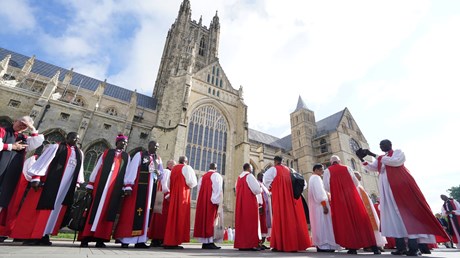
When conservative Anglicans from around the world gather next month in Rwanda, they could begin to explore a new framework of leadership in response to the Church of England’s recent move to let its clergy bless same-sex marriages.

The decision around the blessings, a compromise made at the Church of England’s General Synod in February, provoked bishops representing a majority of the world’s Anglicans to threaten a break with the mother church of their communion.

“The Church of England has departed from the historic faith passed down from the Apostles” and “disqualified herself from leading the [worldwide Anglican] Communion as the historic ‘Mother’ Church,” according to a statement endorsed by 12 archbishops aligned with the Global South Fellowship of Anglican Churches (GSFA).

The bishops represent Anglicans in Africa, Asia, and Latin America. One member of the group, archbishop Foley Beach, represents conservative Anglicans in North America who have broken with the more liberal Episcopal Church.

“As much as the GSFA Primates also want to keep the unity of the visible Church and the fabric of the Anglican Communion, our calling to be ‘a holy remnant’ does not allow us [to] be ‘in communion’ with those provinces that have departed from the historic faith and taken the path of false teaching,” the GSFA stated, a reference to endorsement of same-sex marriage, among other issues.

The Church of England still won’t perform same-sex ceremonies and maintains that marriage is a lifelong union between one man and one woman, but it has now opted to allow clergy to offer prayers and liturgies at civil marriages. At last month’s synod, the ...

Continue reading...


from Christianity Today Magazine https://ift.tt/jhPDrpn