Tuesday, 9 May 2023

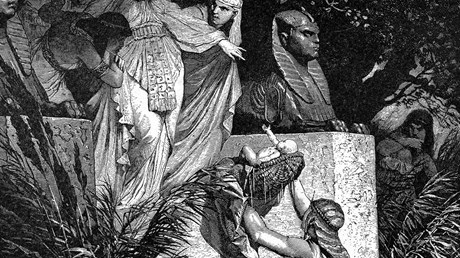
Moses Was Bicultural Like Me

God chose a Hebrew raised as an Egyptian to lead his people out of slavery.
I was six when I found out my sister and I didn’t have the same father. I was six when I realized that someone could be married more than once. I was six when I started asking questions about how families are made and how they fall apart.

I stood at the edge of our narrow kitchen, hours after I’d gone to bed. We’d been woken by earthquakes often since moving there, but this time only familiar voices were shaking.

All I heard clearly was my sister, Cathy, saying, “I’m going to move back to the States to live with my dad.”

To this day, I struggle to remember the weeks after that night. I don’t know what I said to my sister or what my sister or my parents explained to me the next morning. I remember what Cathy wore at the airport when she left: a black and white herringbone coat that went to her ankles.

I watched her leave, and with barely an ounce of understanding about what was happening or why, I believed it was all my fault.

When we returned home, I went straight to Cathy’s teenage room. In the past, she hadn’t allowed me inside. But that day, in the aftermath of losing her, I sat there for hours looking for clues. I read through her school notebooks and studied her handwriting, gripping everything in my lap as if someone or something might come at any moment to snatch it all away.

After that, much of my childhood was spent alone, playing with dolls in the basement playroom.

Weather permitting, my mom sometimes let me wander around the neighborhood on foot or by bicycle. For such a big city, Tokyo is safe. I wandered on busy sidewalks and empty streets, always alone, always on the outside looking in. I grew familiar with the view from the other side of the glass.

Those four ...

Continue reading...


from Christianity Today Magazine https://ift.tt/Qqrf4DT

Estonia Seminary Unites War-Weary Russians and Ukrainians in Christ

Baltic Methodist Seminary offers a rare safe space to Slavic foes.

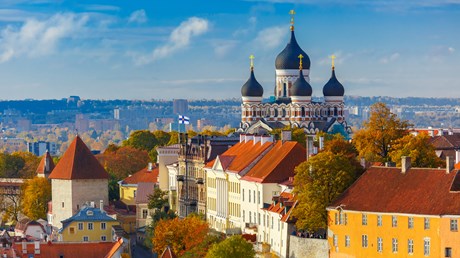
Since Russia’s invasion of Ukraine last year, few European institutions have welcomed both Slavic foes. A rare example is found right on the border, in a nation that wonders if it might be next.

Estonia, the northernmost of three small former Soviet republics on the Baltic Sea, immediately rallied in support of Ukraine. Given that Russia’s aggression began on February 24—coinciding with Estonia’s date of independence, first proclaimed in 1918—some wondered if it was a deliberate message.

The initial blitzkrieg toward Kyiv reminded Estonians of the Soviet occupation of the 1940s. Politicians donned blue and yellow ribbons; military brass sent weapons and aid. Citizens, including the 1 in 4 with Russian ethnicity, reacted to the atrocities in horror.

But as many universities closed their doors to students from Russia and allied Belarus, one evangelical institution bucked the trend. Baltic Methodist Theological Seminary (BMTS)—fully united with the national stance condemning the war—insisted instead on the unity of Christ.

“We did not hang a Ukrainian flag, but held a joint prayer of lament,” said Külli Tõniste, BMTS president. “Preservation of community is more important than an outward show of patriotism.”

Founded in 1994 and accredited by the state, the Methodist seminary hosts students from neighboring Latvia, nearby Finland, the United States, Israel, Nigeria, and Ghana. But it was the caldron of Russians, Belarusians, and Ukrainians—43 percent of the student body—that could have proved to be a tinderbox.

Yet sensing confusion and insecurity among many, Tõniste—an Asbury Theological Seminary alumna with a PhD from the London ...

Continue reading...


from Christianity Today Magazine https://ift.tt/VKjTLA1

Monday, 8 May 2023

Western Classics Exclude Me. But Christ Can Redeem Them

As an Asian American, God's great story helps me value literature that often leaves me out.

Last year, I began reading Herman Melville’s Moby Dick. At first, I was swept away by Ishmael’s beautiful descriptions of his passion for the sea. But I grew increasingly uncomfortable in chapter two, when Ishmael accidentally stumbles into a Black, presumably Christian, worship service.

He shockingly describes the gathering as a “great Black Parliament sitting in Tophet” (another name for hell) and the preacher as “a black Angel of Doom.” In the next chapter, we meet the Native American character Queequeg, whose first words are “Who-e debel you? … you no speak-e, dam-me, I kill-e,” before he is promptly labeled as a cannibal.

What do we do with racist passages in classic books like this—especially as readers of color?

As a lifelong lover of books, I heartily applaud that many Christians seem to have a vested interest in preserving and championing classic Western literature.

In On Reading Well and various articles, Karen Swallow Prior writes about how good books can help cultivate our virtues. Similarly, Jessica Hooten Wilson has said that books help us to be holier. They can sharpen our worldview and help us develop empathy. Reading good books can, as Philip Ryken writes, sanctify our imaginations and nourish our love for beauty; it can even help us be more effective teachers, preachers, and leaders.

As a nonwhite Christian, however, I find that most discussions of reading classic Western literature today either fail to acknowledge or only tangentially mention two difficult truths.

First, even if a book is not overtly racist, readers of color must inevitably reckon with the hostility, condescension, and suspicion toward people of other races that permeated the historic ...

Continue reading...


from Christianity Today Magazine https://ift.tt/WV587Dt

Ron DeSantis’s Campaign Christianity

Can the creator of “God Made a Fighter” political ads woo evangelicals from Trump?

Will they, or won’t they? The question of white evangelical voters’ support for former president Donald Trump isn’t over yet.

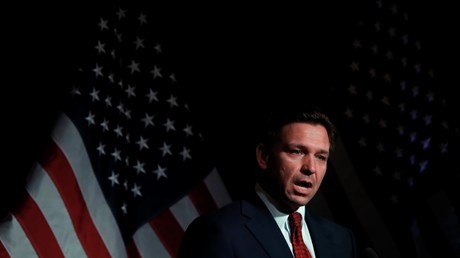
As Florida governor Ron DeSantis seems to be preparing to formally enter the Republican presidential primary for 2024, it could launch a notorious new season, set in sunny Florida and shaped by a buzzy subplot about Christian nationalism, which DeSantis and Trump alike have been accused of propagating.

Trump’s use of Christianity as a political prop is by now well known. Though demonstrably unfamiliar with basic aspects of the faith, the former president gamely toted his Christianity around on the campaign trail and in office. (Sometimes he literally toted it, as when he held up the Bible in front of a church sign for a photoshoot.) In 2016 and 2020, Trump hit his marks, visiting Christian colleges, conferences, and churches, and this year, he’s been eager to remind Christian voters—particularly evangelicals—how well that played with many of them before.

But compared to 2020, when Trump ran functionally unopposed for the GOP nod, in 2024 he’ll have competition. DeSantis, widely expected to be Trump’s most formidable primary opponent, is an especially interesting example here, as his campaign use of Christianity is more knowledgeable and sophisticated than Trump’s has tended to be. Will evangelicals see him as one of our own?

A practicing Catholic, DeSantis has a facility with biblical references Trump could never quite master, and he fits comfortably in evangelical culture in a way Trump does not. He’s a throwback to pre-Trump Republican appeals to white evangelicals as a voting bloc, in which candidates often ...

Continue reading...


from Christianity Today Magazine https://ift.tt/56UwklJ

Christian Faith Was Jackie Robinson’s Haven in a Heartless World

A new biography offers an intimate account of his spiritual life, on and off the baseball field.

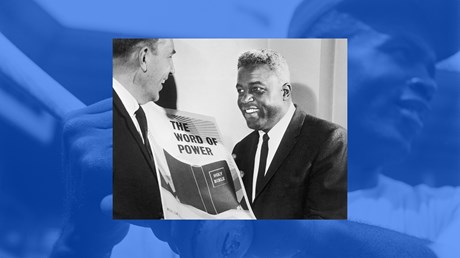
Jackie Robinson, the first African American to play in the modern era of Major League Baseball (MLB), is undoubtedly one of the most significant cultural figures in the history of professional sports. Fittingly, his remarkable life has inspired a number of excellent books aimed at diverse audiences.

The starting point for reading about Robinson ought to be his fantastic memoir, I Never Had It Made, published in 1972 just days after his sudden death at age 53. In it, Robinson details the extraordinary challenges he faced as an agent of integration. And it offers equally keen insights into the man himself, particularly his life after baseball as he tried to balance family, business, and civil rights activism on his own terms.

Relying heavily on the letters of Robinson’s wife, Rachel, Arnold Rampersad’s 1997 Jackie Robinson: A Biography offers more nuanced details on Robinson’s upbringing in Southern California and his often-strained family life. The year before Robinson’s death, his son Jackie Robinson Jr. died in a car accident after struggling for years to overcome substance abuse issues related to war wounds suffered in Vietnam in 1965. Rampersad’s account of Robinson’s life is also a work of genuine literary merit crafted by one of the best biographers of the late-20th century.

Several excellent children’s books, too, have been written about the pioneering baseball star. Most impressively, Frank J. Berrios and Betsy Bauer’s My Little Golden Book about Jackie Robinson explains Robinson’s significance in an understandable and age-appropriate manner for young readers.

More recently, Kostya Kennedy’s True: The Four Seasons of Jackie Robinson (2022) delves into the transformative ...

Continue reading...


from Christianity Today Magazine https://ift.tt/G91pLRO

New Resource Helps Kids ‘Grow Into’ Hymns

Children’s minister and artist collect 150 songs to span generations.

In 2018, Britta Wallbaum and Lindsey Goetz traveled to a worship conference in Nashville. They hoped to come away with new resources to engage children in musical worship at their Presbyterian church in Aurora, Illinois. As they browsed merchandise for leaders displayed in the rows of vendor booths, neither could find the item they had hoped for: a hymnal for children.

“There were zero resources to share with kids,” said Wallbaum. “There were songbooks [for children] with sheet music but no ways to actually engage kids with them.”

The two friends wandered the exhibit hall separately, not knowing that the other was looking for the same thing. When they realized their common goal, it seemed like a divine appointment. They decided to make the resource they wanted for their church and for their own children.

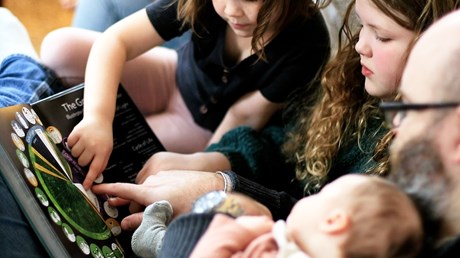
The Gospel Story Hymnal is the product of years of writing, illustration, and curation by Wallbaum and Goetz, who formed Word & Wonder to provide resources for worshipers of all ages, including children.

Crowdfunded by a Kickstarter campaign, the hymnal is a collection of 150 hymns, including centuries-old mainstays like “A Mighty Fortress Is Our God” and “All Glory, Laud and Honor” and more recent works like Michael Card’s “Barocha.” It also contains a schedule that families can use to work through each hymn and the accompanying commentary over a three-year period.

There are five sections in the hymnal: “Creation,” “Rebellion,” “Redemption,” “Already, but Not Yet,” and “Restoration.” Wallbaum and Goetz wanted the hymns to help tell a broad, unified story.

“The Bible isn't a bunch of disconnected ...

Continue reading...


from Christianity Today Magazine https://ift.tt/DmMA18W

Friday, 5 May 2023

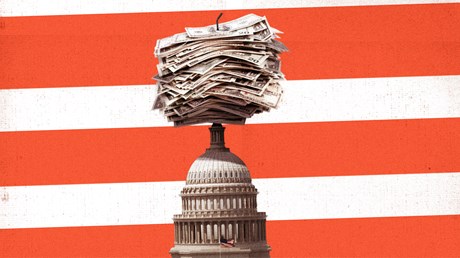
Can the United States Be ‘Forgiven Our Debts’?

Even if the debt ceiling resolves, we should consider future generations.

When my husband and I wanted to buy our first house in 2012, we ran into a problem: Neither of us had a credit history. We both came from families with a typical evangelical wariness of debt, and so we’d gotten all the way through college and marriage without a single loan payment between us. We’d earned scholarships and gone to cheaper schools, hosted a cookout for our wedding reception, and squirreled away cash to buy used cars.

“The borrower is slave to the lender” (Prov. 22:7), my mother had often warned. But declining to take on debt also made sense to me at a personal level. I have all the skepticism of complex financial systems you’d expect in someone who finished college during the Great Recession. I dislike the feeling of obligation and limitation debt can entail (Prov. 22:26–27). With a few exceptions like mortgages and some business loans, I associated accumulation of debt with poor stewardship and lack of self-discipline. Having no debt felt right and responsible.

Like many evangelicals, that attitude easily mapped onto my politics. The US national debt was around $15 trillion in 2012, one year after the debt ceiling drama of 2011. If you’d asked me then, I’d have described that debt just as ethicist David P. Gushee did for CT in 2014. It’s “immoral and unwise,” he argued, even citing my mom’s favorite debt proverb:

Certainly, the Bible regularly calls for generous lending and debt forgiveness. But when it speaks of borrowing, the Bible is negative, and not just when addressing individuals. Borrowing is emblematic of national weakness that invites subservience to creditors (Deut. 15:6; 28:12). Borrowing for short-term needs risks long-term decline ...

Continue reading...


from Christianity Today Magazine https://ift.tt/vCYSPw9