Tuesday, 2 October 2018

Indonesian Earthquake Kills 34 Kids in Bible Camp Mudslide

A rattled Christian community rallies to aid thousands in Sulawesi displaced by the disaster.
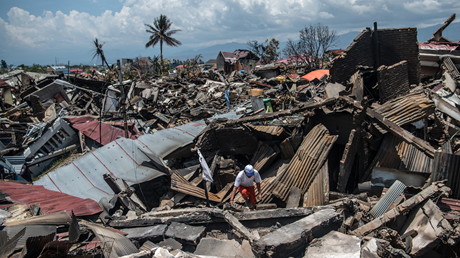
Days after a 7.5-magnitude earthquake leveled homes, businesses, mosques, and churches in the Indonesian province of Central Sulawesi, Christians are reeling from the destruction and casualties into the thousands—which now include dozens of youth killed at a Bible camp.

Under the rubble of one church destroyed in a mudslide, the Indonesian Red Cross this week discovered the bodies of 34 kids who were attending Pusdiklat GPID Patmos “Jono Oge,” a church training center in Sigi, located outside the provincial capital of Palu.

Another 52 students remain missing from the camp, which regularly hosts youth for worship, teaching, and fellowship. Recovery efforts have been slower in hard-to-reach areas, which lack the equipment to move fallen concrete or dig through the carnage. A Red Cross spokeswoman said she expects the number of dead at Jono Oge to rise as the recovery continues.

The center is affiliated with Palu’s largest denomination, the Indonesian Protestant Church in Donggala (GPID), with around 40,000 members. Last week, Palu teens posted shots on Instagram from Jono Oge, sharing favorite Bible verses and posing in front of a banner reading “From Darkness to Light.”

The quake, tsunami, mudslide, and aftershock have left the Protestant minority in Central Sulawesi—about 17 percent of the 2.6 million-person, mostly Muslim province—scrambling for basic necessities to survive while body bags pile along the streets and the smell of death lingers in the air.

On Tuesday, the official death toll reached more than 1,200, with another 800 injured, and both figures are rising. An estimated 50,000 people are displaced in Palu.

Church leaders who made it through the disaster have rallied to ...

Continue reading...


from Christianity Today Magazine https://ift.tt/2O3kQRb

Indonesian Earthquake Kills 34 Kids in Bible Camp Mudslide

A rattled Christian community rallies to aid thousands displaced by the disaster.

Days after a 7.5 magnitude earthquake leveled homes, businesses, and churches in the Indonesian province of Central Sulawesi, Christians are reeling from the destruction and casualties into the thousands—which now include dozens of youth killed at a Bible camp.

Under the rubble of one church destroyed in a mudslide, the Indonesian Red Cross this week discovered the bodies of 34 kids who were attending Pusdiklat GPID Patmos “Jono Oge,” a church training center in Sigi, located outside the provincial capital of Palu.

Another 52 students remain missing from the camp, which regularly hosts youth for worship, teaching, and fellowship. Recovery efforts have been slower in hard-to-reach areas, which lack to equipment or power to move fallen concrete or dig through the carnage. A Red Cross spokeswoman said she expects the number of dead at Jono Oge to rise as relief continues.

The center is affiliated with Palu’s largest denomination, the Indonesian Protestant Church in Donggala (GPID), with around 40,000 members. Last week, Palu teens posted shots on Instagram from Jono Oge, sharing favorite Bible verses and posing in front of a banner reading “From Darkness to Light.”

The quake, tsunami, mudslide, and aftershock have left the Protestant minority in Central Sulawesi—about 17 percent of the 2.6 million-person, mostly Muslim province—scrambling for basic necessities to survive while body bags pile along the streets and the smell of death lingers in the air.

On Tuesday, the official death toll reached more than 1,200, with another 800 injured, and both figures are rising. An estimated 50,000 people are displaced in Palu.

Church leaders who made it through the disaster have rallied to offer ...

Continue reading...


from Christianity Today Magazine https://ift.tt/2yc7lDB

Why I Wrote ‘Christians in an Age of Outrage’

I want to help Christians engage an outraged world with discernment and wisdom, seeing the world as the mission field to which God has called us.

Nearly a year ago this week I started writing a book.

In Fall 2017, it seemed like the world was on fire. Everywhere I looked, I saw anger—anger towards Christians, anger by Christians, anger by Christians towards Christians. People whom I respected as voices of patience and forbearance were being ignored or sucked into the hostility.

Everyone was intimately aware of how others were being angry towards them or their community, but shockingly ignorant of how they were displaying the same level of vitriol towards others.

What I realized as I was researching and writing was that this was a discipleship problem.

We are entering a new age—one defined by polarization and tribalism amplified by new technology and online platforms. As disorienting as this is for Christian leaders, this pales in comparison to those in the pew struggling to make sense of how to live, follow Christ, and witness.

Too often, sermons and small groups curriculum are leading Christians to engage a world that no longer exists. As a result, Christians can frequently be the greatest sources of outrage rather than its counter.

As I wrote, this became the central theme of the book. In the introduction to my new book, Christians in the Age of Outrage, I write,

This is a book about outrage. It’s an acknowledgment that our world, or at least our part of it, seems awash in anger, division, and hostility. Outrage is all around, so we have to decide how to walk through this. We are living in a day— and this is indeed our moment— when we need to live like Christ, as gospel Christians in the midst of shouting, anger, and hatred. And it’s going to get worse. To be sure, there is a lot in this world that is outrage inducing.Terrorism, sex ...

Continue reading...


from Christianity Today Magazine https://ift.tt/2NhZz0K

No Refuge: Persecuted Christians Entering US Dwindle to a Record Low

The country took in 100 times fewer Middle Eastern refugees than just two years ago.

Refugee resettlement hit a record low over the past year, with the United States taking in fewer than half the amount permitted under a reduced refugee ceiling of 45,000.

While the number of as displaced people and persecuted Christians continues to rise around the globe, US refugee figures have plunged under the Trump administration.

The 2018 totals—just 22,491 refugees in the fiscal year ending September 30—indicate a disturbing trend for advocates, following recent news that the govement plans to further restrict the resettlement cap by a third, to 30,000 next year.

Though most of the refugees welcomed over the past year are Christians, the overall drop means far fewer believers are finding refuge in the US than in prior years. In the 2018 fiscal year, 15,748 Christian refugees entered the country, a 36.4 percent decline from the previous year and a 55 percent decline from fiscal year 2016.

The reductions are even more dramatic among Christian refugees escaping persecution for their faith. Only 1,215 Christians were resettled from the 11 countries cited by Open Doors USA as the worst for Christians, down nearly 75 percent from the previous year.

Just 20 believers from Syria, 23 from Iran, and 26 from Iraq were give refuge in the United States in the past year, a huge drop from historic levels despite ongoing risk and conflict in these areas. Many who were told they would be resettled are now stranded in third countries, disallowed from continuing to the US, but unable to return to their homelands for fear of persecution.

“It’s simple math that, with far fewer slots for refugees overall, Christians—who over the past decade have accounted for the plurality of all refugees admitted to the US—would ...

Continue reading...


from Christianity Today Magazine https://ift.tt/2NYIcXV

The Truth of How Pastors Are Doing as We Look to Pastor Appreciation Month

We should remind ourselves to try not to place unreasonable expectations on the person leading our church.

There’s a lot of data out there saying that pastors are not doing well.

In fact, in the past several years, there’s been data going around insinuating that pastors are miserable, depressed, and ready to leave their positions of ministry altogether.

Truth be told, the data initially came from official sounding places and sources; these websites insinuated that pastors were leaving the ministry in droves to the tune of 1,500 pastors per month. Data collected by these sites also suggested that 77% of pastors surveyed felt they did not have a good marriage, 75% felt unqualified and poorly trained to lead, and 72% said that they only studied the Bible when preparing for sermons or lessons.

There’s no hiding the truth—these figures are pretty bad.

I talked to David Kinnaman, President of Barna Group, and we called these the “pastor doomsday stats.” They’re pretty jarring and they are often cited as coming from Barna.

They did not come from Barna Research.

Or from Fuller Seminary or Focus on the Family (two other often-cited sources).

So, since the data was hard to pin down, we did a LifeWay Research study in September of 2015 and surveyed senior pastors. We sought to investigate the claims made by these “doomsday” stats.

What we found at LifeWay Research based on the data we collected was that these stats were actually quite wrong. As a matter of fact, the assertions made were far from true. According to the results of LifeWay’s survey, a tiny fraction of pastors are leaving the pulpit each year.

The reality is that most pastors are happy in their ministry—they’re engaging and ministering to their congregations with great success and fruitfulness.

This is good news ...

Continue reading...


from Christianity Today Magazine https://ift.tt/2zKQsSv

Monday, 1 October 2018

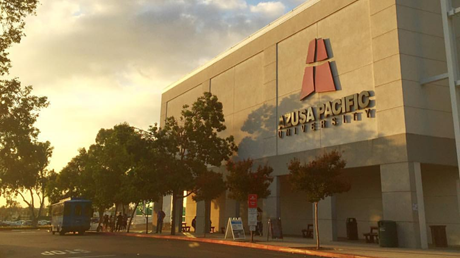
Azusa Pacific Reverses Approval for Gay Student Couples

Board of Trustees never sanctioned the recent code of conduct change. Now the wording's back to before.

Days after Azusa Pacific University (APU) dropped a ban on “romanticized” same-sex relationships from its code of student conduct, its board of trustees reversed the changes.

“Last week, reports circulated about a change in the undergraduate student standards of conduct. That action concerning romanticized relationships was never approved by the board and the original wording has been reinstated,” the Southern California Christian university’s board said in a statement on Friday.

The school’s much-discussed shift on same-sex relationships had been approved by APU’s administrative board, but not the board of trustees, ZU Media, a campus newspaper, reported. The student code change was accompanied by a new on-campus program for LGBT students designed to “reduce feelings of isolation and promote a sense of belonging,” APU told CT.

The board of trustees’ announcement did not address the future of any LGBT support efforts. Unlike many of its fellow members of the Council of Christian Colleges and Universities (CCCU), APU does not require their students to be Christian, though the school comes out of a Wesleyan tradition and ascribes to a biblical statement of faith.

APU had also recently dropped longstanding language from an eight-point statement on human sexuality, which declared “homosexual acts” (among others) are “expressly forbidden” by Scripture; “heterosexuality is God’s design for sexually intimate relationships”; and “humans were created as gendered beings” in order to be fruitful and multiply. Those initial revisions remain on the website and were not specifically addressed in the board’s remarks.

Last ...

Continue reading...


from Christianity Today Magazine https://ift.tt/2OowUvw

Five Signs My Church May Have Become an Idol

How can we see the signs and repent?

Most of us have misspent precious time on WebMD. We’ve developed a peculiar malaise and launched our own investigative examination (with unquestioned personal expertise) to secure a speedy and satisfying diagnosis.

Although we were troubled by our original symptoms, we soon become suspicious that we’ve contracted a far more exotic condition. After a few hours, that tickled throat is now proof-positive of a chronic, excruciating death-sentence just around the corner. We close our computer, draw a deep breath, and pray that a real doctor has better news.

Symptoms are funny things. To some, they are in themselves the problem. Heroic efforts are braved in order to mask the evidence of a deeper and more malignant issue. To others, symptoms are snubbed. With clenched teeth and firm resolve, we soldier on, feigning as if nothing is out of the ordinary.

Still to others, symptoms become a source of paralysis. With fear and dread we cocoon, hoping for a miraculous delivery while we dawdle in our emotional fetal position attempting to conjure happier thoughts.

All three responses are inadequate. Symptoms are never the problem, should never be ignored, and cannot be wished away by a pseudo-counternarrative. Symptoms are God’s way of getting our attention.

Consider the case of the church in North America.

Symptoms of disease are everywhere. Church closures. Dismal baptism numbers. Disqualified pastors. Negative cultural influence. Infighting. Dysfunction. Scandal. Failure. The symptoms are all pointing to a deep problem somewhere, but the question is: Where?

Before we round up the usual left-wing suspects to pin sole culpability, an internal evaluation is in order. A Kingdom-centric worldview understands that the pervasive ...

Continue reading...


from Christianity Today Magazine https://ift.tt/2xP0a5g