Thursday, 3 January 2019

Congress’s ‘Other’ Christians: The Fastest-Growing Faith on the Hill

A record 1 in 5 freshman politicians falls into a Protestant catchall category.

At the swearing-in of the 116th United States Congress today, nearly 100 new legislators will take the oath of office, pledging to “well and faithfully discharge” their new duties, “so help me God.”

After last year’s campaign and midterm elections, the ceremony represents answered prayers for dozens of incoming evangelical politicians.

Though the overall number of Christians in Congress fell slightly from 91 percent from 2017 to 88 percent in 2019, a vast majority of freshmen—79­­ of the 97 newly elected lawmakers—identify as Christian and around half—47—are Protestants, according to Pew Research Center’s Faith on the Hill report.

With the largest freshman class since 2011, these representatives bring historic levels of diversity to Washington, a range of backgrounds outside politics, and deep convictions about faith in governance. The group includes Sunday school teachers, deacons, Christian college graduates, missions trip participants, prayer advocates, a former aspiring pastor, and plenty of churchgoers.

“In Romans 13, government officials are described as ministers of God,” said Senator Josh Hawley of Missouri, who assumes Claire McCaskill’s seat, in an interview last year about his faith. “That’s how serious God is about politics.”

Former counsel with the religious liberty legal group Becket (where he helped defend the Hobby Lobby and Hosanna-Tabor cases before the Supreme Court), Hawley belongs to the Evangelical Presbyterian Church, speaks before Baptist crowds, and is one of 20 freshmen who identify as unspecified/other Protestants in the congressional questionnaire from CQ Roll Call, the basis for the Pew report released ...

Continue reading...


from Christianity Today Magazine http://bit.ly/2QkMBAK

Congress’s ‘Other’ Christians: The Fastest-Growing Faith on the Hill

A record 1 in 5 freshman politicians falls into a Protestant catchall category.

At the swearing-in of the 116th United States Congress today, nearly 100 new legislators will take the oath of office, pledging to “well and faithfully discharge” their new duties, “so help me God.”

After last year’s campaign and midterm elections, the ceremony represents answered prayers for dozens of incoming evangelical politicians.

Though the overall number of Christians in Congress fell slightly from 91 percent from 2017 to 88 percent in 2019, a vast majority of freshmen—79­­ of the 97 newly elected lawmakers—identify as Christian and around half—47—are Protestants, according to Pew Research Center’s Faith on the Hill report.

With the largest freshman class since 2011, these representatives bring historic levels of diversity to Washington, a range of backgrounds outside politics, and deep convictions about faith in governance. The group includes Sunday school teachers, deacons, Christian college graduates, missions trip participants, prayer advocates, a former aspiring pastor, and plenty of churchgoers.

“In Romans 13, government officials are described as ministers of God,” said Senator Josh Hawley of Missouri, who assumes Claire McCaskill’s seat, in an interview last year about his faith. “That’s how serious God is about politics.”

Former counsel with the religious liberty legal group Becket (where he helped defend the Hobby Lobby and Hosanna-Tabor cases before the Supreme Court), Hawley belongs to the Evangelical Presbyterian Church, speaks before Baptist crowds, and is one of 20 freshmen who identify as unspecified/other Protestants in the congressional questionnaire from CQ Roll Call, the basis for the Pew report released ...

Continue reading...


from Christianity Today Magazine http://bit.ly/2R6uCn4

Interview: Eugene Peterson Wanted to Know Your Name

How, the late pastor asked, can you shepherd a flock you don't know?

Eugene Peterson—who died in October at age 85—is best known, perhaps, as the author of The Message, his vernacular paraphrase of the Bible. But for many pastors and church leaders, Peterson was also a mentor who taught them to be shepherds rather than CEOs—in large part by modeling that approach himself. Drew Dyck, acquisitions editor at Moody Publishers, spoke with Peterson in 2017 as one of his final books (As Kingfishers Catch Fire) was published. They spoke about recent developments across the ministry landscape, the seriousness of the pastoral calling, and how The Message sprouted from his desire to truly know and listen to the people in his ministry. Pieces of that interview appear here for the first time.

In the preface of As Kingfishers Catch Fire, you write that the Christian life is “the lifelong practice of tending to the details of congruence.” What does that look like in a pastor’s life?

As pastors we’re interested in getting people to live a life that is congruent with the gospel. One of the things I realized from day one is that I needed to listen to congregants and not just put things into their heads. This is one of the wonderful things about being a pastor. You get the time and the opportunity to make connections with the everyday lives of people in your congregation. You can’t just treat Christianity as a pile of ideas from which to add and subtract.

You grew up in farming country, and your father was a butcher. Did that environment shape you as a pastor?

By all means. People who work with the soil and with animals learn to respect what they’re doing and the subjects of their work. My dad had one man working for him who he would send to the farms or ranches. ...

Continue reading...


from Christianity Today Magazine http://bit.ly/2QhPtyo

What Is Biblical Preaching?: The Demonstration of the Spirit’s Power in Preaching

When the Spirit moves during a sermon, what does it look like?

The Apostle Paul made a statement that should resonate in the mind of every preacher with the courage to stand behind a pulpit and declare "thus saith the Lord" to any audience: "My message and my preaching were not with wise and persuasive words, but with a demonstration of the Spirit's power" (1. Cor. 2:4).

The question arises: Does this passage present a rubric for effective delivery of God’s word?

Like many people I grew up with, I was raised in an era that saw a revival of popularity in a TV series that originally aired before my birth. The original Star Trek is the grandaddy of all sci-fi space odysseys. Most of my friends could quote the opening lines: "Space—the final frontier. These are the voyages of … " And so on and so on.

For many, Captain Kirk was the ultimate hero. He was the model of modern leadership: handsome, wise, decisive, witty, willing to lay down his life for his crew at any given moment and of course, over the top.

My favorite character, though, was none other than Mr. Spock. Leonard Nimoy brilliantly portrayed a humanoid from an alien race who had a trait more distinctive than his pointy ears. Mr. Spock was a Vulcan, and Vulcans had evolved to be a superior people in comparison with the futuristic humans whose origin was Earth.

It did not take long to learn that this evolution had taught the Vulcans how to completely suppress emotions. Emotions were seen as the root of all evil, of all wars, of the unnecessary pursuit of romantic relationships, and other flaws that made earthly humans sub-par.

Kirk and Spock were the yin and yang, the Lone Ranger and Tonto, the Batman and Robin of space. They were diametrically opposite. Kirk was led by emotions, but ...

Continue reading...


from Christianity Today Magazine http://bit.ly/2Autiji

Wednesday, 2 January 2019

When the Word Becomes Words

Ann Voskamp and photographer Esther Havens document the moment a new Bible translation arrives in a rural Kenyan community.

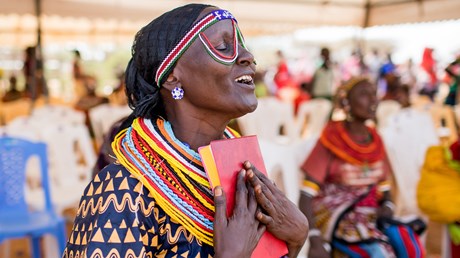
The word of God comes riding in on a camel. It’s a kind of modern-day Palm Sunday in Northern Kenya, the nomadic Rendille people waving their worn sticks instead of palm branches, the Word of God itself stacked in bound cardboard boxes, lashed to the hump of a swaying dromedary.

More than a thousand Rendille and dozens of distant neighboring tribespeople have gathered in the stifling heat, with ready smiles and raised hands, to greet the completed New Testament in their own mother tongue. They have been parched for living water under the desert sun for decades—centuries—and this day is nothing short of a resurrection coming. Dancing women stir the dust with their feet, thousands of beaded necklaces rattling like rising bones, and they point out how even the Word-carrying camel can’t seem to stop grinning.

The Rendille translation is one of more than 120 nearing completion in Africa alone in 2018. Over three decades ago, two faithful missionaries and two deeply committed Rendille tribesmen began laying the foundation for this day when they set out to translate parts of both Testaments into the Rendille language. Their painstaking work finally came to fruition in the last three years, thanks to technology and consulting methods beyond those early missionaries’ wildest imaginings and to partnerships between groups including Wycliffe, Seed Company, BTL Kenya, and Africa Inland Mission.

Which is what makes today, the day the Good Book comes, seem like a divine visitation.

Pastor David Gargule, a native Rendille who holds master’s degrees in theology and in organizational leadership and management, has returned here to the desert, because what would it be to find success in the world if his own ...

Continue reading...


from Christianity Today Magazine http://bit.ly/2R5sE66

Preoccupied with Love: Lifting High Evangelism Again

An interview with Dominique Dubois Gilliard.

Ed: It’s hard to deny that we are living in challenging times culturally. The church’s influence is fading, and we are struggling to find answers to some hard questions. What’s your take on the health of the church today, especially as it relates to our witness?

Dominique: Amid increasing political polarity, the church must be reminded that Christianity cannot fit neatly into partisan politics. Both the left and the right are inadequate. Neither party is God-ordained, and both have championed principles that are antithetical to the Kingdom. In this critical moment, we must remember that our hope is exclusively in Christ, and that our ethics, values, and virtues must be biblically rooted.

Moreover, the church is called to be a prophetic presence in the world, not merely an echo chamber that only resounds once there is no longer any social risk involved in speaking up.

However, far too often, fear prohibits us from faithfully responding to the needs around us. Fear domesticate our witness—be it the fear of being perceived as “too political” when we strive to embody passages like Proverbs 31: 8-9, Matthew 25, or 1 John 3:16-18, or political fear-mongering—which both parties deploy—that we succumb to, which leads us to “other” or dehumanize individuals made in the image of God.

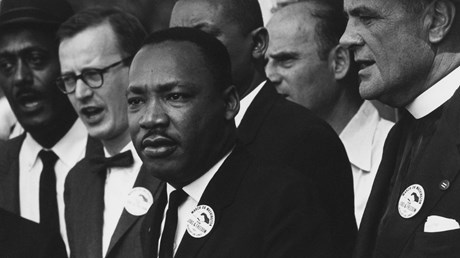
In this watershed moment, we must remember the wise council of Dr. King, who said, “The church must be reminded that it is not the master or the servant of the state, but rather the conscience of the state.”

Dr. King also spoke about the urgent need for the church to recapture its prophetic zeal and remember its missional purpose. In his legendary “Letter from a Birmingham Jail,” ...

Continue reading...


from Christianity Today Magazine http://bit.ly/2F42p9d

Tuesday, 1 January 2019

Starting a New Year Centered on God’s Love

The cultivation of our love for God isn’t something we can nurture all on our own.

New Year’s is perhaps the only holiday that requires its celebrants to continue the ‘festivities’ months and months after the day is out.

After all the partying and fellowship die down, most people can’t help but get started setting goals and making resolutions. As a matter of fact, a full 40% of the nation’s population makes New Year’s resolutions each year. Of course, the size and scale of these goals often differs from person to person. Many set out to change their budgets, bodies, homes, or education levels. Others want to focus on emotional well-being or the building of meaningful interpersonal connections with others.

But regardless of the specific area of interest, there exists a couple of common denominators between these resolutions worth acknowledging. First and foremost, everyone seems to want more of something specific in their lives. Statista performed a study in 2017 on individuals’ New Year’s resolutions across the country. When asked, 53% of respondents wanted to save more money, 24% of respondents wanted to travel more, 23% wanted to read more books. Others wanted to increase their own personal health by losing weight, getting in shape, or quitting smoking.

Of course, it’s not that any of these things individually are wrong. Many of us could benefit from books, travel, or a little weight loss. What’s most impressionable here is the theme of discontentment; we are a society full of perpetually unsatisfied people, hungry for more of whatever we can get our hands on.

Second, when it comes to New Year’s resolutions, it seems that the method we use for going about getting to the ‘more’ we’ve set our sights on is the same across the ...

Continue reading...


from Christianity Today Magazine http://bit.ly/2GMYhww