Tuesday, 2 June 2020

George Floyd Protests Mark a Turning Point for Minneapolis Evangelicals

From cleanup efforts to sermons against systemic racism, local pastors say an effective response requires they listen to the communities hurting the most.
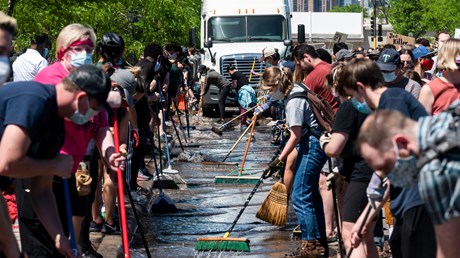
Dozens of evangelical churches are joining together to help Minneapolis as protests against racism and police violence rock the city and destructive riots devastate minority neighborhoods.

In the week after the death of George Floyd, local evangelicals have participated in the citywide response, donating food and supplies and rallying volunteers for cleanup efforts. But as church leaders consider the long-term needs that will continue when the news cycle and national attention move on, they’ve realized how important it is to work together to coordinate their responses.

“People want to just do something, but that doesn’t mean we know what to do,” said Shawna Boren, the engagement pastor at Woodland Hills Church in St. Paul. “We’re really trying to be effective by listening to the churches in the neighborhoods that are affected and doing what they tell us to do.”

Boren was one of more than 250 ministers who joined a Zoom call on Monday to discuss ways that churches can collaborate. The call was organized by Transform Minnesota, an evangelical organization that brings pastors together to wrestle with social issues.

The church leaders heard about specific community needs, like baby formula and hand sanitizer. They shared their exhaustion after months of dealing with the impacts of COVID-19. They talked about best practices for helping clean up after a riot, like checking in with community leaders before showing up in a neighborhood with a van full of people. And they discussed concerns about how helping could hurt.

“We don’t need saviors. What we need are partners,” Charvez Russell, a black Baptist pastor, told the group. “Yes, we need your help right now. Yes, we ...

Continue reading...


from Christianity Today Magazine https://ift.tt/2AtalQZ

Two Views of the Racial Injustice Wrecking Havoc on Us: Being Hmong in Community and Seeking a Revolution of Our Values

As if it wasn’t hard enough to know that another injustice was compounded onto the surmounting hurt and pain the African-American community was feeling, now, we were seeing a part of ourselves reflected in this police officer’s lack of intervention and complicity.

From Daniel Yang:

When I watched the video of George Floyd lying face down with a white police officer’s knee on his neck and an Asian police officer supervising, I immediately thought two things: 1) “God, not another unarmed black man dying at the hands of police” and 2) “Lord, the Asian police officer looks Hmong.”

It was. And he was.

I sometimes think Hmong people have an almost spiritual sense when it comes to recognizing other Hmong people. In speaking with my Hmong friends who saw the video, they too immediately thought he was Hmong.

As if it wasn’t hard enough to know that another injustice was compounded onto the surmounting hurt and pain the African-American community was feeling, now, we were seeing a part of ourselves reflected in this police officer’s lack of intervention and complicity.

The day after the video came out, I contacted Dr. Theon Hill to process this with him as a race scholar. Not only is he a friend and Wheaton colleague, but he’s also a fellow resident in Aurora, IL, where, just two nights ago, our city experienced a long evening of protests which ended in rioting and looting.

In our email exchange, I realized there’s so much about American racialization that the Asian-American conscience, Hmong in particular, is being awakened to at this moment.

These are complicated feelings for a people group that have fresh wounds from our own recent war-torn history.

Yet, despite these feelings, many of us join the sentiment of my friend Der Lor, who’s a Hmong pastor in a multi-ethnic church in the Twin Cities. This weekend, he marched in solidarity with a sign that read, “Hmong Americans for Black Lives.”

I don’t mean to take attention ...

Continue reading...


from Christianity Today Magazine https://ift.tt/3gLHRCL

Trump Makes Surprise Visit at Historic Church Near White House

Episcopal leaders “outraged” that protestors were cleared for the president’s brief appearance where he raised a Bible for a photo op at St. John’s.

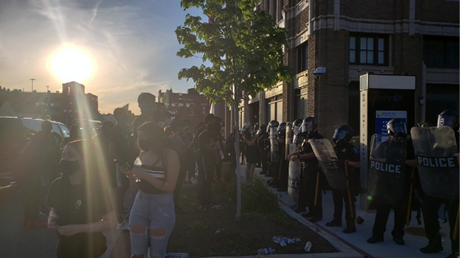
It began with Attorney General Bill Barr standing with his hands casually in his pockets, not wearing a tie, surveying the scene at Lafayette Park across from the White House, where several thousand protesters had gathered for more demonstrations after the police killing of George Floyd.

President Donald Trump had announced he would soon be addressing the nation from the White House Rose Garden, as a 7 p.m. curfew in the city loomed and a mass of law enforcement, including US Secret Service agents, Park Police, and National Guardsmen, stood sentry, many dressed in riot gear.

Moments before 6:30 p.m., just when Trump said he would begin his address, the officers suddenly marched forward, directly confronting the protesters as many held up their hands, saying, “Don't shoot.”

Soon, law enforcement officers were aggressively forcing the protesters back, firing tear gas, and deploying flash bangs into the crowd to disperse them from the park for seemingly no reason. It was a jarring scene as police in the nation's capital forcefully cleared young men and women gathered legally in a public park on a sunny evening, all of it on live television.

With smoke still wafting and isolated tussles continuing in the crowd, Trump emerged in the Rose Garden for a dramatic split-screen of his own creation.

“I am your president of law and order and an ally of all peaceful protesters,” he declared, before demanding that governors across the nation deploy the National Guard “in sufficient numbers that we dominate the streets.” And he warned that, if they refused, he would deploy the United States military “and quickly solve the problem for them.”

As an additional show of force, Trump announced ...

Continue reading...


from Christianity Today Magazine https://ift.tt/3crHGZN

George Floyd Protests Mark a Turning Point for Minneapolis Evangelicals

From clean-up efforts to sermons against systemic racism, local pastors say an effective response requires they listen to the communities hurting the most.

Dozens of evangelical churches are joining together to help Minneapolis as protests against racism and police violence rock the city and destructive riots devastate minority neighborhoods.

In the week after the death of George Floyd, local evangelicals have participated in the citywide response, donating food and supplies and rallying volunteers for clean-up efforts. But as church leaders consider the long-term needs that will contine when the news cycle and national attention move on, they’ve realized how important it is to work together to coordinate their responses.

“People want to just do something, but that doesn’t mean we know what to do,” said Shawna Boren, the engagement pastor at Woodland Hills Church in St. Paul. “We’re really trying to be effective by listening to the churches in the neighborhoods that are affected and doing what they tell us to do.”

Boren was one of more than 250 ministers who joined a Zoom call on Monday to discuss ways that churches can collaborate. The call was organized by Transform Minnesota, an evangelical organization that brings pastors together to wrestle with social issues.

The church leaders heard about specific community needs, like baby formula and hand sanitizer. They shared their exhaustion, after months dealing with the impacts of COVID-19. They talked about best practices for helping clean up after a riot, like checking in with community leaders before showing up in a neighborhood with a van full of people. And they discussed concerns about how helping could hurt.

“We don’t need saviors. What we need are partners,” Charvez Russell, a black Baptist pastor, told the group. “Yes, we need your help right now. Yes, we need ...

Continue reading...


from Christianity Today Magazine https://ift.tt/2yWa5cO

George Floyd Protests Mark a Turning Point for Minneapolis Evangelicals

From clean-up efforts to sermons against systemic racism, local pastors say an effective response requires they listen to the communities hurting the most.

Dozens of evangelical churches are joining together to help Minneapolis as protests against racism and police violence rock the city and destructive riots devastate minority neighborhoods.

In the week after the death of George Floyd, local evangelicals have participated in the citywide response, donating food and supplies and rallying volunteers for clean-up efforts. But as church leaders consider the long-term needs that will contine when the news cycle and national attention move on, they’ve realized how important it is to work together to coordinate their responses.

“People want to just do something, but that doesn’t mean we know what to do,” said Shawna Boren, the engagement pastor at Woodland Hills Church in St. Paul. “We’re really trying to be effective by listening to the churches in the neighborhoods that are affected and doing what they tell us to do.”

Boren was one of more than 250 ministers who joined a Zoom call on Monday to discuss ways that churches can collaborate. The call was organized by Transform Minnesota, an evangelical organization that brings pastors together to wrestle with social issues.

The church leaders heard about specific community needs, like baby formula and hand sanitizer. They shared their exhaustion, after months dealing with the impacts of COVID-19. They talked about best practices for helping clean up after a riot, like checking in with community leaders before showing up in a neighborhood with a van full of people. And they discussed concerns about how helping could hurt.

“We don’t need saviors. What we need are partners,” Charvez Russell, a black Baptist pastor, told the group. “Yes, we need your help right now. Yes, we need ...

Continue reading...


from Christianity Today Magazine https://ift.tt/2BrzJak

The Bible Is Not a Prop. Its Teachings, Though—about the Gospel and Justice—Are What We Need Right Now

A Bible in a photo opp was not the Bible we needed.

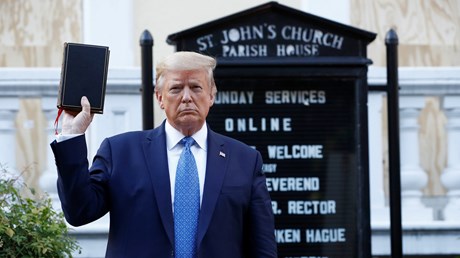
It was a jarring and awkward photo op. It did not play well, even with many of the president’s supporters.

Every pastor has, at some point, accidentally held a Bible upside down, so that can happen. But, the president did not open it. He did not read from it. When asked if it was his Bible, he said it was a Bible (emphasizing the “a”).

To use the Bible in a photo op, after clearing peaceful protestors (with tear gas and rubber bullets) from Lafayette Park so he could walk to a church, was simultaneously unhelpful to the current situation and at odds with the message of that Bible.

A Bible in a photo op was not the Bible we needed.

The Bible

Anyone who has been paying attention to national politics immediately understood what was happening. Likely aimed towards evangelicals like me, it would show that, somehow, standing in front of a church and awkwardly holding a Bible means that we should support the president.

In the past I have voiced my support when I have seen this president’s administration do good things. I have worked with the administration toward their good efforts on opioid abuse and mental health.

Moreover, I’ve prayed for President Trump regularly.

But what Trump did on the steps of St. Johns is what most pastors around the country remind their congregations not to do. The Bible will be as useful to you displayed on the fire mantle as it will when held aloft outside a church. Jesus himself warns against this in Matthew 6, cautioning to “beware of practicing your righteousness before other people in order to be seen by them.”

In other words, God is not pleased when we use the Bible as an ornament to be seen by others.

Rather, the power of the Bible is in the story that it tells. ...

Continue reading...


from Christianity Today Magazine https://ift.tt/3019UIs

Tears on Red Soil: Navajo Evangelical Leader Hears Her Homeland ‘Crying Out’

World Renew’s Carol Bremer-Bennett rallies coronavirus relief to the close-knit, under-resourced reservation.

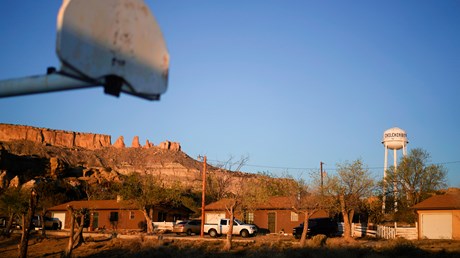
The 27,000-square-mile Navajo Nation—stretching across parts of New Mexico, Arizona, and Utah—has surpassed New York’s per-capita COVID infection rate. Among a population of around 175,000, the Navajo people have registered 5,250 cases of COVID-19, and 241 deaths.

While states scramble to respond and reopen, Christian ministries are among those turning their attention to the unique needs of the Navajo, who have less access to basic resources like utilities, the internet, grocery stores, and hospitals, with just four inpatient facilities on the reservation.

Carol Bremer-Bennett is positioned well to lead the charge. The only Navajo at the head of a US evangelical organization, she became the national director of World Renew—the international relief and development agency of the Christian Reformed Church (CRC)—after a career as an educator at a Christian school for native students. In the classroom, Bremer-Bennett said she learned to see the God-given potential in every child and help “eliminate as many barriers and obstacles and challenges in the way.”

That attitude has shaped her approach development work, pushing her to see the opportunity that lies within a community, but may have been held back by injustices of the past. As she turns her attention and relief efforts to her former and ancestral home in Navajo Nation, she is rallying the church to join along.

Besides the CRC, other denominations operating in Navajo Nation have joined in to help. Franklin Graham visited last week to meet Navajo President Jonathan Nez and Vice President Myron Lizer and distribute supplies. He offered to set up a Samaritan’s Purse field hospital.

Bremer-Bennett talked with Megan Fowler about her “Esther ...

Continue reading...


from Christianity Today Magazine https://ift.tt/2U0406j