Thursday, 3 September 2020

Goodbye Christ. I’ve got Justice Duty.

Justice without Jesus is just us—and it's not the answer.

I know a white pastor who came to understand the depth of racial inequity and white dominance in our society. He also came to see how the Church at large has so often been either complicit or directly supportive of such dominance.

He no longer accepted living in such a way. He changed his faith to be more focused on justice. Disturbed that he had not been taught this in seminary, he came to question how we have interpreted the Bible. He came to question whether personal morality really mattered. As he moved more toward a focus on justice, I saw other changes—his language got saltier, laced with what the Bible calls unwholesome words. He felt it necessary language to confront injustice. His countenance changed. He became increasingly angry and outwardly bitter. The world was so broken, too many people did not see it, and it all combined to deepen his frustration.

His sermons changed, focusing less on Biblical exegesis and more on the principle and imperative of justice, at first linked to the Bible. But the Bible began feeling like it did not go far enough, so he drew on alternative sources. Justice must be achieved, even if it cost him his faith, which in the end, it did.

I know a young white professor, raised in a Christian home, committed to her faith in a very serious way. But through her education she increasingly came to see the gross inequities of our world.

Out of her Christian conviction she sought to study, learn, and produce new knowledge that would bring about racial justice. She grew increasingly frustrated with the church as she knew it. It seemed uninterested in racial justice. She questioned whether the Bible really can be interpreted as truth. If it could, why were the folks who say the Bible matters uninterested ...

Continue reading...


from Christianity Today Magazine https://ift.tt/3gS2A6N

Redeeming Condos, Presbyterians Buy NYC Building for $30 Million

The church Tim Keller founded is part of a hidden trend turning real estate into worship space.

In New York City, you can find a church building that has been changed into a pizzeria. You can find a church remade as a bar. One Episcopal structure was turned into a cultural center, and then a rehab clinic, a dance club, a shopping center, and now a gym with a French bistro. You can find lots of churches converted into condos. High-end housing in former worship spaces has been the hot trend in New York for the past five or 10 years, with churches from Brooklyn to Greenwich Village to Harlem repurposed for upscale luxury living.

But Redeemer Presbyterian Church, founded by Tim Keller, is going in the other direction. The church announced it has bought a 45,000-square-foot condo building in the city and converting the former housing space into a church. The building cost $29.5 million, according to real estate news outlets, and will undergo a two-year renovation to become the new home of Redeemer’s Upper East Side congregation.

The purchase is “an important part of God’s long-term vision for our church,” said James Herring, elder and chair of a Redeemer building committee, in an announcement video posted August 14. Plans for the new building are still being developed, but Herring hopes to see a sanctuary seating 600, a fellowship hall seating 300, and space for “all the things we have only dreamed about having space for in the past.”

The church has been looking for new property since 2016 and considered more than 500 properties in four years. The committee pursued 22 properties and made offers on five, according to Herring.

The location they settled on, 150 East 91st St., is only 16 blocks from Redeemer’s current Upper East Side meeting place, the Temple Israel at 112 East 75th St. ...

Continue reading...


from Christianity Today Magazine https://ift.tt/2EUFkb5

Wednesday, 2 September 2020

What Happens at Liberty Doesn’t Stay at Liberty

The Falwell investigation has far-reaching consequences for local churches in Virginia and beyond.

The Associated Press recently reported that Liberty University is launching an independent investigation into the conduct of former president Jerry Falwell Jr. and his wife, Becki. For some evangelicals, the scandal elicits nothing more than a shrug for the isolated actions of a few bad apples. For others, these significant misdeeds will be swept away quickly in the tides of history. Historian Grant Wacker makes this argument in a recent Washington Post piece titled “Jerry Falwell Jr.’s downfall won’t change anything for evangelicals.”

If you take a bird’s eye view of time, then he’s likely right. But for those of us who inhabit space inside Liberty University’s large sphere of influence, the truth is quite the opposite. This scandal and its ensuing investigation have far-reaching consequences, not only for parachurch practice but also for local church polity. Put another way, the cautionary tale of the Falwells carries implications for how believers here and elsewhere think about the intricate bonds between the local body of Christ and adjacent parachurch institutions.

My first glimpse into Liberty’s regional influence happened roughly 20 years ago, when I came to visit the man who would later become my husband. He’d lived his whole life in rural southwest Virginia, where the primary force in his spiritual formation was a small Baptist church that still sits atop a knoll just off the Blue Ridge Parkway. Driving through the countryside those years ago, I was entranced by the passing forests and hills dotted with small farms and rock churches. I also remember the moment when I rounded a corner and came face-to-face with a billboard for a local university. One of the few ...

Continue reading...


from Christianity Today Magazine https://ift.tt/32TN2ul

White House Administration Equipping Faith Leaders with Tools for Action in the Rural Addiction Crisis

New tools to address addiction in rural America from the Director of the White House Office of National Drug Control Policy.

As the Nation’s “Drug Czar,” I regularly travel around the country to understand how the addiction crisis is affecting local communities. People often ask me, “What can I do?” As a person of faith, my first response is simple: “Pray.” However, in my belief, I am also reminded that my faith is brought to life with action.

Perhaps nowhere is the need for action more evident than in rural America — especially now. The COVID-19 pandemic has presented rural communities with new challenges. Jobs in fields such as manufacturing, agriculture, and tourism have seen a significant economic impact in recent months, and many who work in jobs in these sectors do not have the luxury of working remotely.

The impact of addiction is great, but resources are few. In 2018, more than 67,000 Americans died from a drug overdose. Many of those deaths occurred in rural America. A survey conducted by the American Farm Bureau Federation and National Farmers Union, two leading farm organizations, found that nearly 50 percent of adults living in rural America have been directly impacted by the opioid crisis.

One reason rural America is suffering is because there is a significant gap in many communities in the services needed to help people struggling with an addiction get healthy and stay well. I have seen this firsthand in my travels throughout rural America to places like Wise county, a rural county in southwest Virginia. This spring, I met with leadership from the Health Wagon, a faith-based clinic that provides critical care for this mountainous region that has been hard hit by poverty and addiction. Beyond its core mission of primary care, the Health Wagon has started providing medication-assisted treatment ...

Continue reading...


from Christianity Today Magazine https://ift.tt/3hSPqaV

Commentary: On Matters of Race and Justice, Listening Isn’t a One-Way Street

Why we shouldn’t divide the church into those who “get it” and those who don’t.

In early June, with protests erupting around the country and George Floyd’s dying words still hauntingly fresh, The Washington Post published a column with a pointed headline that surely spoke for many who were fed up with seeing racism denied or minimized: “The best white statement to make right now may be to shut up and listen.”

Glaring episodes of racial injustice often inspire renewed appeals for white people to humble themselves, tamp down the defensiveness, and be open to what their black neighbors are saying. Indeed, it’s hard to imagine a more reasonable, unobjectionable request. Listening well is the barest requirement of basic human kindness, especially when those around you are hurting. When black people volunteer their personal experiences of prejudice, their perspectives on structural racism, or their raw fear of a loved one being gunned down by police, they deserve far more than stony indifference or mulish combativeness.

For Christians, the call to listen carries added force, not least when it comes from brothers and sisters in Christ. After all, biblical people are nothing if not listening people. As James instructs us, “Everyone should be quick to listen, slow to speak and slow to become angry” (1:19). Proverbs abounds with warnings against running one’s mouth while closing one’s mind and ears. “Fools find no pleasure in understanding,” according to Proverbs 18:2, “but delight in airing their own opinions.” By contrast, Scripture commends those who embrace a righteous rebuke: “Whoever loves discipline loves knowledge, but whoever hates correction is stupid” (Prov. 12:1).

Seen this way, cries of “It’s time to listen” ...

Continue reading...


from Christianity Today Magazine https://ift.tt/334uxDB

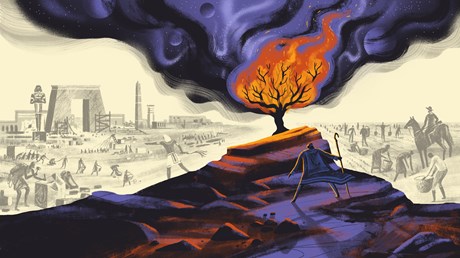
The Roots of the Black Prophetic Voice

Why the Exodus must remain central to the African American church.

This is the last in a six-part series of essays from a cross section of leading scholars revisiting the place of the “First Testament” in contemporary Christian faith. —The editors

I was 11 when I watched a documentary about Martin Luther King Jr. and the civil rights movement called Eyes on the Prize. Images of black women knocked to the ground by fire hoses in Birmingham flashed before my eyes. Police dogs charged after people. Angry white faces screamed racial slurs at black children seeking to enter a desegregated school.

Growing up in the Hatchie Street Church of Christ, a small black church in southwest Tennessee, I heard sermons and studied Sunday school lessons about Israelite slavery in Egypt. After watching Eyes on the Prize, it became clear to me that black people’s lot in America was the same as that of the Israelites in Egypt. This realization inspired me to follow in the tradition of Moses, the Old Testament prophets, and the judges (whom we might call “freedom fighters”), as well as in the legacy of Martin Luther King Jr. The Old Testament speaks against the suffering and oppression black people in America experience today, and the black church—increasingly tempted toward a gospel of prosperity and middle-class comforts—needs to remain rooted in this legacy.

The Power of Exodus

The story of the exodus has had staying power in the African American church because the narrative speaks so readily to the troubles faced by its congregants. African Americans through the generations found in Exodus a God who attends to the oppressed who cry out to him:

I have indeed seen the misery of my people in Egypt. I have heard them crying out because of their slave drivers, and I am ...

Continue reading...


from Christianity Today Magazine https://ift.tt/2YZevJN

Tuesday, 1 September 2020

The COVID-19 Crucible: Confronting Our True Selves

A new series on navigating healthy relationships through COVID-19

This is the first of four articles on the topic of COVID-19 and individual, couple, family, and social issues viewed through a systemic marriage and family therapy lens. In this article, Dr. David Van Dyke, licensed Marriage and Family Therapist and director of the Wheaton College Marriage and Family Therapy Program, shares skills and resources for individual and relational care and growth in the crucible of COVID-19.

The tough news: our true selves are being exposed, and we don’t like what we see.

Funny thing about introductions, they are usually followed by some sort of relationship. I have had introductions that were funny, socially awkward, endearing, and ill-timed. The world was introduced to the COVID-19 in its most recent and novel form in early 2020, and our first impressions (which usually chart the course of a relationship) of COVID-19 are all negative. Our current relationship with COVID-19 is unpredictable, disoriented, and marked heavily by a sense of loss. The virus, its effects, and our fear of it has shifted daily routines, family rituals and interactions with others. As with most relationships, we respond with varying degrees of reactivity. These responses have been intensified because we are now relating both with and within the COVID-19 crucible.

What is a crucible? Here are two definitions of a crucible that I find valuable for understanding COVID-19:

1) A vessel of a very refractory material (e.g., porcelain) used to expose materials to intense heat.

2) A severe test, trial, or extremely challenging experience such as those seen in Arthur Miller’s 1953 play, The Crucible.

I think about the COVID-19 crucible as the current context container in which we experience social isolation, loss, and intense ...

Continue reading...


from Christianity Today Magazine https://ift.tt/34URMCC