Sunday, 4 July 2021

Sunday Journey Series: New Hope Church in Honolulu

Visiting Wayne Cordeiro and New Hope Church was our last big trip before shutdown.
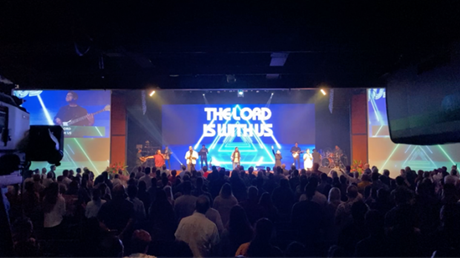
Of course, seeing these pictures now is a bit strange considering this was January of 2020. We already knew that the pandemic was starting to spread and was probably present in Hawaii.

My assigned topic that day was the people of Issachar, which basically meant I was focusing on the theme of how to know and engage our cultural context. I have noticed this is a recurring theme as a missiologist. We walked through that theme together in the service as shown below.

Let me observe a few things in the service that I thought were particularly interesting.

First, you can’t help but notice the beauty of the diversity at the church.

It’s of course made up of many native Hawaiians, but like much of Hawaii which is remarkably diverse, you see that diversity in the leadership and more.

Second, let me also mention that I found it interesting how they took time in the service to give specific thanksgiving for answered prayers and more.

Without giving names, they actually just shared on a big board and read out some of the prayer reports that were evident in the life of the church. Here’s a picture of one of several worship services that I had the privilege of preaching in.

Also, they take time to pray for specific needs.

But what I thought also particularly interesting was just how much they focused on hospitality. Let me first say the hosting, as often is the case in cultures like this, was amazing and quite gracious. For example, you will see rows set aside for people from the outside. They were very welcoming as they read “Aloha.”

Another example of their hospitality was when they put a lei on me. I asked the question, “Is that normal for outsiders or will that seem odd or patronizing if I wear that?” ...

Continue reading...


from Christianity Today Magazine https://ift.tt/3AuGBxy

Saturday, 3 July 2021

America’s True Freedom Is Getting to Sing About God, Not Country

This Fourth of July, worship leaders work to focus devotion “In Christ Alone.”

Around star-spangled holidays like Memorial Day and Independence Day, churches have often faced pressure to feature a patriotic song or two in their worship service lineups. But this year, many worship leaders are thinking more carefully about those expectations and how they can recognize a national holiday while preserving God’s place as the sole focus of our devotion.

Cole Willig, worship leader at The Crossing in Milton, Delaware, anticipates some criticism over the absence of patriotic content in this year’s Fourth of July service.

“I’m not going to gear [the service] toward a man-made nation,” Willig said. “My job is to provide a space for people to worship, but then also to teach what worship is.”

For the Christian, faith and patriotism are not simply two dimensions of identity; worship music and patriotic music are not simply two “genres” of music. The worship of God through song is a distinct spiritual act of love and obedience. The singing of patriotic music is a voluntary act expressing varying degrees of allegiance and support for one’s country.

But throughout US history, we’ve seen generalized Christian faith and patriotism go side by side, as two complementary facets of American civic religion and identity.

During the final years of World War II, the US military found itself responsible for the internment of over 375,000 German prisoners of war. Those in charge of overseeing the massive internment project were interested in more than just containment—they realized that they had the opportunity to “reeducate” the enemy through carefully curated propaganda.

Music was part of this propaganda effort. A radio broadcast called “Cavalcade ...

Continue reading...


from Christianity Today Magazine https://ift.tt/3qEpLbg

Friday, 2 July 2021

Wheaton College Graduate School Cohorts for Southern Baptists

Wheaton College Graduate School is starting two new SBC cohorts, one at the master’s level and one in our forthcoming Doctor of Ministry.

While I was with the SBC in Nashville recently, several people inquired about options for SBC students in the School of Mission, Ministry, and Leadership at Wheaton College where I am the Dean. As a result, we are now planning two new cohorts for SBC students.

Wheaton College

Wheaton College is the most well-known evangelical institution for higher education. It is known as an academically rigorous institution that has educated influential Christian pastors and leaders both nationally and internationally throughout its existence.

The School of Mission, Ministry, and Leadership in the Wheaton College Graduate School exists to inspire and equip academically grounded, spiritually maturing, and practically skilled leaders who live out Christ’s mission, proclaiming and demonstrating the gospel and serving the Church in a changing world.

Study among Evangelicals with Diverse Perspectives

Many in the SBC are aware that Matt Chandler, pastor of The Village Church, is pursuing his master’s degree in one of our cohorts. Here’s why Matt decided to pursue his M.A. degree at Wheaton College:

I've committed myself to being a lifelong learner, and so whether that's books or seminars or schooling, it has always been my hope that no matter how old I get that I continue to learn and grow in my understanding. We have a tendency to get stuck—to stop learning or feel like we've arrived in learning. I think that the men and women who lead well to the end are men and women who have been committed to being challenged, to having their ideas critiqued, to not resting on "I figured this out once and for all," but have continually sharpened what they know.

Matt could have studied at any of the SBC seminaries, ...

Continue reading...


from Christianity Today Magazine https://ift.tt/2Uo3ZMU

Thursday, 1 July 2021

We Can Reach Conspiracy Theorists for Christ. Here’s How.

God rescued me from a conspiracy theory and terrorism, and he can save others as well.

We live in a time of social upheaval, and social upheaval is fertile soil for conspiracy theories. Most of them are based on error and misinformation, and some can be downright dangerous. The ones that ensnared me in the turbulent 1960s drew me into racial hatred and political extremism and led to a shootout with police that killed an accomplice and very nearly killed me—all in the name of Christian patriotism.

My story is just one of many that ended in tragedy. Back then, conspiracy theories were on the margins of society, but today, with the advent of the internet, they are proliferating. They have moved mainstream and now into the church, where low levels of biblical literacy and high levels of cultural seduction make people more vulnerable.

Some conspiracy theories are relatively harmless, like the idea that the moon landing was faked. Others, like the theories I believed, are dangerous. By intensifying fear, anger, and hatred, they led to violence.

The most common conspiracy theories today are not as violent as before but can still deceive and lead people astray with serious consequences. QAnon, a right-wing theory that believes former President Donald Trump was fighting an underground ring of Satan-worshiping pedophiles, is probably the most popular right now and is making significant inroads in our culture and the church. Recent research from the American Enterprise Institute shows that 25 percent of white evangelicals affirm part or all of the QAnon conspiracy theory.

QAnon makes frequent use of scriptural references and eschatological allusions, giving it unmerited credibility and even leading some ministries to propose a merger of QAnon and Christianity. The Institute for Strategic Dialogue reports that QAnon ...

Continue reading...


from Christianity Today Magazine https://ift.tt/3hag6FY

America Has Tried Three ‘Narratives of Belonging.’ None Worked as Planned.

How a sober look at failed projects of nationalism can help Christians envision a better way.

Three days after polls closed on one of the most divisive elections in recent American history, Joe Biden delivered a victory speech intended to unite a fractured nation. “I’ve always believed we can define America in one word: possibilities,” Biden said. Yet more than six months later, a majority of Republicans still insist the 2020 election was not conducted fairly, and just fewer than one-third of all Americans don’t consider Biden to be the legitimately elected president. Samuel Goldman’s new book, After Nationalism: Being American in an Age of Division, helps to place both Biden’s attempts at unity and national partisan polarization in a broader historical context.

After Nationalismis a gripping, fast-paced, and probing study into how American political leaders and thinkers—ranging from John Jay to Abraham Lincoln to Fredrick Douglass to Dwight Eisenhower—have debated the essence of American identity and what binds the nation together. Goldman, a political scientist at George Washington University, tells a history of repeated failed attempts by these American elites to sustain compelling “narratives of belonging.” He offers three symbols, or myths, of American identity that progress chronologically: covenant, crucible, and creed. Drawing inspiration from philosopher Alasdair MacIntyre’s After Virtue (1981), which identified fundamentally different conceptions of virtue “in which people mean different things by the same words,” After Nationalism points to a similar ambiguity surrounding the word nationalism.

Like MacIntrye, Goldman does not just describe a situation but also suggests a path forward. Instead of endorsing another attempt to define ...

Continue reading...


from Christianity Today Magazine https://ift.tt/3dB9cYh

Do Flags Belong in Churches? Pastors Around the World Weigh In.

Christian cases for yes, no, and flying another nation’s flag as congregations balance love of God, neighbor, and country.

The Fourth of July falls on a Sunday this year. As American churches consider how to recognize the United States’ independence day during their worship services, CT decided to revisit a question first posed to American church leaders in 2013.

Here’s what their counterparts from 11 different countries have to say in 2021. Answers are arranged from Yes to No:

Egypt: Sameh Maurice, senior pastor, Kasr El Dobara Evangelical Church in Cairo

Yes, I agree with displaying the flag of my country in the church. The flag of my country only and not other countries, as it is a spiritual and not a political orientation.

The purpose of raising the flag is to keep my heart united with my people in prayer for the salvation of their souls. It’s to remember that I must stand in the gap for my people, that they may know the Lord and see the light of the gospel, and to tell my country and my people how much I love them and pray for them.

Jordan: Hani Nuqul, pastor, Evangelical Free Church in Jabal Al Hussein, Amman

I strongly believe that each church building should post the flag on the building and in the sanctuary. As an elder and pastor, we made this decision a few years ago to do so in order to show our loyalty as citizens to the country of Jordan. We believe that by doing so, we are a good example and testimony to others and also following the teachings of the Bible.

As the Evangelical Free Church council, we have taken the decision to put the Jordanian flag in all local churches that belong to the council along with the church logo and flag.

Indonesia: Wahyu Pramudya, pastor, Indonesia Christian Church Ngagel in Surabaya

In Indonesia, we usually display our national flag in the sanctuary every August, which is the month when we ...

Continue reading...


from Christianity Today Magazine https://ift.tt/3htM9Qc

I Was Sick and You Gave Me a WhatsApp Group

In India, Christian volunteers didn’t wait for churches when COVID-19 hit. The resulting Love Your Neighbor Network offers lessons for believers in other countries suffering second waves.

Amid the harrowing stories of COVID-19 carnage in India, hundreds of Christians across the country have volunteered via the Love Your Neighbor Network, an organic lay-led effort which has brought relief and comfort to tens of thousands of Indians impacted by the pandemic.

In May 2020, during the world’s largest nationwide lockdown, Rahul George, an entrepreneur in Bengaluru and founder of the network, was stirred to do something when he saw visuals on local media of daily-wage migrant laborers walking back to their villages without any means of sustenance and support.

“The images kept haunting me,” he told CT. “I was angry and depressed, often looking at the little children who were accompanying their parents and thinking of my own children and if I was a migrant worker myself.”

On March 24, the Indian government had announced a three-week nationwide lockdown, giving its 1.38 billion people only four hours’ notice. This severe step, which ended up being extended for two weeks, was viewed as a “human tragedy” by media outlets as it left millions of daily-wage migrant laborers without work overnight.

Along with their families, the migrants were forced to leave locked down cities and return to their home villages on foot since public transportation was not available. Many collapsed and died on the road as they battled starvation and fatigue while walking hundreds of miles.

George reached out to his contacts and asked if they could join together to help people in need. As often happens in India, a group was formed on WhatsApp. Within two days, it grew to 256 members—the maximum number allowed by the social media platform.

“This is the first time we had organized anything ...

Continue reading...


from Christianity Today Magazine https://ift.tt/2UfxUH0