Friday, 4 March 2022

Can China’s New Set of Regulations Really Stop Evangelism on the Internet?

While some Chinese church leaders are concerned that it may scare Christians, others hope believers will continue to plough the frozen ground and sow in the digital mission field.

China’s new internet regulations went into effect March 1, laying out broad restrictions on religious communication, teaching, and evangelism. The new rules put into writing unofficial penalties that some Christians already faced for their online activity, so Christians aren’t sure how they will be implemented and how much they could hamper missions.

The regulations were announced at the end of last year by China’s State Administration of Religious Affairs (SARA) and allow only religious groups with government approval to share information on the internet. According to the new Measures on the Administration of Internet Religious Information Services:

Organizations and individuals must not proselytize online and must not carry out religious education or training, publish preaching, or repost or link to related content; must not organize the carrying out of religious activities online; and must not broadcast religious rites … through means such as text, images, audio, or video either live or in recordings.

On February 28, the Chinese government issued a press release answering questions about the new regulation and saying that the government “will have close and thorough cooperation to ensure the implementation of the measures.”

How will the implementation of these new measures affect the use of the internet for evangelism and mission by Chinese Christians? Will Christians in China no longer be able to do anything online? As the new measures come out during the pandemic, where will the internet mission of Chinese churches in China and overseas go?

CT Asia editor Sean Cheng interviewed several Chinese pastors and Christians (for security reasons, the names of Christians in China are pseudonyms), ...

Continue reading...


from Christianity Today Magazine https://ift.tt/Jify0W7

Thursday, 3 March 2022

Another UMC Conference Delay Prompts Conservative Churches to Leave

New breakaway denomination moves up its launch as the United Methodist Church announces it’ll be two more years before voting on a split over LGBT stances.

The United Methodist Church has delayed its General Conference meeting for a third time due to the continuing COVID-19 pandemic. In response, some conservative United Methodists have announced they will preemptively leave the denomination rather than wait for the long-anticipated meeting.

Delegates to the General Conference were expected to take up a proposal to split the denomination over disagreements on the full inclusion of its LGBTQ members at the meeting of its global decision-making body scheduled for August 29 to September 6 in Minneapolis.

But General Conference organizers announced Thursday evening they are postponing that meeting to 2024 because of the continuing COVID-19 pandemic.

Obtaining vaccines and travel visas remains a challenge for delegates traveling outside the United States, according to the Commission on General Conference.

“We engaged in a fair, thorough, integrity-filled discussion of the alternatives,” said Kim Simpson, chairperson of the Commission on General Conference.

“The visa issue is a reality that is simply outside our control as we seek to achieve a reasonable threshold of delegate presence and participation. Ultimately our decision reflects the hope that 2024 will afford greater opportunity for global travel and a higher degree of protection for the health and safety of delegates and attendees.”

But one group of theologically conservative United Methodists said Thursday it is not willing to wait any longer to discuss a split and announced plans, through its Transitional Leadership Council, to launch the Global Methodist Church on May 1.

“Many United Methodists have grown impatient with a denomination clearly struggling to function effectively ...

Continue reading...


from Christianity Today Magazine https://ift.tt/xiZ4ytl

Hundreds of Russian Pastors Oppose War in Ukraine

Ukrainian evangelicals demand more Bonhoeffers, as Russian evangelicals debate whether public protest under Putin can achieve more than prayer.

Ukrainian evangelicals have had enough.

Battered by a week of war, they have heard numerous prayers for peace uttered by their Russian colleagues. But they did not hear condemnation.

“Your unions have congratulated Putin, giving thanks for freedom of belief,” said Taras Dyatlik, the Overseas Council regional director for Eastern Europe and Central Asia. “The time has come to make use of that freedom.”

As Kyiv, Kharkiv, Kherson, and other cities have suffered missile strikes, the United Nations reports the death of more than 200 civilians. Ukraine’s State Emergency Service reports more than 2,000. The military casualties are disputed, with both nations claiming thousands of fatalities among the other’s ranks.

But rather than focusing on the numbers, Dyatlik, who coordinates a regional network of dozens of Protestant seminaries, turned to the Bible.

“Remember Mordechai and Esther,” he wrote March 1 in an open letter. “Do not be like Jehoshaphat, who entered into an alliance with Ahab, and was silent when God spoke through the prophet Micaiah.”

Dyatlik accused his Russian colleagues of buying into national rhetoric—first in 2014, when Russian-backed forces invaded the eastern region of Donbas—and again today. But “begging on my knees,” he leveraged his reputation with the heads of Russia’s evangelical unions—while acknowledging their difficult reality.

“You fear prison,” he said. “[But] do not be faithful to Putin. Be faithful to the body of Christ.”

A new draft law proposes a 15-year prison sentence for “fake” claims about the violence in Ukraine, as authorities crack down on Russians who call the “military ...

Continue reading...


from Christianity Today Magazine https://ift.tt/Kg3NGeM

Moldova Welcomes 100K Ukraine Refugees, With Evangelicals Opening Doors

The neighboring country focuses on hospitality while hoping Russian violence doesn’t cross its border.

Eugen Cozonac has spent the past week focused on refugees.

More than 112,000 have crossed Ukraine’s southwestern border into his home country of Moldova, a landlocked nation that’s not much bigger than the state of Maryland. As a cabinet-level director with the government, Cozonac arranged facilities to receive donations and house refugees—everywhere from exhibition halls and sports complexes to film studios and resorts.

As he worked on Tuesday, his cellphones pinging from companies and volunteers, Cozonac paused to remember a certain group of refugees who had come to the capital city of Chișinău to escape an invasion from Russian-backed fighters: his own family.

It was on March 2, 1992—30 years ago to the day—that the Transnistria War erupted in the area now along the Moldova-Ukraine border. Cozonac was a kid at the time, fleeing with his parents and brother. Their house was bombed.

Like fellow Eastern European neighbors and the rest of the watching world, the people of Moldova did not expect the recent Russian invasion of Ukraine to happen so suddenly, to send a million people from their homes in just a week. But they have long known the threat from Russia.

On Wednesday, Moldova applied for membership into the European Union (Ukraine and Georgia have as well), and its president reiterated a call for Russia to withdraw the 1,000-plus troops that have remained in the country since the war three decades before.

Amid the escalating violence and the steady demand for humanitarian aid, Cozonac said he’s been able to stay focused in because of his experience as a refugee and the faith he discovered then. During his family’s displacement, Cozonac started reading a children’s Bible and ...

Continue reading...


from Christianity Today Magazine https://ift.tt/tLOzQJe

Church Asks for Help Feeding People and Animals in Ethiopia

Christians share grazing pasture as climate crisis devastates the region.

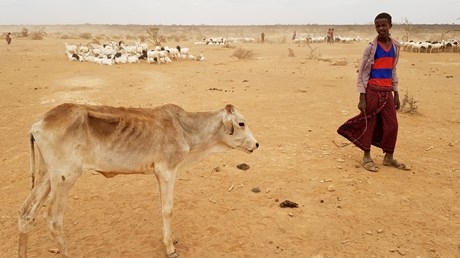
In one picture, dozens of pale-skinned cattle lie dead or dying in the baking heat. In another, a cow with its bones visible beneath its skin drinks from a green plastic bowl of water supplied by its owner.

“The situation is heartbreaking and painful,” said Yishak Yohanes Dera, president of the South Ethiopia Synod of the Ethiopian Evangelical Church Mekane Yesus (Place of Jesus).

As the senior official of one of Ethiopia’s leading Protestant churches, with more than 10 million members, Dera is appealing for help to prevent starvation in four of country’s low-lying regions. They are in the grip of a devastating drought.

He is talking to aid agencies, faith-based organizations, and government bodies, asking them to “come to Borena and save the lives of our people.”

The church, which is part of the World Lutheran Federation and has associations with the Missouri Synod Lutherans and the Reformed Church in America, has dispatched its humanitarian and development organization to work in the Borena Zone, in the Oromia Region. This is one of the worst-affected areas.

In Borena alone, 420,000 people urgently need food aid, Dera said, while more than 400 schools have no water, and most of the children have left.

“The situation is expected to worsen,” he told CT. “During this lean period, more animals are expected to die. This may push many children, women, and old-aged people into famine and unexpected death.”

More than 90 percent of the 1.2 million people in Borena live off their flocks of sheep, cattle, goats, and camels. The loss of water leads to loss of livestock, and loss of livestock to loss of livelihood.

World Vision reported last June that across six countries in East ...

Continue reading...


from Christianity Today Magazine https://ift.tt/RcVQ7ME

Bomb Shelter Ministry in My Ukrainian Town

Thanks to air raid sirens, neighbors and refugees are hearing more about the gospel than ever.

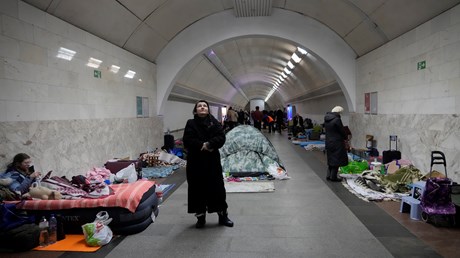
We are now a full week into open war with Russia. Of course, Russia has been warring against Ukraine since 2014, but this is an unprecedented phase. Still, it’s amazing how quickly one gets used to the mundane realities of war.

On day one, the news of other cities being bombed caused great anxiety in the city of Svitlovodsk, where my family and I live. Of course, the fact that the news woke us up before dawn and was very unexpected made it much worse. The intent to cause panic seemed planned.

Now, on day seven, the adrenaline has worn off. We are used to the 8 p.m. curfew and sitting in a dark apartment at night. We find ourselves ignoring some of the air raid sirens—especially the ones in the middle of the night, since we’re so exhausted. We’ve also learned that not every siren means a bomb might drop on our heads.

But whenever we do head to the bomb shelter, my family and I take the opportunity to share the hope of Christ with our neighbors.

“Bomb shelter ministry” is, I must admit, not a ministry profile I thought I’d ever have. And yet, we are already seeing how fruitful it’s been. Our neighbors have heard more about Christ, heard more Scripture, and been led in more prayer in the last week than most of them probably have in their lives.

In addition to the “Our Father” prayer, I’ve taken to reading various Psalms with them—a particularly fitting book for us in Ukraine, as David often cries out amid being hunted by his enemies.

One of our neighbors is the equivalent of our building superintendent. The other night in the bomb shelter, she said with tears in her eyes how thankful she was to have neighbors like us. She said she can’t ...

Continue reading...


from Christianity Today Magazine https://ift.tt/MUDdOWn

Meet the Middling Musician Who Helped Launch the Gospel Music Industry

Homer Rodeheaver was an unexceptional trombonist. But he had an ear for great songs and a knack for promoting them.

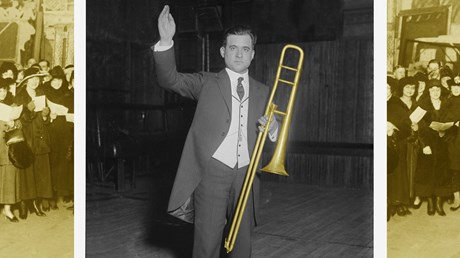
Like most kids growing up in mainstream Protestant denominations in the mid-20th century, I associated the name Homer Rodeheaver—if it came up at all—with hymnals and gospel songs, most notably my grandmother Allie’s beloved “The Old Rugged Cross.” As an adult immersed in Black gospel music, I’ve paid little attention to the mostly sketchy scholarship on Rodeheaver. His Billy Sunday–styled revivalism, mass community sings (involving mostly white singers), and trombone-heavy stylings seemed to barely intersect with my work. His association with Sunday was especially troublesome in an Elmer Gantry sort of way.

As it turns out, I was wrong on nearly every count.

Homer Rodeheaver has quite a lot to do with all kinds of gospel music, as Kevin Mungons and Douglas Yeo demonstrate in their fascinating, eminently readable biography of a wildly underrated and rarely appreciated figure who made a significant impact on sacred music, Black and white. Homer Rodeheaver and the Rise of the Gospel Music Industry introduces readers to a man who was clearly long overdue for a scholarly reappraisal.

Mungons is a well-respected writer and researcher; Yeo a master of the trombone, having performed with major symphonies and taught at the university level. Together, they untangle a number of personal, professional, and musical knots in Rodeheaver’s fast-paced, eventful, and woefully underdocumented life.

Barnstorming the nation

In the authors’ telling, Rodeheaver emerges as a complex, creative, entrepreneurial marvel, capable of predicting (and profiting from) future trends in sacred music. They reveal how he was able to promote African Americans and their gospel songs even as he (apparently) turned ...

Continue reading...


from Christianity Today Magazine https://ift.tt/dMB2CR4