Friday, 6 May 2022

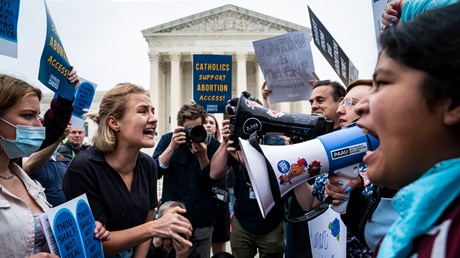
White Evangelicals Twice as Likely to Want to Ban Abortion

Ahead of a possible decision to rescind Roe v. Wade, Pew Research finds most Americans and most believers hold convictions with exceptions.

As the country awaits a landmark Supreme Court ruling that could overturn Roe v. Wade, Americans are conflicted about abortion. They’re not just in conflict with each other, but in many cases hold varying moral and legal positions in their own minds.

A new report from the Pew Research Center shows that the most common answer to the question of whether or not abortion should be legal remains “it depends.” Even among groups with the strongest positions on the issue—including white evangelical Protestants—only a minority want to legalize or ban abortion outright.

The survey was conducted in March 2022, several weeks prior to the leaked draft opinion that indicated the Supreme Court could overturn Roe v. Wade in its upcoming ruling in Dobbs v. Jackson Women’s Health Organization.

Three-quarters of white evangelicals say abortion should be illegal, with half (53%) allowing for exceptions and 21 percent saying it should be banned in all cases—about the same levels as in recent years.

White evangelicals were more likely than other faith groups and twice as likely as Americans overall to say abortion should be illegal.

White evangelicals are also far more likely to call abortion morally wrong. According to Pew, 81 percent of white evangelicals see it as morally wrong compared to 46 percent of Americans overall.

Yet more than half of evangelicals who think abortion is immoral say there are some cases where it still should be legal.

“Across both political parties and all major Christian subgroups”—including Republicans and white evangelicals, the report said—“there are substantially more people who say that there are situations where abortion should still be legal despite ...

Continue reading...


from Christianity Today Magazine https://ift.tt/fCRmpuB

The Scottish Complementarians Who Teach Women to Preach

A church planting network in Edinburgh’s poorest neighborhoods is flipping gender norms on their heads.

On a gray and crisp Sunday afternoon last year—it happened to be Halloween—I found myself crammed in the back seat of a black-and-silver Mini Cooper, jolting over speed bumps on the narrow streets of an Edinburgh suburb.

I was returning from lunch with the pastor of a church in a gentrifying housing project, or “scheme,” southeast of Scotland’s capital.

Suddenly my new friend Tasha, a 34-year-old native of the city’s schemes, hit the brakes and rolled down her window.

“Hey!” she yelled, commanding the attention of a gaggle of middle school–aged boys. “What are you doing?” They were, in fact, throwing rocks at some second-story tenement windows. Tasha spent a minute or two chastising them, and the boys sheepishly moved on.

“I know them,” she explained, but she didn’t have to. I had already gathered that Tasha was well-known and respected in her community. Tasha, whose full name is Natasha Davidson, oversees women’s ministry at the church I was visiting, Niddrie Community Church.

The congregation is part of a growing church planting network called 20schemes, whose leaders dream of starting or revitalizing 20 churches in 20 of Scotland’s housing projects. They have six churches so far, with five more teams gearing up to plant. Schemes generally have a strong community identity and don’t intersect with neighboring schemes. As a result, 20schemes has three churches within walking distance in three distinct communities.

Personally, I was drawn to 20schemes’ focus on women. Throughout my life, I have been immersed in complementarian circles that valued women but also a theology of male headship in the church and home—first ...

Continue reading...


from Christianity Today Magazine https://ift.tt/QyBm2Vq

Despite Pandemic Holdups, Christians Keep Shifting Foster Care Approach

Advocates address COVID-19 fallout and focus on family unity.

For tens of thousands of vulnerable children whose lives and families were already unstable before COVID-19 hit, the pandemic brought further disruption, unpredictability, and loss.

Prior to 2020, the child welfare system in America had begun to adjust its approach. The focus among Christian ministries, advocates, and government programs had increasingly turned to prevention and early intervention for at-risk families to get the support they need.

There’s been a “huge shift” recently, according to Cheri Williams, senior vice president of domestic programs at Bethany Christian Services, as systems work to find ways to “keep kids safe and protected with their [biological] families.”

The Families First legislation, passed in 2018, addressed strains in the foster care system by promoting ways to keep children being removed unnecessarily from their parents. The law offered more help for kinship guardians—relatives who could care for children in need—while aiming to reduce the need for fostering and limit group home options to the most difficult situations.

The coronavirus derailed some of those plans, as everything from funding to placements to preventative programs slowed to a halt amid government lockdowns and insufficient, makeshift virtual solutions. Agencies and advocates are now attempting to move forward with pre-pandemic plans, but the consequences of the past couple of years still linger.

Foster care entrances were down by 14 percent from 2019 to 2020, according to data released late last year, but not for lack of need. Rather, there were fewer opportunities to see and report abuse or neglect.

The Administration for Children and Families found that parental terminations were down by ...

Continue reading...


from Christianity Today Magazine https://ift.tt/eV5Ojur

Thursday, 5 May 2022

Our Pro-Life Advocacy Shouldn’t Be Limited by Tribal Loyalty

As Christians, we must not let political allies selectively dictate who our neighbors are.

This piece was adapted from Russell Moore’s newsletter. Subscribe here.

From all indications, the Supreme Court seems poised to overturn the almost-50-year precedent enshrining legal abortion as a constitutional right. As expected, this does not sit well with those who support Roe v. Wade (which is much of the country, according to most polls).

Some are suggesting this is a manifestation of a kind of soft theocracy—that those of us who are pro-life are now imposing our religious views on the rest of the country. For others, the charge is not that pro-life Americans are too consumed with abortion, but that abortion is just a stalking-horse for the real issues, which are white supremacy and Christian nationalism.

The first argument is one that goes back almost to the days of Roe itself: the idea is that most people who oppose abortion do so because of a religious commitment. Sure, there might be an atheist pro-lifer here or there, the argument goes, but most people at the March for Life or working at the crisis pregnancy center near you are Roman Catholics, evangelical Protestants, or, sometimes, Orthodox Jews.

According to this reasoning, to oppose legal abortion is to impose a certain religious viewpoint upon other people, and thus violate the religious freedom of those who don’t believe the fetus to be a human person.

That would be true, of course, if what anyone sought to do was to impose a religious dogma. That’s why I oppose, for instance, public school teachers offering a gospel invitation at the close of a class period or municipal governments declaring that the Trinity is the truth. A religion cannot and should not be coerced.

I believe in religious freedom for everybody—Jews, ...

Continue reading...


from Christianity Today Magazine https://ift.tt/beONYxG

There’s No Substitute for Presence. So I Uprooted My Family.

How the conviction to honor my aging parents convinced me to move home.

I don’t necessarily believe God advertises on billboards—but I had to wonder last August.

My husband and I were sitting in a Chicago park, talking about our pressing responsibilities to our aging parents. It was the first time since the beginning of the pandemic that we had crossed the Canada–United States border to visit them: my mother in Ohio, my husband’s mother in Illinois. My mother had particularly suffered from the year of social isolation, a hardship compounded by the toll of caring for her ailing husband. For the first time since moving to Toronto a decade before, we wondered, Is it time to go home?

That question hung in the August heat, and presumably, it was answered by the billboard I then noticed on the other side of the Edens Expressway.

Tired of Illinois taxes? Move to Ohio!

In 2011, my husband accepted a Toronto-based position with his American company. We expected, as the company did, that this would be a short-term opportunity for our family. We quickly plugged into a wonderful church in Toronto and grew to love our new city. Though our initial visa was approved only for three years, we chose to extend it. Then extend it again. And again. In 2017, we finally gained permanent resident status in Canada. We bought a house. We spent two years renovating that house. We moved back into the house in October 2019 and intended to stay.

Until last summer—and the billboard and fears for our aging parents.

We spent the fall praying and involving our community in a process of discerning God’s will. And what became unavoidably clear to me, especially as I plodded through my daily Bible reading plan, was the emphasis in Scripture on honoring one’s parents. ...

Continue reading...


from Christianity Today Magazine https://ift.tt/Ya0mfTC

Wednesday, 4 May 2022

Wendell Berry Taught Me to Preach

Lessons from “How to Be a Poet.”

I was a poet long before I wanted to be a preacher, but when I entered the ministry, I thought poetry was a distraction, something that needed to be put to the side for the sake of the serious work of the pulpit.

What I’d failed to realize was that good preaching requires a poetic vision, the ability to speak to the heart and discern what is hidden beneath the subtext of life. The skills and sensitivities that I had developed as a poet were also needed to make me a good preacher. In abandoning poetry, I lost my ability to see past the superfluous and into the human heart.

The Caribbean poet Derek Walcott famously said, “I have never separated the writing of poetry from prayer. I have grown up believing it is a vocation, a religious vocation.” The poet and the preacher share more than they realize, and the preacher stands to learn a great deal from the poet. Wendell Berry’s poem “How to Be a Poet” outlines what it takes to be a great poet and in turn illuminates what it means to be a great preacher.

“Make a place to sit down. Sit down. Be quiet.”

For many preachers, silence is a void waiting to be filled. We are used to being the dominant voice in a room, and as a result, we spend most of our lives thinking we are perpetually at the pulpit, much to the annoyance of friends and loved ones alike. This need to fill quiet spaces with the sound of our own voice creeps into our spiritual lives.

But what happens when our well runs dry, when the words don’t come, and Sunday looms over us like an unconquerable peak? It’s in these moments we begin to realize that we have come to the end of our words and that for all our pouring out, we have done very little to receive.

Here in these ...

Continue reading...


from Christianity Today Magazine https://ift.tt/SKD0gnI

These Homeless Ministries Changed in the Pandemic. They’re Not Changing Back.

The rotational model of church shelters was hit hard by COVID-19.

Lebanon County Christian Ministries (LCCM) had to pivot to a new model for housing homeless families in a matter of hours.

LCCM is the only family-based shelter for people temporarily without housing in its southeastern Pennsylvania community. Before the COVID-19 pandemic, the ministry worked with about a dozen churches, rotating families from congregation to congregation for two weeks at a time. But Bryan Smith, who spent 25 years as a paramedic before becoming the executive director at LCCM, watched as the coronavirus arrived in the US in early 2020 and quickly swept across the country.

He knew he had to figure out an alternative.

On March 13, 2020, the day President Donald Trump declared a national state of emergency, Smith reached an agreement with a local hotel. He informed the management that LCCM would transfer guests “in the next week or two.” Two hours later, at 3 p.m. on a Friday, the contact person at the current host church informed Smith the congregation was shutting down its building and wouldn’t be able to house anyone that week.

“We immediately called the hotel and said, ‘Yep, now,’” Smith recalled. “We moved our guests into the hotel that night, and that really changed the next two years of our shelter.”

Today, LCCM is not planning to go back to the old model. The ministry has a temporary shelter, which opened in February 2022, as it explores possibilities for a permanent location. Churches send volunteers to help, and LCCM continues to assist the congregations of Lebanon County in reevaluating how they will serve the community.

LCCM isn’t the only homeless ministry where temporary changes have become permanent. Across the country, organizations serving ...

Continue reading...


from Christianity Today Magazine https://ift.tt/i1CvpA9