Tuesday, 19 July 2022

Saving Local Media Outlets Is a Way to Love Your Neighbor

As Good News people, these Christians are fighting to revive community-centered journalism.

In 2015, as local newspapers were folding right and left, a community paper in Pflugerville, Texas, made the surprising announcement that it planned to construct a 36,000-square-foot facility with a new printing press.

At the time, Community Impact Newspaper, a hyperlocal monthly newspaper founded by John Garrett, had 20 editions covering communities in Austin, Houston, and Dallas. Printing and production costs for the papers, delivered free to each home in the community, totaled nearly $5 million a year, so he began scheming about owning his own printing presses.

Garrett flew to New York to look at a new Goss press, which would be a $10 million investment, not including constructing the facility, hiring workers, and purchasing the other equipment needed.

“It was the biggest, craziest thing I could imagine,” Garrett said. “I’m just praying, ‘God, I need you to show up in a way that only you can. … I need you to do your thing, because this is too big.’”

The day he flew home, he heard that the Austin-American Statesman would stop its press and outsource its printing. To Garrett, that confirmed God’s timing: The Statesman was one of the few operators in the Southwest that could print Garrett’s newspaper. It was a wakeup call that he couldn’t rely on other printing presses; his company needed its own. He signed the paperwork for the new press.

Then came a second sign: Garrett received a call from the Statesman asking to hire their press operators. The machines required specialized skills that few still possessed. The pressmen’s six-month severance pay ended exactly when Community Impact’s presses would be up and running.

“Everyone is running away ...

Continue reading...


from Christianity Today Magazine https://ift.tt/b3xKz7q

Survey: Most Pastors Don’t See Deconstruction in the Pews

“It may be easier to find people in the midst of deconstructing their faith on social media than within churches.”

A Lifeway Research study of US Protestant pastors finds almost 3 in 4 are familiar with the concept of deconstruction, and more than a quarter of those say people in their churches have deconstructed their faith.

When asked how familiar they are with “the concept of an individual deconstructing their faith in which they systematically dissect and often reject Christian beliefs they grew up with,” 25 percent of pastors say they are very familiar, 21 percent say familiar and 27 percent say somewhat familiar. While 12 percent say they’re not that familiar with the concept, 14 percent say they haven’t heard the term before, and 1 percent aren’t sure.

“In recent years, many Americans have stopped associating themselves with Christian churches,” said Scott McConnell, executive director of Lifeway Research. “While surveys have shown that many who don’t attend or claim to belong to a church still maintain many Christian beliefs, for a noticeable minority, the journey away from the Christian church begins with a change in beliefs.”

Age and education are key indicators of how knowledgeable a pastor may be about the concept. Younger pastors, those 18–44, are the most likely to say they’re very familiar with deconstruction (36%), while pastors 65 and older are the least likely to possess that same level of familiarity (12%). Pastors with doctoral degrees are the education level most likely to be very familiar (43%), and those with no college degree are the least likely (8%). Pastors without a college degree are also the most likely to say they’ve never heard the term before (27%).

Additionally, African American pastors (24%) are more likely than white pastors ...

Continue reading...


from Christianity Today Magazine https://ift.tt/QLGNsIp

Monday, 18 July 2022

Blame David, Not Bathsheba. The Prophet Nathan Did.

In the Book of Samuel, three key voices say he’s the guilty one, not her.

The story of David and Bathsheba has a lot of gaps. It's a brilliantly told narrative that requires us to draw conclusions based on what we already know. The downside to this sophisticated mode of storytelling is that readers will make unjustified assumptions to fill in the gaps.

As Sara Koenig notes in Bathsheba Survives, the history of this passage’s interpretation makes a fascinating case study of how each generation thinks about sexuality.

Today is no exception.

In the age of #metoo and #churchtoo, the conversation is trending again on Twitter. (As far as I can tell, #sbctoo sparked this latest round.) Once again, various personalities are arguing that David committed adultery, not rape, or vice versa.

Those arguing that David committed adultery often try to pin blame on Bathsheba for bathing in public, thereby seducing David, while those arguing that David raped her point to the uneven power dynamics between them.

But here’s the problem: We think of “adultery” as consensual by definition, while the Bible defines it as the responsibility of the male head of the household to keep his hands off his neighbor’s wife (Ex. 20:14).

That doesn’t mean a woman can’t sin sexually. However, the Ten Commandments are addressed to men by default. They were called to restrain their strength for the sake of community.

It’s hard to think of another Old Testament story that fits the bill more precisely. Bathsheba is literally David’s neighbor’s wife, which means she’s totally off limits to him.

She’s also off limits because of David’s warfare practices.

We learn in 1 Samuel 21:4–5 that he prohibited sexual relations during battles or ...

Continue reading...


from Christianity Today Magazine https://ift.tt/l9bU13X

Cupboards Not Quite Bare as Food Pantries Struggle Against Inflation

Record price increases put pressure on churches trying to meet rising need.

Grant Hasty sees the impact of inflation in the increasing requests for food at Crossroads Community Baptist Church in Stearns, Kentucky. And he feels it every time he fills up the truck the ministry uses.

“It’s about double what it was a year ago just for the fuel to pick up the food to give away,” the pastor told CT.

According to a July 13 report from the United States government, inflation has gone up more in the last year than any time since 1981. The cost of cereal has increased about 14 percent in the last 12 months, and fruits and vegetables are up more than 8 percent. The cost of butter and margarine increased by 26 percent.

Gasoline prices have increased more than they have at any time since 1980, going up nearly 60 percent from June 2021 to June 2022.

In Stearns, Kentucky, that means a lot more people are asking for help. The church has seen people from all age demographics hit hard, but particularly those on fixed income.

“Their fixed income hasn’t risen the way the cost of everything else has,” Hasty said.

Yet isn’t only individuals, struggling with inflation. Ministries have been hard hit too. Church food pantries and soup kitchens across the country are trying to meet the increasing need, while at the same time they are also forced to pay more and more for food, gas, electricity, and other operational expenses.

Northside Food Pantry, at a Presbyterian church in Indianapolis, told CT it was spending about $6,500 per month on food in the spring of 2021. The ministry spent another $1,000 on household and hygiene items to give away to people in need.

This spring, the ministry spent an average of $12,000 per month—a spike driven by both need and increased costs.

“We’ve ...

Continue reading...


from Christianity Today Magazine https://ift.tt/iZecPSV

Sunday, 17 July 2022

Preach the Gospel Everywhere. When Necessary, Use Laundromats.

A different kind of “third place” ministry creates community and connections with washers and dryers.

Some come with track marks from years of drug abuse. Others come with children in tow. Some are struggling through a bad week. Others, a bad decade. All bring their dirty laundry.

They wash it and dry it for free at church-run laundry services throughout the United States.

“Christ said we should feed the hungry and clothe the naked, and I think those clothes should be clean,” said Catherine Ambos, a volunteer at one such ministry in New Brunswick, New Jersey.

Of course, it’s not really about hygiene, but dignity.

“If someone is dirty, unkempt, you tend not to look at them. You don’t want to meet their eye,” Ambos said. “If you can’t afford to wash your clothes and you’re a budding teenager, it’s an embarrassment.”

Churches have been washing clothes across the US since at least 1997, when a minister at First United Methodist Church of Arlington, Texas, started doing a circuit around the city’s coin-operated laundries, passing out change. There may well have been others before this. Today, these ministries exist across the country, run by churches of all traditions and sizes.

They’re not as common or as well known as church-run coffee shops, which have been promoted as “third places,” locations separate from work and home where people create community. But a growing number of churches see laundry ministries as a better way to connect with their neighbors and witness to the gospel.

Some churches buy their own washers and dryers, renovate a space so it has enough electrical outlets, and open a church-run laundry. Others, like Christ Episcopal Church in New Brunswick, send out volunteers with quarters. Ambos started doing that four years ago.

They ...

Continue reading...


from Christianity Today Magazine https://ift.tt/JcPVQ5k

Saturday, 16 July 2022

The Struggle for Sri Lanka’s Second Birth

Christians have served well as our society fell apart amid economic crisis. But we still have work to do.

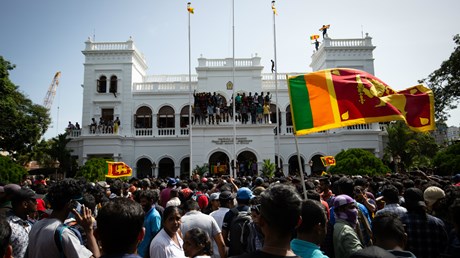
Chaotic scenes unfolded before an incredulous world last weekend in an Indian Ocean island the size of West Virginia yet with a population ten times larger. Since July 9, global media outlets have been running lead stories on the dramatic social ferment in Sri Lanka.

A massive citizen mobilization pushed President Gotabaya Rajapaksa, the most powerful Sri Lankan leader since the days of the country’s ancient kings, to unceremoniously leave by a back door to escape the wrath of hundreds of thousands of protesters that came calling at his presidential palace this past Saturday. He fled Wednesday out to deep sea aboard a naval vessel, next to the Maldives on board a military jet, then to Singapore on a commercial airline. From there he sent his belated resignation Thursday, which enabled some closure so that the nation could look to rebuild from here.

Lonely Planet listed this middle-income country and tropical tourist hotspot as the world’s best place to visit in 2019. Later that year, Rajapaksa became president by a landslide. He used his military background to great effect to coerce the masses haunted by memories still fresh of the horrific Easter attacks of April 2019. In less than three years, though, he succeeded in presiding over a catastrophic economic collapse that defies belief.

Experts call it a man-made humanitarian disaster caused by a deadly cocktail of ego, corruption, and reckless government policies in the face of the pandemic. By January, Sri Lanka ran out of foreign reserves and became incapable of sustaining essential imports or servicing its international debt obligations. By April, the Central Bank officially announced that the second-strongest Asian economy of 1948 was effectively bankrupt.

By ...

Continue reading...


from Christianity Today Magazine https://ift.tt/aojWTgr

Friday, 15 July 2022

Indian Christian Day Uses Martyrdom of Apostle Thomas to Unite the Diaspora

One in five Indian Americans is now Christian. But they remain divided by language, doctrine, and generation.

July 3 has long been observed as Saint Thomas Day, commemorating the death of the apostle considered by many to be the patron saint of India.

Now it is also celebrated as Indian Christian Day (Yeshu Bhakti Divas), an annual opportunity for Jesus followers of Asian Indian origin to preserve their distinctive identity and their global presence by uniting across their many languages, denominations, regions, customs, and creeds.

This month, ICD celebrations were carried out in cities across India, including New Delhi, Mumbai, Chennai, and Bengaluru, as well as Indian diaspora locations around the world, including New York, Philadelphia, Washington, Dallas, San Francisco, London, Durban, and Singapore. This Saturday (July 16), Indian Christians in the Chicago region will gather for an evening of ethnic worship and prayer at Wheaton College, led by Indian worship leader Vijay Benedict from Mumbai.

Last year, the grassroots organizers chose the martyrdom of Thomas, one of the 12 disciples of Jesus, to celebrate the ancient heritage and rich legacy of Christianity in India because the ancient Syrian Christian community of India traces its origin to the apostle. And it’s not just Catholics that revere Thomas. So does my own reformed evangelical denomination, the Mar Thoma Syrian Church.

According to reliable traditions and well-known Christian historians, Thomas came to the Malabar Coast in Kerala in A.D. 52 and was martyred near Chennai in Tamil Nadu in A.D. 72. Thus, this month marks the 1,950th anniversary of his martyrdom in southern India.

Followers of Jesus Christ have lived in the Indian subcontinent for nearly 2,000 years. They have lived in peace and harmony with their diverse religious neighbors and have played a significant ...

Continue reading...


from Christianity Today Magazine https://ift.tt/dmDOc3U