Friday, 2 June 2023

Theological Education Can’t Catch Up to Global Church Growth

Unless seminaries leave the ivory tower for local leaders in the public square. Like these ones have.
I recently received a handwritten letter from a pastor in India.

His name is Roy, but I didn’t know this gentleman, and we had never corresponded. Somehow he contacted me and told me about the two congregations he leads in Andhra Pradesh and of his great desire to study the Bible.

His ending struck me: “I have no money.”

Roy is not alone. Countless pastoral leaders worldwide are eager to faithfully lead their churches, but they lack access to training. This is especially the case in majority world contexts in Latin America, Africa, and Asia where the gospel continues to rapidly grow—with hundreds of new congregations birthed daily.

Founded in 1846, the World Evangelical Alliance (WEA) now represents churches in over 130 countries and estimates there are 50,000 new baptized believers each day. These believers need pastoral leaders who are trained to effectively lead their congregations.

The challenge is highlighted when we draw a contrast with the United States, where there is one trained pastor for every 230 people. By comparison, majority world churches have one trained pastor for every 450,000 people.

This colossal leadership imbalance will only expand as the majority world church continues to surge and spread. Already, theological education is struggling to keep up, and unless something changes, the gap will only increase in the future.

If we are to meet the training needs of thousands of pastors like Roy, the worldwide trajectory must be reset. Theological education, no matter the form, has a long history of being fragmented, with most programs operating in silos, lacking a sense of collegiality. Regrettably, this inward posture makes training even less accessible to local ministries, weakening the collective ...

Continue reading...


from Christianity Today Magazine https://ift.tt/f3iotlU

The Spiritual Battle of Teen Screen Time

Kids’ addictions to their phones isn’t a legislative issue. It’s a discipleship one.

As summer fast approaches, likely so will increased screen time as school lets out. But new data and a bipartisan consensus that phones are bad for kids may give parents pause.

A growing body of research, though certainly not indisputable, has pointed out that smartphones with unfettered access to the internet and social media have serious negative effects for younger users, particularly teenage girls. At the end of May, Surgeon General Vivek Murthy issued a formal warning and report about the effects of social media on child and teen mental health.

Since 2012, as smartphones were integrated into every part of our lives—and as that integration became an ever-earlier childhood milestone—youth mental health has plummeted. Teen anxiety, depression, and even suicidal ideation have all tracked eerily well with this technological shift.

As a society, we plopped Pandora’s box into the hands of 15-year-olds. Good luck, kiddos! Go wild. Instead, they became distraught, disconsolate, and utterly unwilling to give up their phones.

Two primary “solutions” to this problem have emerged: parental responsibility or government regulation. Both have obvious appeal. But both will likely ultimately prove inadequate—if not counterproductive—to the task at hand. No one family can entirely fix the kids and phones problem, but neither can Congress. In each case, the scale of the solution is wrong. And the place we have the best chance of getting the scale right is the local church.

The case for parental responsibility is simple and compelling. A responsible parent, knowing about the consequences of tobacco use, wouldn’t supply her child with cigarettes. A Christian parent, aware of spiritual formation, ...

Continue reading...


from Christianity Today Magazine https://ift.tt/tCsNXMR

Thursday, 1 June 2023

Died: Paul Eshleman, Who Brought ‘Jesus’ Film to the Ends of the Earth

The Campus Crusade evangelism strategist wanted everyone in the world to hear the good news that God loved them.

Paul Eshleman, an evangelism strategist who organized one of the largest outreach efforts of the 20th century so that everyone in the world could hear at least once that God loved them, died on May 24 at age 80.

Eshleman was the director of the Jesus Film Project, producing the 1979 feature for Campus Crusade for Christ (now Cru) in partnership with Warner Bros. and overseeing its translation into more than 2,000 languages. Eshleman arranged for the film to be shown across the world, from places in rural Asia and Africa where people had never seen electric lights before, to national television broadcasts in places like Peru, Cyprus, and Lebanon. According to Cru, nearly 500 million people have indicated they made a decision to accept Jesus as their Lord and Savior after seeing the film.

“I’m driven every day to say, ‘Who hasn’t had a chance to hear yet, and how can I make that possible?’” Eshleman once explained. “We are strategists for Christ, thinking of new ways to reach people with the message of life.”

Saddleback Church founder Rick Warren called Eshleman a “dear friend” and praised him for his “global impact.” Evangelist Franklin Graham said, “God used his life greatly.”

According to Steve Sellers, current Cru president, “Paul was a champion for the cause of Christ and challenged the Church to consider innovative ways to evangelize.”

Eshleman was born October 23, 1942, the eldest son of Janet and Ira Eshleman. His father was an evangelical minister who moved the family from Michigan to Florida in 1950 to launch a Christian resort. He purchased 30 acres of a closed army base in Boca Raton for $50,000, starting a church and a vacation ...

Continue reading...


from Christianity Today Magazine https://ift.tt/UOpxnZW

Manipur Christians: ‘The Violence Has Shattered Us’

Many from India’s tribal Kuki community have fled their homes. Amid ongoing violence, returning isn’t an option.

Lun Tombing was hiding in the bushes with her husband and three- and six-year-old daughters several weeks ago when they saw a mob burn down their home, car, and church.

Tombing and her family had heard reports of mob violence in and around Imphal, the capital city of Manipur, the eastern Indian state where they live, and fled to their church. More than 50 Christians hid in the building, even as a Hindu mob vandalized its outside. When the attackers briefly drove away, the Christians made a run for it.

“With every burning of a vehicle, the mob would clap their hands and shout victory-shouts, as we witnessed all this while trembling behind the bushes constantly afraid of being discovered,” Tombing said.

The group stayed outside for nearly 12 hours, only narrowly avoiding a direct confrontation with the rioters. Despite her mother’s order to maintain absolute silence, Tombing’s eldest daughter repeatedly asked why the mob was destroying their neighborhood.

When the military finally arrived half a day later, they sent the survivors to a local refugee camp. Several days later, the traumatized family, along with hundreds of other Manipur Christians, arrived at the nation’s capital with little more than medicine for the children and some extra clothes.

Since sheltering with a relative in Delhi, both of Tombing’s daughters have struggled to sleep deeply and disruptions as minor as a TV channel changing have startled them awake.

“Even after we reached Delhi, whenever my daughters heard a bang or a sudden noise, they would start to scream, ‘Mummy, they are coming,’” Tombing said.

Between May 3 and May 5, mob violence claimed 75 lives and displaced 35,000 people, according to Manipur’s ...

Continue reading...


from Christianity Today Magazine https://ift.tt/HI0U7cr

Jordan’s Churches Approve Law on Equal Inheritance for Christian Women

Draft law agreed to by 11 major denominations now needs approval by parliament.

An unusual act of Christian unity in Jordan this month could inspire a revolutionary change in the region.

The leaders of all the Christian denominations in the Hashemite Kingdom agreed May 11 on the final draft of a proposed law on inheritance that guarantees equality in distribution between Christian male and female heirs. It would also allow female heirs to ensure their share of inheritance is not distributed to male relatives.

The recommended text, submitted by lawyers and Christian social activists, was years in the making and drafted after repeated appeals by Christian families. It will still need to be approved by the Jordanian government and pass the legislature.

Jordan’s constitution, which doesn’t discriminate based on religion (Article 6), allows for the creation of religious courts that can adjudicate issues of family law such as marriage, divorce, and alimony (Article 109). For decades, Christian ecclesiastical courts have been allowed to work freely and rule in the name of King Abdullah II on all family issues—except on inheritance.

The issue of distributing the assets a deceased Jordanian leave behind is detailed in Article 1086 of the kingdom’s Civil Code, which holds that all Jordanians—irrespective of their religion—must abide by Islamic sharia when it comes to the distribution of an estate. Sharia law gives males twice the share of inheritance that females get; if the heirs are all female, a portion of the estate is given to a male uncle or a male cousin.

In Jordan, as in all Middle East countries (including Israel), all issues of personal status are based on religion. A citizen cannot marry, divorce, adopt, or inherit based on civilian law. Some countries give importance ...

Continue reading...


from Christianity Today Magazine https://ift.tt/4I9lG0d

It’s Time to Forgive Each Other Our Pandemic Sins

As the COVID-19 emergency ends, the church can lead the world into a spirit of amnesty.

This week, an Axios poll found that 62 percent of Americans believe the pandemic is over—weeks after the World Health Organization announced that COVID-19 is no longer a “public health emergency of international concern.”

More than three years after the virus first swept the globe and governments around the world shut down businesses, schools, and public venues, we can finally say the pandemic has ended.

The WHO estimates the coronavirus killed 20 million people worldwide. Even if the figure is inflated, anything near the ballpark of 20 million is a ghastly toll on humanity. Untold numbers still struggle with debilitating aftereffects made worse by the uncertainty about how long and how serious those aftereffects will be.

While COVID-19 will be with us forever, we can celebrate that the state of emergency is over. But some are not in a celebratory mood. In my conversations with students, pastors, friends, and family, I often hear an undercurrent of anger, even bitterness, when the pandemic comes up. Some seem eager to relitigate who said what about masking, social distancing, infection rates, or church closures years after the fact.

Now is a good time declare a “pandemic amnesty.” As Emily Oster suggested in The Atlantic last fall, let’s start assuming each other’s good faith and “forgiving the hard calls that people had no choice but to make with imperfect knowledge.” Christians especially can lead the world in an attitude of grace for the things we collectively said and did during a confusing and unprecedented time.

The pandemic was hard. Navigating the complex medical, political, legal, economic, theological, and humanitarian concerns was difficult. ...

Continue reading...


from Christianity Today Magazine https://ift.tt/i9Sk3PT

Don’t Pretend the Ugandan Homosexuality Law Is Christian

Not everything that’s a sin is a crime—let alone one punishable by death.

This piece was adapted from Russell Moore’s newsletter. Subscribe here.

In this day of social media mobs and troll-fueled extremism, it’s not unusual for a politician to be digitally attacked for being too weak and “not really one of us”—on a seemingly infinite number of topics.

Even so, one might be surprised to see Sen. Ted Cruz (R-Texas)—not known for repudiating the far extremes of his base—labeled on various social media platforms as soft, weak, and compromising. Some even suggested that Cruz was rejecting the Word of God itself. His radically “progressive” idea? That Uganda shouldn’t criminalize homosexuality and execute gay people.

Normally, a social media controversy is the most ephemeral of pseudo-events. People who want to be noticed post shocking and even ridiculous things (“Y’all! It’s not just Target that’s gone woke; let’s boycott Chick-fil-A too!”) to get attention, knowing they’ll be denounced and quote tweeted, which will amplify their reach. They think that retweets and followers will somehow give them the belonging and significance they crave. Often, the best course is to ignore such things in the spirit of Proverbs 26:4—“Do not answer a fool according to his folly, or you yourself will be just like him.”

Sometimes, though, their kind of trolling can lead to two catastrophic ends that should concern those of us who follow Christ: the unjust killing of human beings made in the image of God and, at the same time, the bearing of false witness about what the Christian gospel actually is.

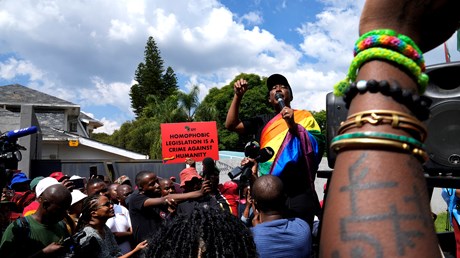
At issue is a harsh new law signed by Uganda’s president Yoweri Museveni that would not only outlaw homosexuality ...

Continue reading...


from Christianity Today Magazine https://ift.tt/bh0Pnq3